


Modern vs. Traditional Quilts: What Actually Separates Them
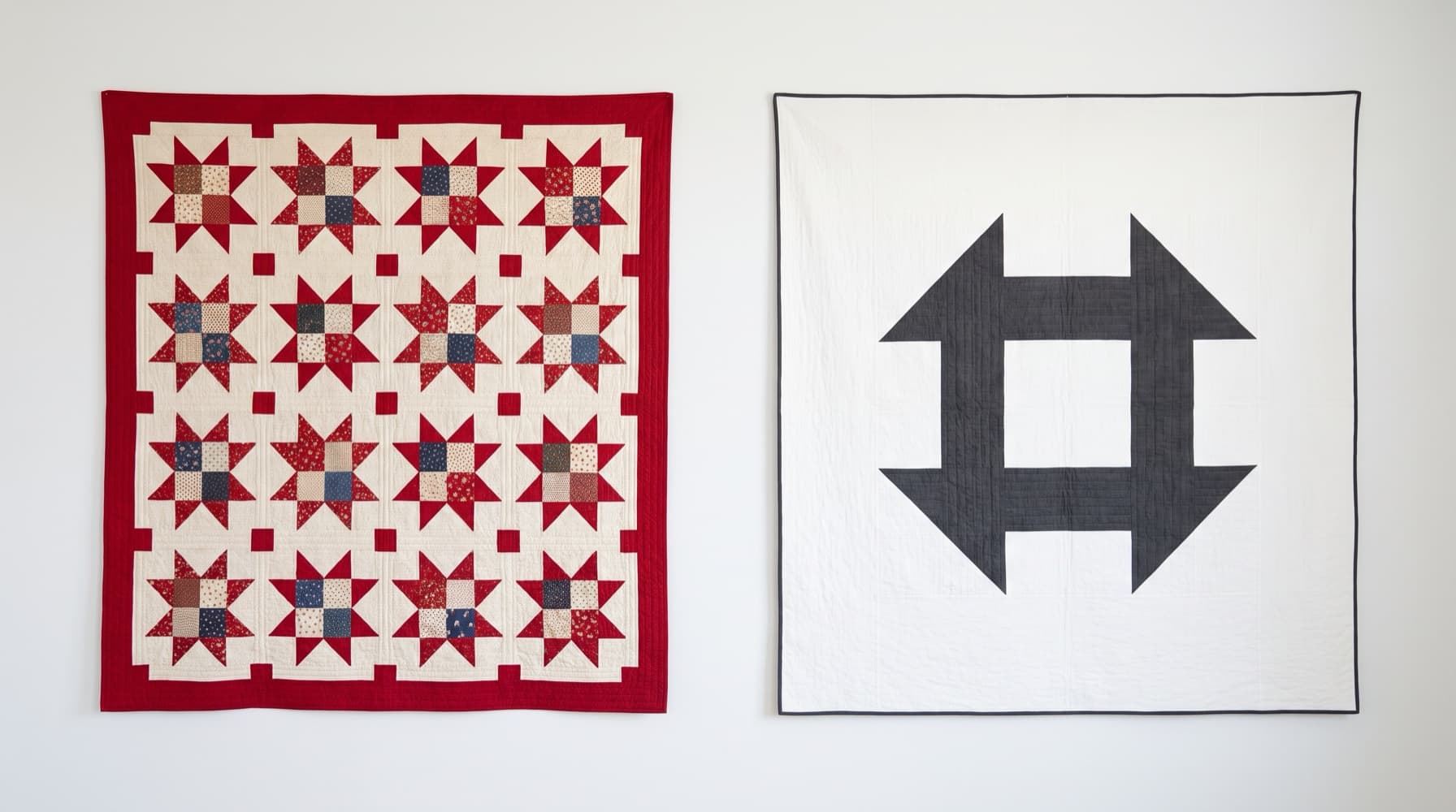
People use "modern" and "traditional" loosely, sometimes to mean nothing more than "solids" and "prints." That's not quite how quilters, guilds and show judges use the terms. This guide explains where each label comes from, what each style looks like, and how to borrow from both when you design.
Where the labels come from
Traditional quilting refers to the block-based vocabulary that grew out of American and British quiltmaking over roughly the last two centuries: Log Cabin (widely popular from the 1860s), Nine Patch, Ohio Star, Bear's Paw, Double Wedding Ring (a 1920s–30s favorite), and thousands more. Those blocks were built to be cut, pieced and repeated efficiently, and the conventions around them (sashing, borders, set-on-point layouts, allover quilting) developed alongside them.
Modern quilting is a named movement, not just "anything recent." It took shape online in the mid-2000s, as quilters on blogs and photo-sharing sites began swapping work that looked more like mid-century graphic design than their grandmothers' bed quilts. The Modern Quilt Guild was founded in Los Angeles in October 2009 by Alissa Haight Carlton and Latifah Saafir, and its show, QuiltCon, first ran in Austin in 2013.
The movement didn't appear from nowhere. The two influences cited most often are older quilts that already looked "modern":
- Amish quilts, with their solid fabrics and large, simple fields of color. Quilts like these came to be seen as graphic art after the Whitney Museum's 1971 exhibition Abstract Design in American Quilts hung pieced quilts on gallery walls.
- The quilts of Gee's Bend, Alabama, whose improvisational, bold compositions reached a national audience through a 2002 exhibition that opened in Houston and toured the Whitney and other major museums.
It also helps to separate modern from two neighboring terms. Contemporary is a general word for current work in any style. Art quilts are usually made to hang rather than use, and they have their own organizations, such as SAQA (Studio Art Quilt Associates). The MQG describes modern quilts as primarily functional.
What makes a quilt read as traditional
A traditional quilt usually shows most of these traits:
- A repeating block on a grid. Blocks sit edge to edge, separated by sashing, or set on point. The rhythm is predictable, and that's the appeal.
- Secondary patterns. When blocks meet, new shapes appear at the corners, like the stars that emerge between repeated Churn Dash blocks. Traditional designers plan for this.
- Symmetry and a frame. Most layouts are symmetrical, often with borders that contain the design, sometimes several of them.
- Fabric used as texture. Prints, often many of them, with value doing the structural work. Scrap quilts might use a hundred fabrics, each in small amounts.
- Quilting that fills or follows. Feathers, cables, crosshatching, Baptist fans, or stitching in the ditch to outline the piecing.
Reproduction fabrics and calicos are common but not required. A Nine Patch in bright batiks is still a traditional quilt, because the structure is what defines it.
What makes a quilt read as modern
The Modern Quilt Guild keeps a list of characteristics often seen in modern quilts, stressing design and originality over replication and perfect technique. In short:
- Bold use of color. Saturated solids, unexpected pairings, and a clear point of view.
- High contrast and graphic areas of color. Big shapes that read from across a room.
- Minimalism. As few elements as the idea needs, and no more.
- Maximalism. Also on the list: dense, busy, intentionally overwhelming compositions count too.
- Improvisational piecing. Cutting without templates or rulers-first plans, and letting the design develop at the machine.
- Expansive negative space. The background is a working part of the composition, not filler between blocks.
- Alternate grid work. Blocks that break the rows-and-columns grid: offset, skewed, scaled up or partly missing.
- Modern traditionalism. Traditional blocks reworked with any of the above.
Not every modern quilt shows all of these, and no single trait makes a quilt modern. Look at the overall intent: does the design treat the block grid as a starting point to depart from, or as the structure itself?
Side-by-side comparison
| Traditional | Modern | |
|---|---|---|
| Layout | Repeating blocks on a regular grid, often symmetrical | Asymmetry, alternate grids, off-center focal points |
| Background | Fills the space between blocks | Negative space as part of the design |
| Scale | Blocks typically 6–12 inches, repeated | Anything from tiny to a single block filling the quilt |
| Borders | Common, sometimes multiple | Often none; the design runs to the edge |
| Color | Many prints; value drives the pattern | Solids and graphic prints; color drives the pattern |
| Quilting | Feathers, cables, crosshatch, fans, in-the-ditch | Straight-line and matchstick quilting, echoing, graphic fills |
| Process | Pattern followed closely | Pattern as a starting point, or improv |
A quick way to read any quilt
Standing in front of a quilt at a show, ask five questions:
- Is there a repeating unit? If you can point to "the block," start with traditional.
- What is the background doing? Filler between blocks points to traditional. A large, deliberate field of one fabric points to modern.
- Is there a frame? Multiple borders lean traditional.
- Where is the visual weight? Centered and even leans traditional. Off-center or clustered leans modern.
- What is the quilting doing? Following the piecing leans traditional. Crossing it in graphic lines leans modern.
Most quilts give mixed answers, and that's the point of the next section.
Five ways to blend both styles
"Modern traditionalism" is where many quilters are working now. Five approaches that work well:
- Scale one block up. A single Churn Dash or Ohio Star enlarged to 48 or 60 inches becomes a graphic statement. The block is traditional; the scale isn't.
- Float blocks in negative space. Piece five Log Cabin blocks and set them in a loose cluster, off-center, on a solid background instead of a full grid.
- Recolor a classic in two solids. Many traditional blocks become striking with just two high-contrast fabrics. It also makes the geometry easier to see as you learn it.
- Break the repeat. Keep a traditional grid but leave some blocks out, fade blocks into the background with lower-contrast fabrics, or let a block spill across two positions.
- Change the quilting, not the piecing. Dense straight-line or matchstick quilting over a traditional sampler changes its character completely.
Practical notes before you cut
Style choices have practical consequences.
- Negative space is yardage in one fabric. A modern throw with a large background field might need four or five yards of a single solid. Buy it all from one bolt, because dye lots vary. For a large background, extra-wide (108-inch) fabric can avoid seams.
- Negative space still needs quilting. Check your batting's label for the maximum distance between quilting lines. A big "empty" area quilted too sparsely can shift and bunch over time.
- Improv still needs a plan for size. Improvisational piecing grows unpredictably. Decide on a finished size, and trim sections to regular dimensions before joining them.
- Solids show everything. Wobbly seams and mismatched points are more visible against a plain background than inside busy prints. Press carefully and use a scant quarter-inch seam where your pattern calls for it.
Designing either style in QuiltLab
Designing on screen is the cheapest way to try both directions before you cut. In QuiltLab:
- For a traditional layout, start a Grid quilt in the Quilt Editor. Set the block size, rows and columns, and choose Standard or On Point. Rotate or flip individual blocks to see which secondary patterns appear, then add one or more borders with square or mitered corners. The System Library includes classic blocks such as Churn Dash, Ohio Star and Log Cabin to start from, or you can draw your own in the Block Editor.
- For a modern layout, start a Freeform quilt instead. There's no grid: drop blocks wherever you like and draw rectangular pieces of background around them. That's the easiest way to test a floating cluster or an off-center focal point.
- To scale a block up, set a large block size in the Block Editor (up to 60 inches) and redraw a classic block at that scale. Seeing a Churn Dash at 48 inches on screen tells you quickly whether the idea works.
- To compare colorways, fill blocks with photos of your real fabrics, set to their true size in the Swatch Editor, so you can judge print scale as well as color.
The Quilt Editor guide covers Grid, Freeform and Photo Mosaic in more detail.
FAQ
Can a quilt be both modern and traditional? Yes. The Modern Quilt Guild names "modern traditionalism" as one of its characteristics: traditional blocks reworked with modern color, scale or layout.
Does using solid fabrics make a quilt modern? Not by itself. An Amish Center Diamond in solids is a traditional quilt. Layout, scale and use of space matter more than fabric.
Is "modern" the same as "contemporary"? No. Contemporary means current work in any style. Modern refers to the design movement and aesthetic described above.
Do modern quilts have borders? Sometimes, but many don't. The design often runs to the binding, and the binding is chosen to disappear or to act as a final accent.
Further reading
- The Modern Quilt Guild's What Is Modern Quilting?
- The International Quilt Museum collections, with thousands of traditional and contemporary quilts to study
- The Quilt Index, a searchable archive of historical quilts
- Sherri Lynn Wood, The Improv Handbook for Modern Quilters (2015)
- Barbara Brackman, Encyclopedia of Pieced Quilt Patterns, the standard reference for traditional block names
Related posts
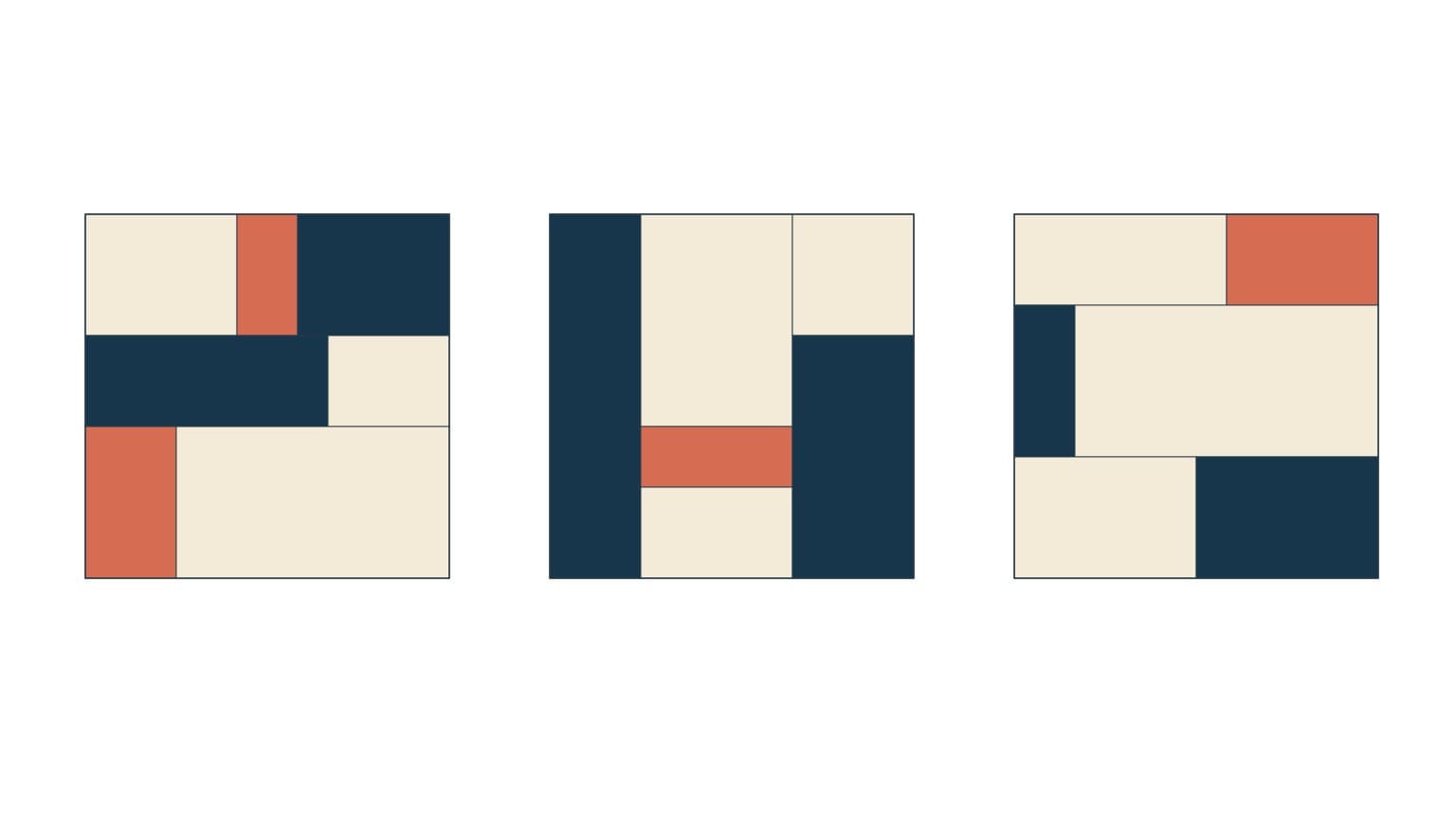
Improv Quilt Design Constraints: Three Limits
Start an improv study with a shape vocabulary, three fabric roles and a finished envelope, then explore several original compositions.
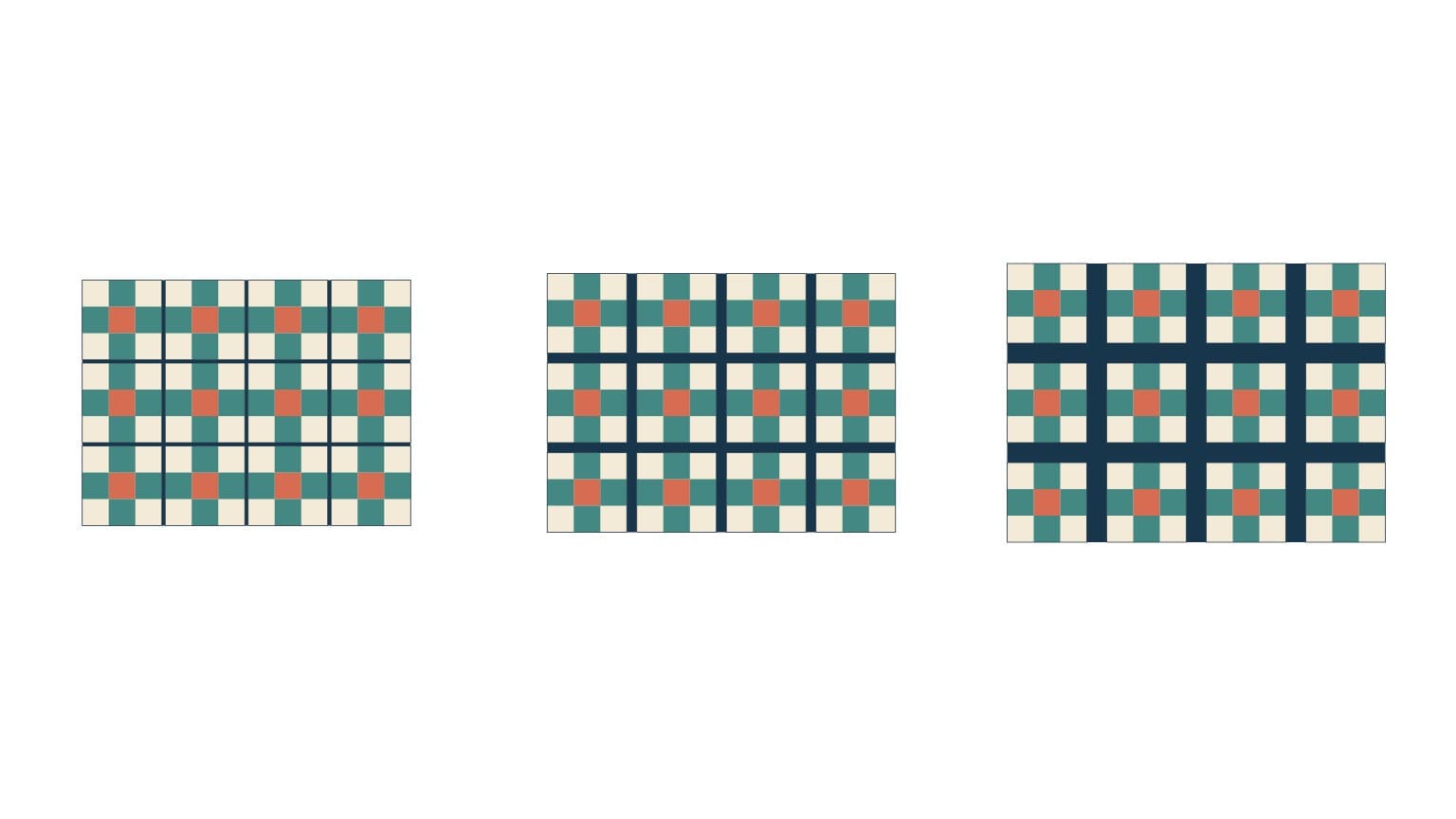
Quilt Sashing Width: Compare Block Scale
Compare three sashing widths around the same blocks, check finished-size growth, and separate the visible strip from its seam allowances.
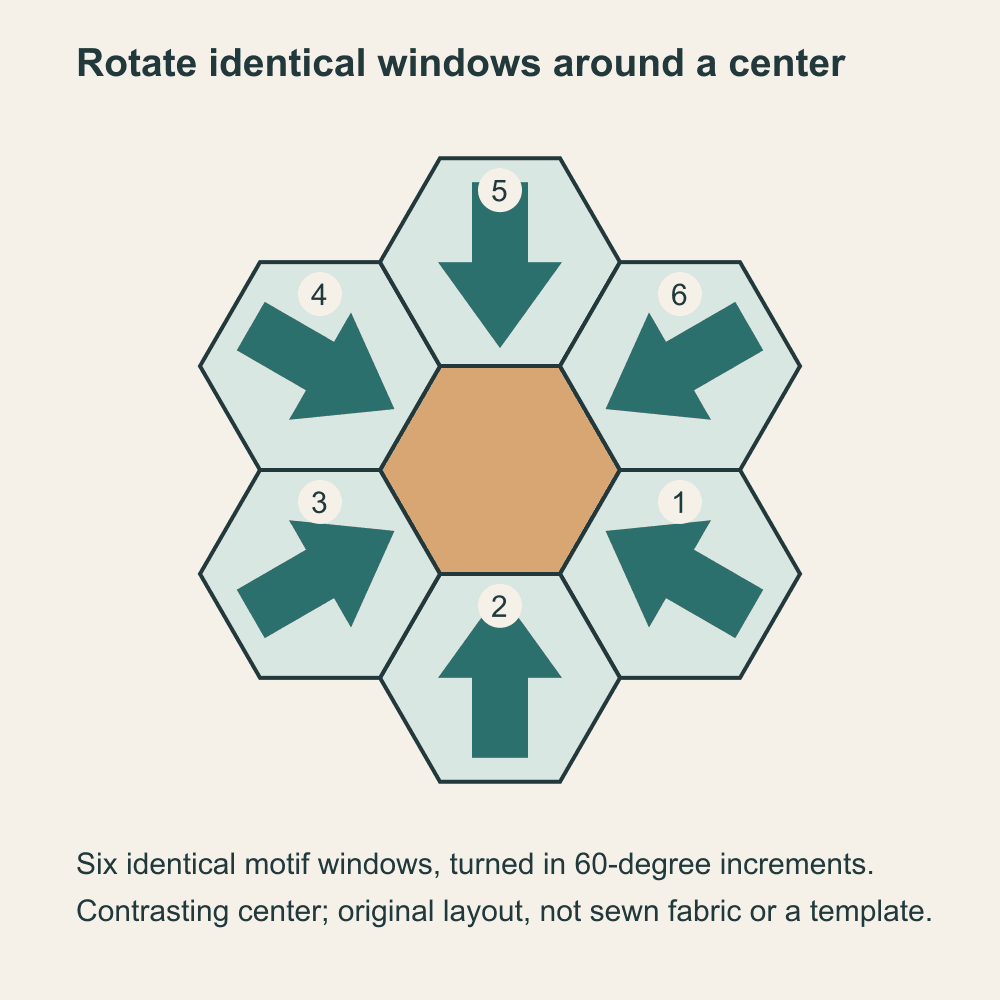
Fussy Cutting Hexagons: Plan Repeats for a Rosette
Count six matching motifs, record their orientation and preview a hexagon rosette before cutting the fabric.