


English vs Foundation Paper Piecing: Which Should You Try?
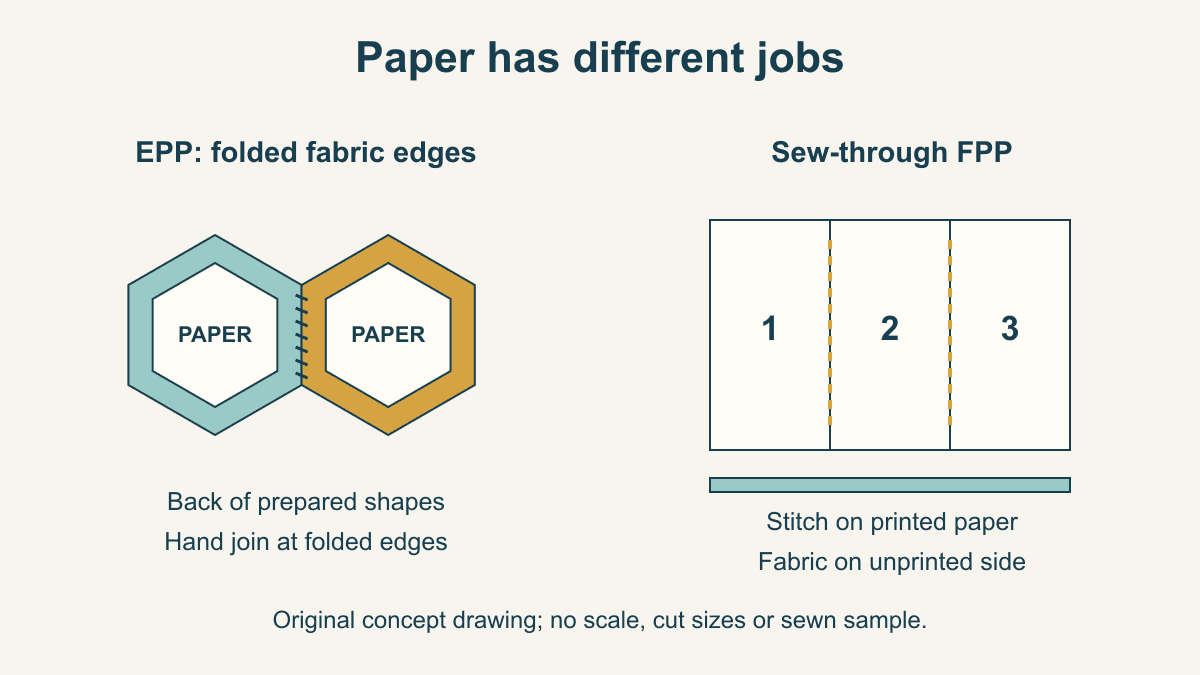
Choose English paper piecing (EPP) if you want to prepare individual fabric shapes around papers and join their folded edges by hand. Choose standard sew-through foundation paper piecing (FPP) if you want to machine-stitch along a printed foundation, often for pointed or angular patchwork.
The similar names describe different sewing sessions. This comparison shows what the paper does in each method and helps you choose a pattern that fits the activity you want to repeat.
Understand the paper's job in EPP
English paper piecing is commonly shortened to EPP. Paper shapes stabilize the fabric as you prepare its edges and join the pieces. Fabric outside the paper shape folds around it; the folded edges determine the prepared piece's outline.
Manufacturer Paper Pieces' beginner explanation describes fabric basted to individual paper shapes with thread or glue, then joined by hand. The paper remains a temporary support and is eventually removed according to the project's instructions.
That distinction matters when looking at supplies. A paper shape and a fabric-cutting template can have different boundaries: the cloth needs material for wrapping beyond the paper. Do not treat a paper's outer edge as an instruction to cut the fabric to that exact edge.
Hexagons are familiar EPP examples, but the method is not defined by the hexagon alone. Different polygon and other shape systems exist. Check the particular pattern's paper shapes, joins and preparation instructions, rather than assuming that anything with six sides uses identical assembly steps.
EPP can suit someone who wants to do the joining by hand away from a sewing machine. Preparation, arranging a larger project and finishing still require planning; choosing hand piecing does not make every part of the quilt a portable task.
Understand the paper's job in sew-through FPP
Foundation paper piecing is commonly shortened to FPP. A foundation carries the seam geometry and, in many patterns, the order in which fabric is added. Pieces are built into sections on that foundation, rather than prepared as individually wrapped paper shapes.
Designer Carolina Moore's introduction at Always Expect Moore distinguishes machine-stitched foundation piecing from hand-joined EPP. She describes using a printed or drawn foundation as the guide and notes its usefulness for pointed or irregular patchwork.
For the standard sew-through workflow shown here, the printed paper faces the stitching, while fabric is on its unprinted side. Jennifer Fulton explains those two faces in her foundation paper piecing lesson at The Inquiring Quilter. The machine follows a marked seam line through the paper into the fabric behind it.
This comparison is about that sew-through workflow. Other foundation methods, including freezer-paper approaches, can handle the paper differently. Check the named method before assuming that every foundation is stitched through or removed in the same way.
FPP does not mean the paper has calculated every fabric cut for you. The chosen pattern still needs fabric large enough for its sections, allowances, folds and trimming. Nor does a numbered drawing by itself prove that an arbitrary design has a workable sewing order.
Compare the two conceptual views
The EPP view below shows the back of prepared shapes: visible paper centers sit inside folded fabric rims. The marked meeting edge shows where prepared fabric edges join.
The FPP view shows a printed foundation face, with conceptual numbered areas and seam guides. Gold dashes represent stitching on that face; the separate layer view locates the fabric behind the paper.
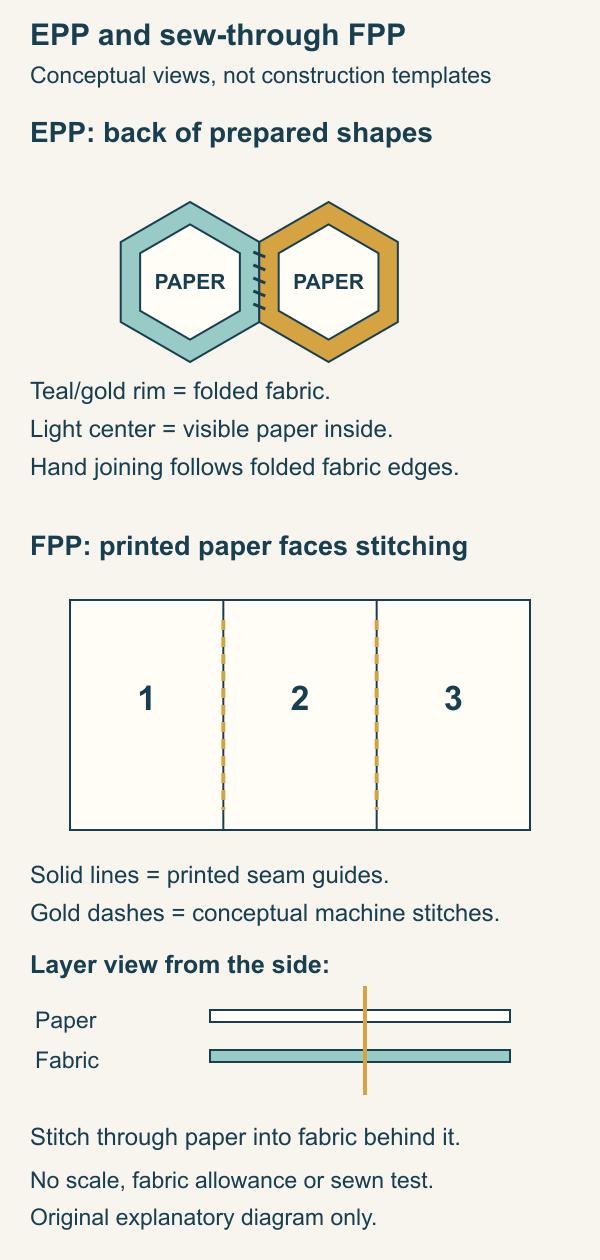
Identify whether the paper supports the outline of individual prepared shapes or guides an ordered foundation section.
Match the technique to the sewing session
| Decision | EPP | Sew-through FPP |
|---|---|---|
| Joining activity | Generally hand joining prepared fabric edges | Machine stitching along foundation lines |
| Paper role | Supports individual shapes | Guides seam geometry and section order |
| Working position | Handle prepared pieces and their meeting edges | Alternate fabric-side preparation with printed-side stitching |
| Starting resource | EPP pattern and matching paper shapes | FPP pattern with its correct foundation sections |
These differences suggest preferences, not a universal ranking for speed, accuracy or difficulty. Someone comfortable with a machine may still prefer hand joining for one project. Someone who likes EPP may choose FPP for a design built around a particular foundation.
Do not decide from the finished quilt photograph alone. Both methods can produce intricate geometry. Look at the instructions and the activities you would repeat, then choose which repetition you want to practice.
Choose the method for your project
Brief A: hand joining during short sessions. You want a small patchwork project that can progress without access to a sewing machine during the joining stage. Repeated shapes appeal to you, and you are willing to prepare fabric around papers beforehand. EPP is the closer match to that brief. Choose a genuine EPP pattern and its shape system.
Check how the pattern connects units into larger sections and how much arranging space those later sections need. A small prepared unit travels more easily than an entire assembled top.
Brief B: machine sessions for an angular design. You want to work at a machine and follow defined seams in an intricate angular block. You are comfortable checking a printed foundation and alternating between its paper and fabric faces. A pattern specifically designed for FPP is a closer match. Its section order and joins determine the work; merely tracing the desired picture onto paper does not establish them.
Practice a representative foundation section before committing to the larger project. Check its finished shape and the fabric coverage as you follow the pattern.
Brief C: simple rectangles with no wish to handle papers. You want to sew a repeated rectangular block by machine and already have conventional cutting instructions for it. Neither paper-supported technique is automatically necessary. Traditional piecing may fit the brief better. Adding paper simply because a design is precise can introduce an activity you did not want.
These briefs show how a concrete preference narrows the method choice. If your priorities conflict, write down which one matters most: hand joining, a particular foundation-designed image, a portable joining stage or avoiding paper preparation. Then look for a pattern whose construction actually supports that priority.
Keep design planning separate from the template
A sketch can compare colors and the placement of units before you settle on a construction method. It does not establish paper size, printed scale, seam allowances or an achievable order of assembly. Keep those decisions in the pattern and the relevant technique instructions.
For EPP with deliberately repeated printed motifs, our fussy-cut hexagon planning guide addresses the separate question of finding and orienting usable motif windows. Keep your chosen technique instructions beside that motif plan.
For either method, read the complete pattern before obtaining or preparing the full set of materials. The pattern-reading audit helps separate finished measurements, cutting requirements and checkpoints. Confirm what the supplied papers or foundation files represent before treating them as ready-to-use construction tools.
Record the choice before beginning
Write a brief decision: "EPP because I want hand joining with individual prepared shapes," or "Sew-through FPP because I want machine stitching guided by this pattern's foundations." Add the exact pattern name and version, the technique it specifies, and the lesson you will use for unfamiliar steps.
Choose one actual shape group or foundation section to practice next. Follow the designer's dimensions, allowance and printing requirements, then check that small unit before preparing the full batch.
Related posts
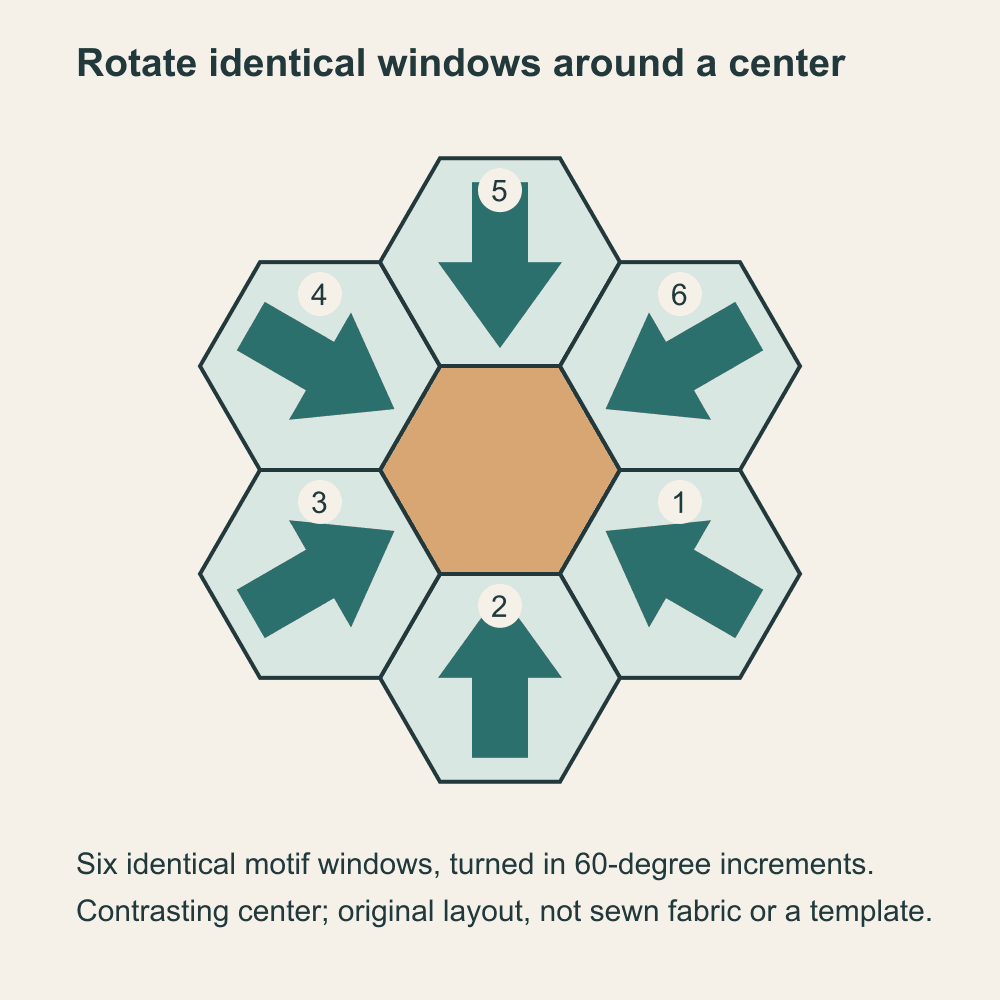
Fussy Cutting Hexagons: Plan Repeats for a Rosette
Count six matching motifs, record their orientation and preview a hexagon rosette before cutting the fabric.
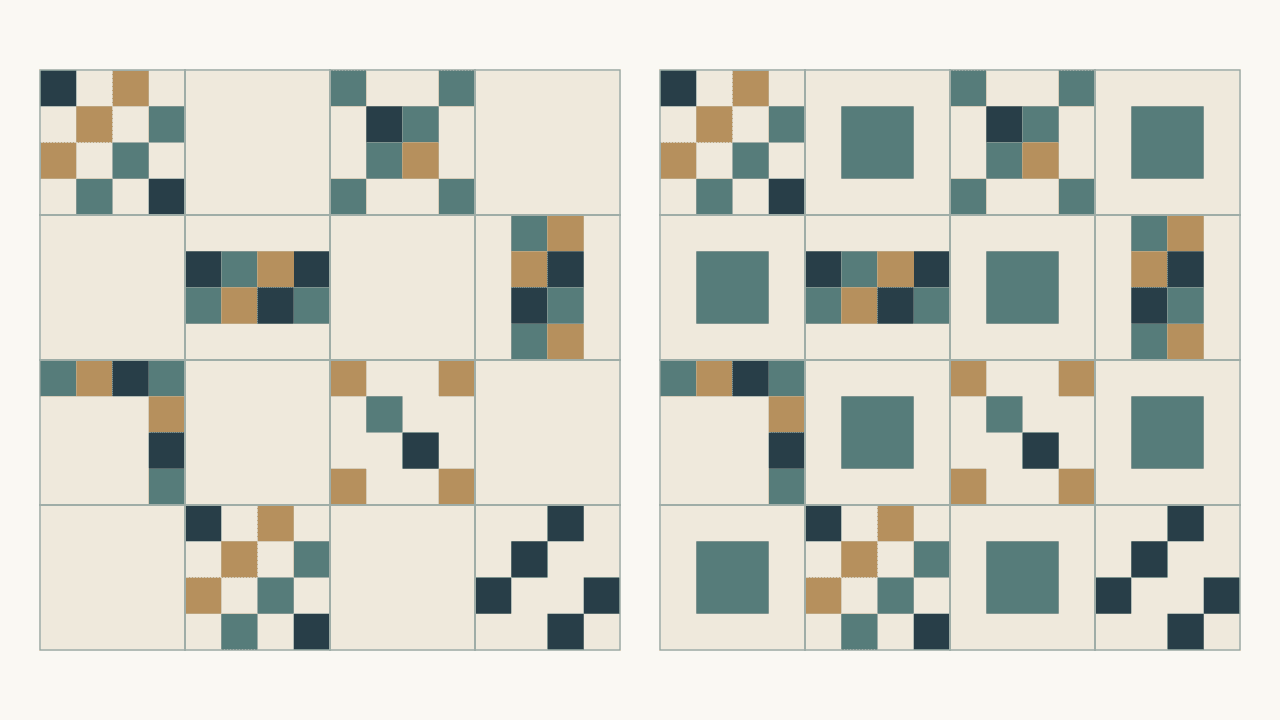
Alternate Blocks for Sampler Quilts: Plain or Pieced?
Plain alternate blocks give a busy sampler room to breathe; a simple repeated block adds rhythm. See how each changes your block count and quilt size.

Courthouse Steps Color Placement: Where Do Lights and Darks Go?
Put light fabric on one pair of opposite sides and dark on the other, or color by rounds for framed squares. Two 10-inch maps show how each one repeats.