


Plan Quilt Guild Challenge Rules Everyone Can Use

Separate the creative prompt from the requirements an entry must meet. State what participants must make, how you will measure it, how it will be displayed and how any judging works. Good quilt guild challenge rules make the boundaries easy to check while leaving the creative choices open.
Write the rules before inviting entries. A short question-and-answer page can then clarify the same rules for everyone, instead of letting private answers quietly change the challenge.
Choose which decisions are genuinely required
A theme does not automatically imply a size, technique or finishing method. Decide each one deliberately.
Bloomington Quilters Guild's 2026-2027 challenge is a useful example: stars are the creative focus, while technique and size remain open. Its quilting, binding and presentation requirements are separate decisions.
The Centre Pieces Quilt Guild's September 2026 color challenge takes a different approach. It gives a front-side color-family prompt while leaving backing, batting and thread free, and it allows work beyond a finished quilt. Those are two real programs with different aims, rather than competing definitions of how every guild should run a challenge.
Before adding a rule, ask what it enables. A display constraint may require a particular finished size or hanging provision. A creative prompt may leave both open. State the reason where it helps someone make the right choice.
Keep acceptance requirements separate from judging
Participants need to know which conditions determine whether an entry is accepted and which qualities a judge or viewer may consider afterward.
| Part of the brief | What it should answer |
|---|---|
| Creative prompt | What idea or constraint starts the design? |
| Acceptance requirements | What must every entry include or satisfy? |
| Judging or voting | How are accepted entries considered? |
| Display and return | What does the organizer need to handle the work? |
If color use is a requirement, explain what counts. If creativity is a judging consideration, describe how the voting or judging will work without pretending there is a single numerical measure of creativity.
Avoid introducing a new requirement during judging. A participant who followed the published rules should not discover that an unstated technique or finish was expected.
Make the size rule measurable
Say whether the size describes the finished outside edge, the pieced top or another part of the work. Include the binding or facing in that explanation where it affects the measurement.
South Bay Quilters Guild's published 2026 challenge rules specify a finished 24-by-24-inch size including the edge treatment. They also list separate structural, labeling and sleeve requirements. The dated program illustrates how dimensions and physical acceptance conditions can be written together.
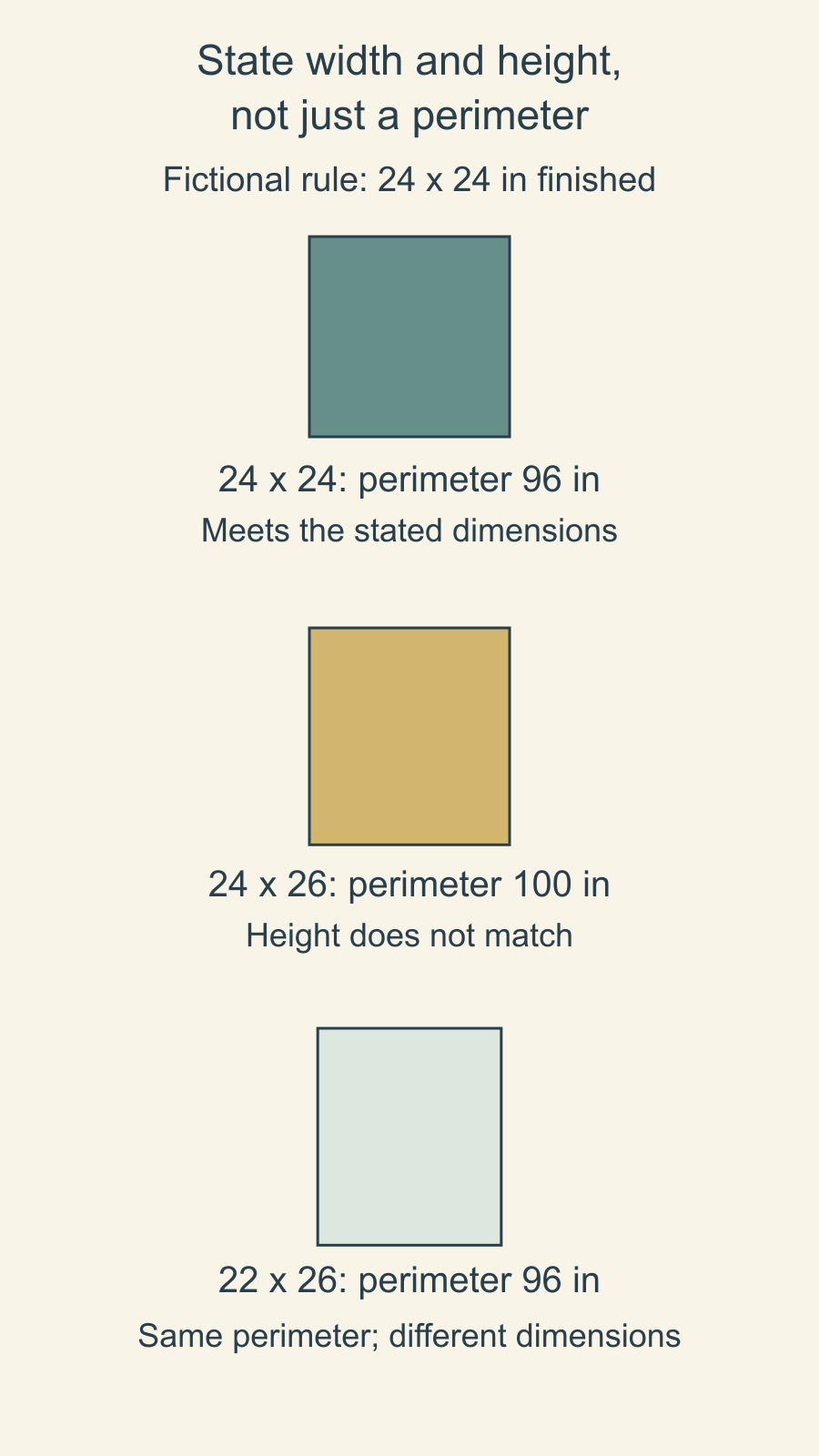
Consider a fictional challenge that requires a finished 24-by-24-inch square. Here are three drawn candidates:
| Candidate | Perimeter | Meets that exact width and height? |
|---|---|---|
| 24 x 24 inches | 96 inches | Yes |
| 24 x 26 inches | 100 inches | No |
| 22 x 26 inches | 96 inches | No |
The square and the 22-by-26-inch rectangle have the same perimeter. That does not make them the same size or shape. If the display needs a square, a perimeter-only rule will not communicate that requirement.
For actual instructions, decide whether 24 inches is an exact requirement, a target with a stated tolerance or a maximum. Explain the measuring method and what happens if an entry differs. The exact-number exercise above checks the wording of a rule; it does not assume fabric measurements will never vary.
Write a brief that leaves useful choices open
Suppose a fictional local challenge uses the prompt "Evening Windows." The organizer wants a small square display but has no reason to require one construction technique.
The brief could name the finished size, explain the edge measurement and allow piecing, applique or another agreed textile method. It could ask each maker to include a short note about their interpretation, with a separate agreement about whether that note is displayed.
The organizer should still decide the physical requirements. Does the work need to be quilted and finished? Is a hanging provision required? Who supplies any display support? A creative title does not answer those questions.
This example is an organizer's planning exercise, not an announced QuiltLab competition. Use the decisions to write a brief for the actual space, participants and handling arrangements you have.
Test the wording with near misses
Before sharing the brief, describe a few imaginary entries and ask whether the rules give the same answer to each reviewer.
For a color-family prompt, what happens when a maker uses a small contrasting accent? If the rules restrict only the front, what may appear on the back? Centre Pieces' published questions and answers are useful for seeing those boundaries addressed explicitly.
For a size rule, try a rectangle with the allowed perimeter and a square slightly beyond a stated maximum. For a technique requirement, ask whether a mixed-method entry qualifies.
For the fictional Evening Windows brief, assume piecing and applique are both permitted and all entries must finish at exactly 24 by 24 inches. A correctly sized pieced quilt and a correctly sized applique quilt both pass those two requirements; a 24-by-26-inch entry does not. A judge may prefer one accepted design, but that preference cannot add an unstated construction rule or waive the published size rule.
If the answer depends on who reads the brief, revise the rule or publish the clarification where everyone can see it. Keep a date or version label on the shared instructions so participants can identify the current wording.
Plan the handoff as carefully as the prompt
State how and when work is submitted, what identification is attached and who receives questions. Include the display, collection and return arrangements that participants need to plan around.
Ask for any photo or public-identification permissions you intend to use. Keep those choices explicit instead of assuming that entering supplies every permission an organizer might want.
If entries travel by mail, give the recipient and packing requirements separately from the creative brief. If a sleeve or label is required for display, show its actual specification before people finish their edges.
Our group-quilt overview can help when the guild is still choosing a collaboration format. A quilt design brief then helps an individual maker turn the challenge's boundaries into a personal plan.
Choose three possible entries now and check them against your draft rules. Revise any sentence that leaves their acceptance uncertain, then ask another organizer to repeat the check before opening the challenge.
Plan your next quilt
Lay out blocks and try colors in QuiltLab's grid editor before you cut.
Free forever, no card needed.
Get quilting tips by email
QuiltLab updates, tips and quilting inspiration. Unsubscribe anytime.
Related posts

Large Star Quilt Planning: Choose the Star Before the Margins
Compare 36-inch and 48-inch stars on one quilt top, then check the center print, background and fabric-width constraints.

Nested Star Quilt Design: Keep Every Ring Visible
Compare three nested star sizes, choose contrast at each shared edge, and check which fabric survives in the narrowest ring.
Pieced Quilt Border Math: Fit Whole Motifs
Fit complete border motifs around a measured center, compare end caps with resizing, and keep repeat phase clear at the corners.