


Star Sampler Quilt Planning: Check the Centers First
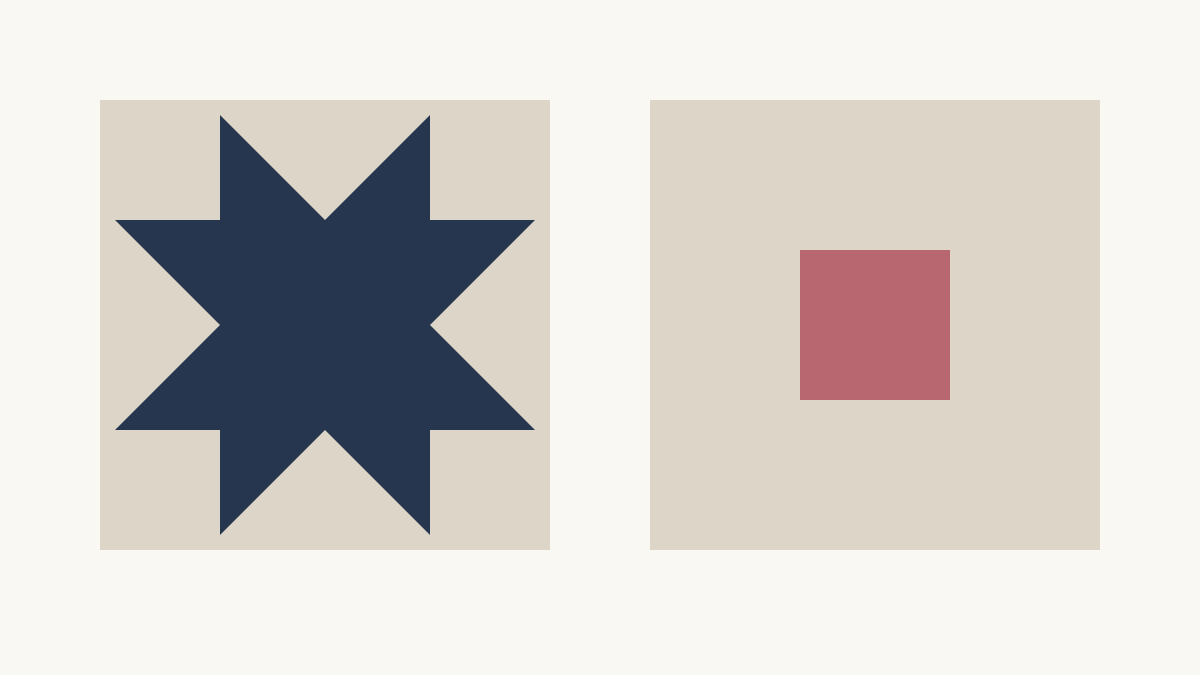
Choose sampler prints against the smallest finished center they must fill. In the 12-inch blocks compared here, a Sawtooth Star has a 6-inch center and an Ohio Star has a 4-inch center. A 5-inch-wide motif fits the first and must be cropped in the second.
For a first star sampler, keep a shared background and a clear value plan, then check the actual patch shapes block by block. That gives you a consistent quilt without pretending every star uses fabric in the same proportions.
Start with the block patterns
Write the finished size beside each chosen star. Then list its center, points and background shapes from the construction pattern. A block's name alone doesn't tell you how large its center will be.
Amanda's Star Sampler Quilt Along introduction at 3and3quarters gathers twelve different stars with deliberately assigned main fabrics and accents. It illustrates why a sampler needs both an overall palette and decisions within each block.
For the comparison here, we use familiar 12-inch finished Sawtooth and Ohio Star layouts. These are equal-size blocks with different grids. Keep your own pattern's sizes beside the comparison; don't turn an unfinished measurement into a finished one to make the numbers match.
Put the unequal centers side by side
A 12-inch Sawtooth Star built on its usual four-part grid has a 6-inch finished center. A 12-inch Ohio Star on a three-part grid has a 4-inch finished center.
Check the visible window rather than the cutting size. Sara Buscaglia's Sawtooth Star tutorial cuts its center at 6 1/2 inches. Melissa Mortenson's Ohio Star tutorial cuts its center at 4 1/2 inches. With their quarter-inch seams, the outer allowance disappears into the joins.
| Block | Finished block | Finished center | Motif being auditioned |
|---|---|---|---|
| Sawtooth Star | 12 in | 6 by 6 in | 5 in wide |
| Ohio Star | 12 in | 4 by 4 in | 5 in wide |
The 5-inch motif has half an inch of space on each side in the Sawtooth center. It exceeds the Ohio center by 1 inch. Centering it there crops half an inch from each side of the motif, even though both blocks finish at 12 inches. Check the motif's height too; fitting across the window is only half the test.
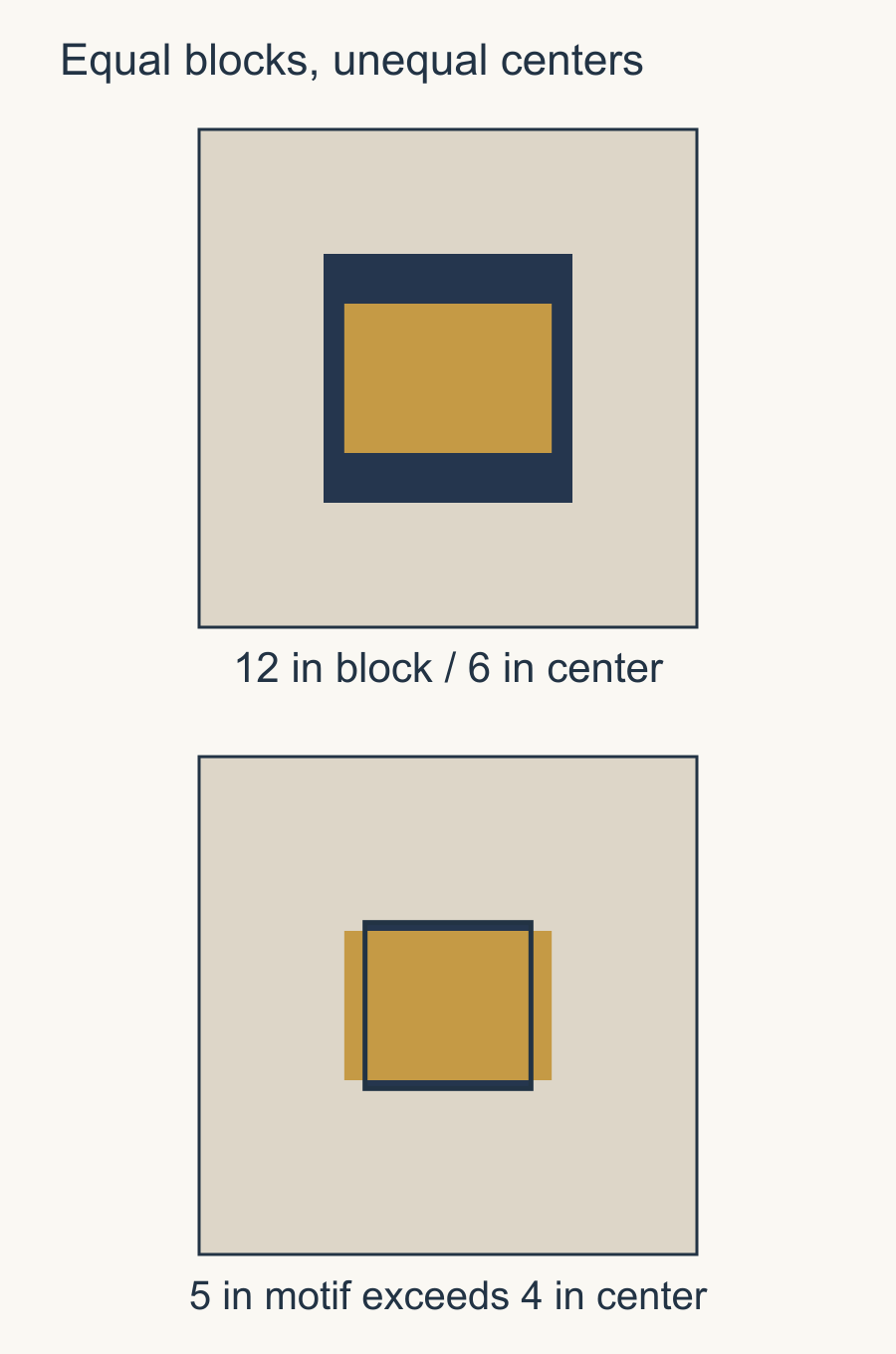
The first useful sampler decision is therefore about print fit. Changing the color name won't solve a motif that is wider than the visible patch.
Give the print a job it can do
You have several good options when one center is too small.
Use the feature print only in the larger centers and a related small print or solid in the smaller ones. Repeat a color from the feature print in the other stars so the fabric still belongs to the whole quilt.
You can also accept a cropped motif. Make the crop deliberate: look at what remains in the finished window and whether that fragment is interesting by itself. A partial flower can work; half a face may tell a different story than you wanted.
Another choice is a smaller-scale print used throughout. That is often simpler when the sampler contains many different center sizes. Audition it in the smallest window first, then decide whether the larger windows need extra interest.
Our Sawtooth Star placement study and Ohio Star placement study separate the point and center decisions for each block. Bring those individual choices together only after checking the windows.
Check area as well as color
Equal block sizes do not mean equal amounts of each color. In this comparison, the center and eight points share one fabric. They occupy 72 square inches in the Sawtooth Star and 48 in the Ohio Star. The Ohio Star's four inner triangles stay in the background fabric.
Place two of each in a 24-inch square sampler. Their combined colored area is:
2 times 72 + 2 times 48 = 240 square inches.
The four-block field covers 24 times 24 = 576 square inches, so the colored shapes occupy about 41.67% of that field. The remaining area is background.
That average can hide a visual imbalance. The two Sawtooth blocks carry more colored area than the two Ohio blocks. If their fabric is also darker or more active, they may dominate.
Try the darker fabric in the stars with less colored area before adding more colors. Or keep the same point fabric but make the larger centers quieter. You are balancing the amount of fabric viewers see, not only repeating a fabric name in a list.
Use value to connect different stars
Shannon Brinkley describes value as a color's lightness or darkness. A shared value relationship can connect stars even when their centers use different prints.
For example, keep the background light, points dark and centers medium across the four blocks. Then check whether the large feature print actually reads as medium in its visible window. A mostly light piece cut from a medium-looking fabric can interrupt that plan.
Lay the four blocks out at the same scale. Move the two stronger stars diagonally across from each other, then try them together. The better arrangement depends on the balance you want, but the comparison makes their different visual weight easy to see.
Our sampler fabric-placement article covers the overall role map. The center-window sheet adds the star-specific check that a role map cannot supply.
Decide what sashing needs to solve
Sashing can separate busy blocks and repeat a common color. It cannot restore the part of a motif that disappeared into the center seams.
In Connie Kresin's Star Sampler tutorial, she describes sashing as the element that pulls varied blocks together. Use that as a layout tool after each block's print fit works.
Try the sampler without sashing first. Then add the intended width at the same drawing scale. Watch whether the stars feel more distinct, whether the background breaks into separate boxes, and whether the center prints still compete.
Keep the sashing decision separate from changing a block's size. Resizing an Ohio Star to obtain a larger center changes the pattern calculations and may change the sampler layout. It is a different job from swapping a center fabric.
Make a cutting-table sheet
For each star, record the finished block size, finished center window, chosen center fabric and crop decision. Add a small fabric clipping or photograph with the intended motif marked.
Here is one way to keep the 5-inch motif whole without forcing it into every center:
| Block | Finished window | Center fabric | Crop decision |
|---|---|---|---|
| Sawtooth Star | 6 by 6 in | Feature print | Keep the whole motif; check its height |
| Ohio Star | 4 by 4 in | Coordinating small print | Use a different center fabric |
If you prefer the feature print in both blocks, change the Ohio entry to describe the exact fragment you want to keep. That turns an accidental crop into a repeatable cutting decision.
If the block uses several center-like patches, name them separately. A central square and four corner squares can share a fabric yet expose very different parts of its print.
Before cutting a whole sampler, place the actual pattern's finished windows over the fabric. Keep a separate outer cutting line for the seam allowance. Check more than one repeat, especially when the print has uneven spacing. Mark which centers require selective cutting and which can use ordinary cuts.
Choose your smallest center now and audition the feature print there. That one check will tell you whether the sampler needs one shared center fabric or a coordinated set with different jobs.
Plan your next quilt
Lay out blocks and try colors in QuiltLab's grid editor before you cut.
Free forever, no card needed.
Get quilting tips by email
QuiltLab updates, tips and quilting inspiration. Unsubscribe anytime.
Related posts
Large Star Quilt Planning: Choose the Star Before the Margins
Compare 36-inch and 48-inch stars on one quilt top, then check the center print, background and fabric-width constraints.

Nested Star Quilt Design: Keep Every Ring Visible
Compare three nested star sizes, choose contrast at each shared edge, and check which fabric survives in the narrowest ring.
Pieced Quilt Border Math: Fit Whole Motifs
Fit complete border motifs around a measured center, compare end caps with resizing, and keep repeat phase clear at the corners.