


How to Strip Piece a Quilt and Count Every Unit
Here's how to strip piece a quilt: sew long fabric strips together in the required order, press the set, square an end and cut across it to make pieced units. For a first project, count the units your layout needs before sewing all the sets. Then check one sewn set's width and usable length before batching the rest.
That last step matters when the quilt uses more than one fabric order. Twenty-four squares can still leave you short if two of the missing squares need a different center fabric. The example below works backward from a small top, including its seam allowances and leftover set ends.
What changes when you sew strips into a set?
Christine Mann's strip-piecing basics at New Quilters explains the cut, sew and subcut sequence. Instead of joining each little rectangle separately, you sew the long seams first. Every crosscut then contains several fabrics already joined together.
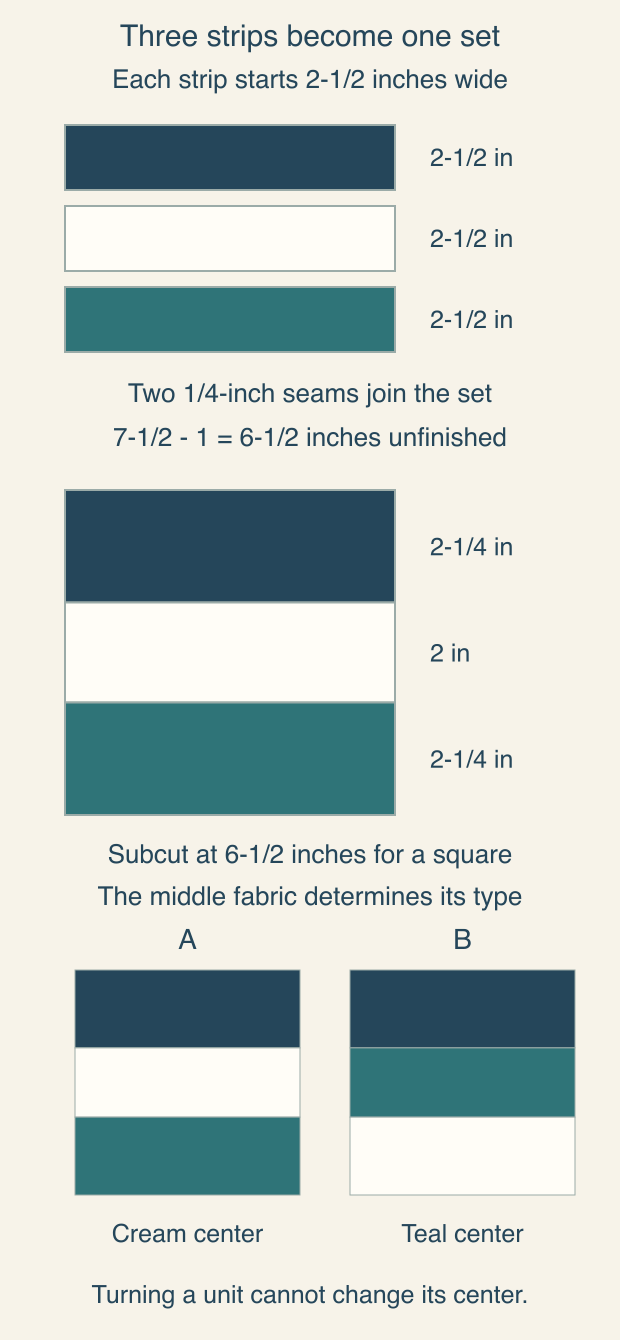
The set's width changes as those seams take up fabric. Three strips cut 2-1/2 inches wide do not make a 7-1/2-inch-wide sewn set. Two quarter-inch seams each consume half an inch across the two pieces they join:
2-1/2 + 2-1/2 + 2-1/2 - 1/2 - 1/2 = 6-1/2 inches unfinished.
Cut across that set at 6-1/2 inches to make a square unit. Once joined on all four sides, it finishes at 6 inches square. Its three bands each finish at two inches wide.
Before those outside seams are sewn, the outer bands each show 2-1/4 inches and the middle band shows two. Measuring only the middle band won't tell you the whole unfinished unit size.
For a loose strip's cutting yield, use our jelly roll strip guide. Here, the unit comes from a sewn set, so its width, fabric order and useful length all need to work together.
Count the fabric orders your layout needs
We'll use navy, cream and teal to make two units:
- A: navy, cream, teal. Cream stays in the middle.
- B: navy, teal, cream. Teal stays in the middle.
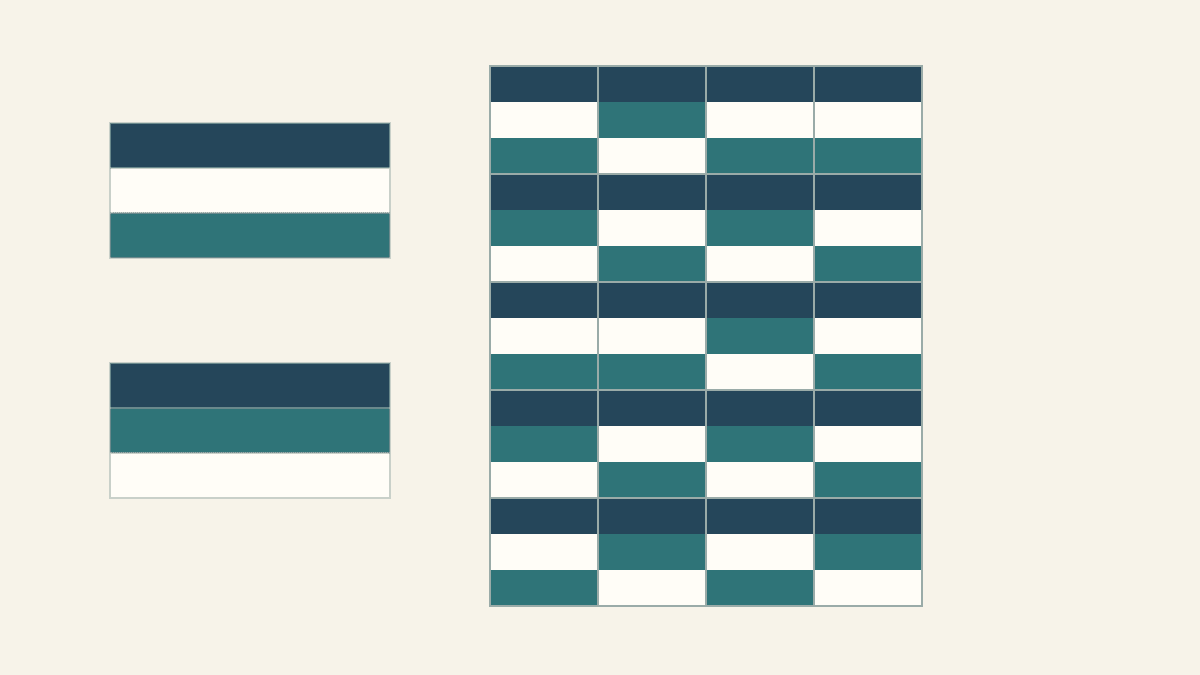
Keep the bands horizontal in this layout. Read each row from left to right:
| Column 1 | Column 2 | Column 3 | Column 4 |
|---|---|---|---|
| A | B | A | A |
| B | A | B | A |
| A | A | B | A |
| B | A | B | A |
| A | B | A | B |
The five rows need 12 A units and 8 B units. With four 6-inch-finished units across and five down, the field finishes at 24 x 30 inches, before borders.
Turning an A unit around doesn't turn it into B: cream remains in the center. Reversing its top and bottom swaps the outer bands but still leaves cream in the center. Keep the two orders in separate labeled stacks.
If you're still deciding the arrangement, our quilt layout guide starts with the block, rows and overall size. Settle the unit count before making the strip-set plan.
Build the count from usable sewn length
For this plan, assume your selvage-free strips measure 41 inches long before you square the set's ends. We'll budget 1/2 inch at each end, leaving 40 usable inches. Those are example inputs; measure your own fabric and allow for the trimming it needs.
Six subcuts at 6-1/2 inches use 39 inches. A 40-inch usable set therefore gives six units and a 1-inch residual.
Two A sets give all twelve A units. One long B set gives six B units, leaving two more to make. For those last two, use a shorter B set made from three 15-inch strips. After the same half inch is removed at each end, its 14 usable inches hold two subcuts totaling 13 inches, with one inch remaining.
| Set and order | Raw to usable length | 6-1/2-inch subcuts | Residual |
|---|---|---|---|
| A1: navy/cream/teal | 41 to 40 inches | 6 A | 1 inch |
| A2: navy/cream/teal | 41 to 40 inches | 6 A | 1 inch |
| B1: navy/teal/cream | 41 to 40 inches | 6 B | 1 inch |
| B2: navy/teal/cream | 15 to 14 inches | 2 B | 1 inch |
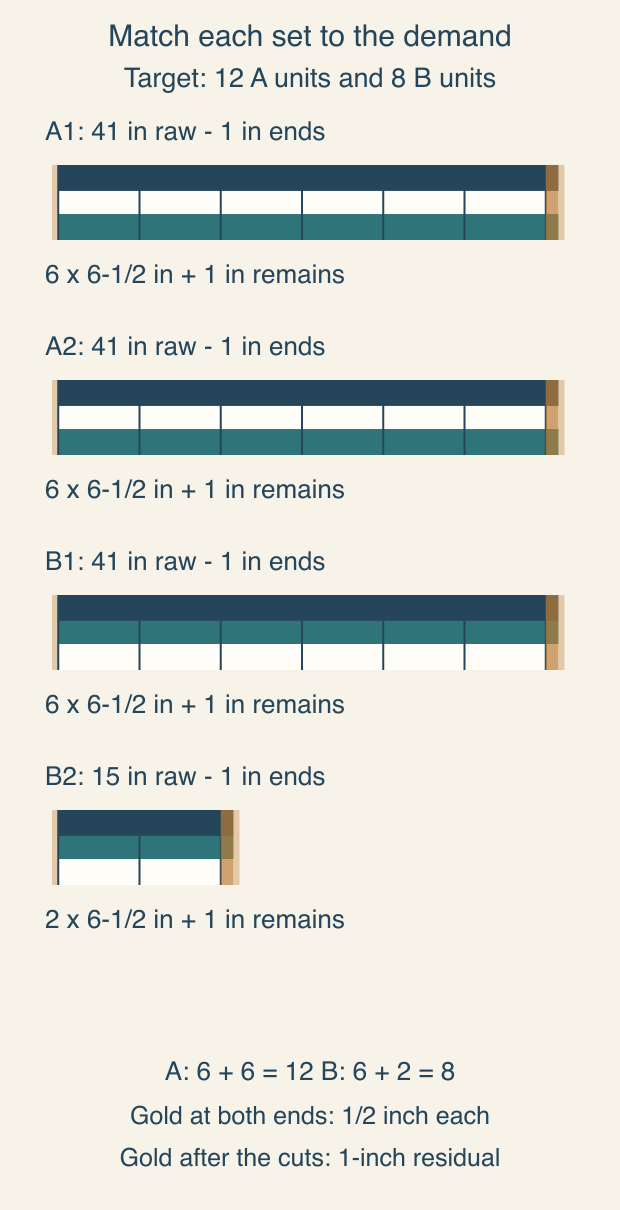
The cutting list is twelve raw strips, all 2-1/2 inches wide: three strips for each of four sets. For each color, you need three 41-inch lengths and one 15-inch length, totaling 138 inches of cut strip. That isn't 138 inches of yardage; several strips can be cut across one piece of fabric.
The length accounting for each color is 130 inches inside the twenty subcuts, four inches removed at the ends and four inches in the residuals. 130 + 4 + 4 = 138. Keep the residuals labeled A or B if you save them. A leftover pieced end has an order as well as a size.
Check one set before sewing the rest
Start with A1. Put navy and cream right sides together, match their long edges and sew. Add teal to the cream edge. Keep a small labeled reference beside the machine so the second seam doesn't accidentally put teal in the middle.
Press according to your pattern's directions. Brittany Lloyd's strip-piecing lesson at Lo & Behold Stitchery emphasizes keeping the order correct, pressing the set and using the seam lines to square it before subcutting. She also advises removing as little as necessary because the subcuts still need that length.
Measure the set across its width in several places. It should reach 6-1/2 inches unfinished, with straight seams and no folded fabric hidden at a join. If it is too narrow, check cutting, seam position and pressing now. A narrow set cannot become the intended square by cutting a longer crosswise piece.
Sherri McConnell's strip-set tips at A Quilting Life recommend checking the seam allowance at the start and pressing carefully to avoid adding curves. She also suggests shorter lengths where the pattern allows and alternating the end from which you sew successive strips. Those are useful habits to try before a stack of identical sets is sewn.
Square the first end, check the length still available and cut one 6-1/2-inch unit. Measure that square in both directions. Check the fabric order too. Once this first unit is right, finish subcutting A1 and use it as the reference for the remaining sets.
Let the measurement change the plan
Keep the count by type as you work. Suppose A2 needs more trimming and has only 38-1/2 usable inches. Five cuts use 32-1/2 inches, leaving six inches. The sixth 6-1/2-inch cut doesn't fit.
Now A1 and A2 supply eleven A units, one short. Mark that shortage before moving on. You can prepare a small replacement set in the A order or piece that unit separately to the same unfinished dimensions. Recheck its measurements before adding it to the accepted stack.
An extra B unit won't solve that shortage. The reverse can happen too: three full A sets and one full B set would make 18 A and 6 B units. That's 24 altogether, yet the layout still lacks two B units and has six surplus A units.
Recheck squareness during subcutting and update the remaining usable length whenever another trim is needed. The one-inch residual is a small margin, so don't keep a six-unit prediction after the measurements change.
Finish with two checked stacks
Before joining rows, lay out twelve accepted A squares and eight accepted B squares, all measuring 6-1/2 inches unfinished. Match them to the row table, then photograph and label the rows.
With nominal quarter-inch joins, four squares across measure 24-1/2 inches unfinished: 26 inches minus three half-inch seam losses. Five down measure 30-1/2 inches unfinished: 32-1/2 minus four half-inch losses. The remaining outside allowances bring the field to its 24 x 30-inch finished size.
Write the two demand counts, the 6-1/2-inch checkpoint and the planned end trim on one card. Sew and check A1 before cutting every remaining strip. That first measured set gives the rest of the plan something reliable to follow.
Related posts

Freezer Paper Foundation Paper Piecing or Sew-Through?
Compare sewing through a foundation with sewing beside folded freezer paper, using one simple unit and a realistic plan for sixteen repeats.
Pinked Edges on Precuts: Where to Measure the Seam
Peaks or valleys? Compare Moda and C&T guidance, then use a three-strip check to choose a consistent seam reference for your actual precuts.
Wonky Log Cabin Quilt Blocks That Trim to One Size
Keep the irregular strips and still make blocks that fit. Plan an 8-inch finished block, check the trimming square and protect the outer seams.