


How to Keep a Quilt Materials Record Before the Labels Are Gone
A quilt materials record lists every material in a quilt, from top fabrics and backing to batting and thread, with its exact product name, a photo of its label and its care directions. Most quilt record guides cover the maker, pattern, quilter and a photo. The American Quilter's Society's guide to quilt labels adds batting type, fabric content, fabric line and care instructions. Start the record while the batting bag and selvages are still in your sewing room.
That timing matters. Once the bag is gone and the last selvage is trimmed, "cotton quilt" is often all anyone can say when they ask how to wash it.
For most quilters, one notebook page or document per quilt plus a folder of phone photos is plenty. It's a private working file, separate from the short label sewn on the back. Below we build one for a made-up project, Q-014, to show the format.
Give the quilt one ID number
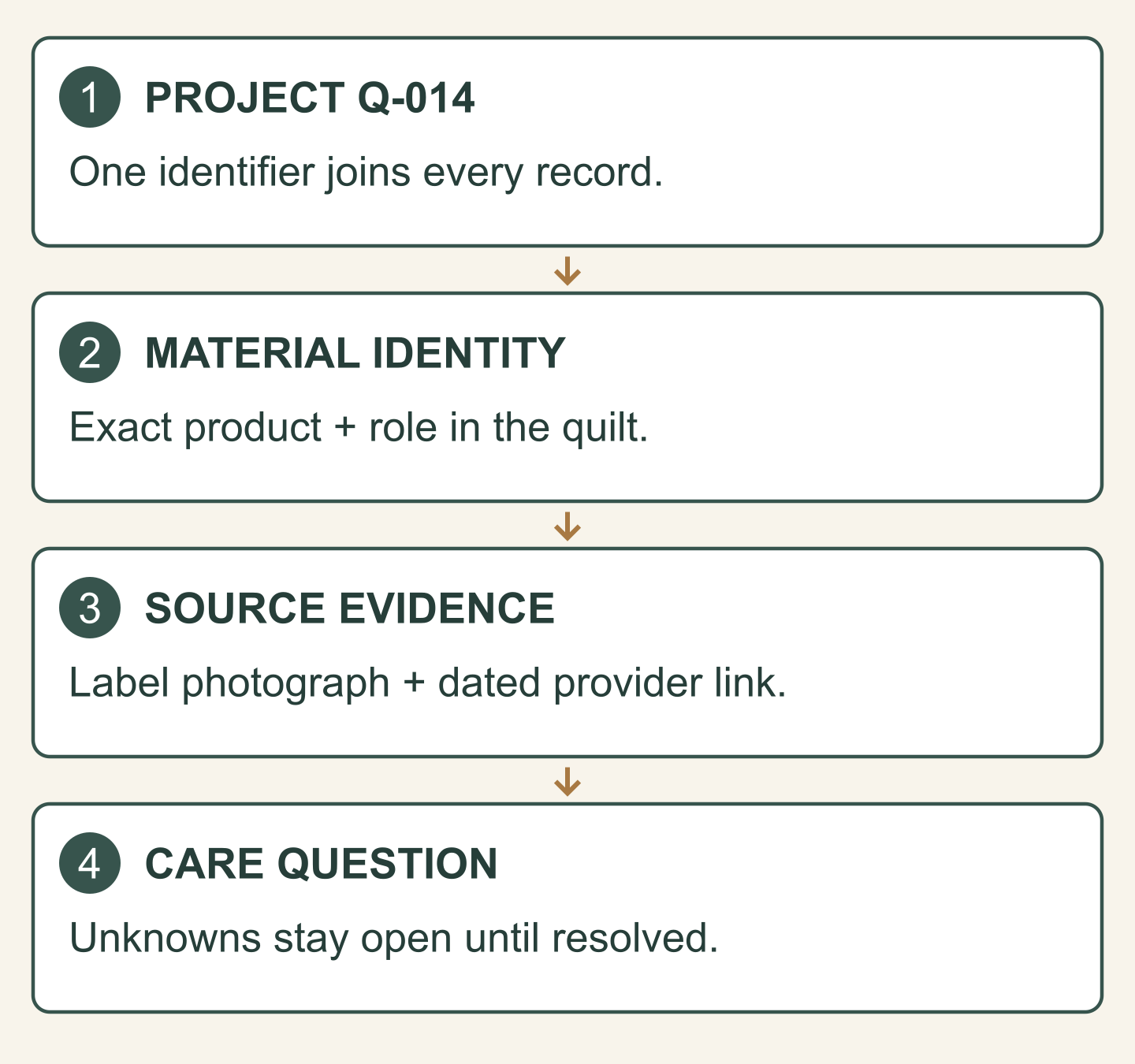
Give each quilt a short ID and put it on every related file. Ours is Q-014. The ID ties the fabric list, batting photos, construction notes and finished-quilt photo together, even if you rename the quilt later.
Quilter and longarm designer Mary M. Covey suggests the same start in her quilt record-keeping post: assign each project a number when you begin, and photograph the finished quilt. Her list also keeps the pattern credit and who pieced and quilted it.
On the first page, write the quilt's name, maker, intended use, finish date and pattern or design credit. If someone else quilted it, name them and their role. If you don't know a date, write "unknown"; a confident guess is hard to untangle later.
Keep addresses and private gift notes out of any copy you plan to share. A recipient needs materials and care information. Your own file can also hold receipts and messages.
Record each material by its job in the quilt
Each entry should say where the material is used, exactly what it is, and how you know. A backing fabric and a border fabric from the same company can be different cloths. Two batting packages with similar names can differ in fiber, color, bonding and instructions.
Use one row per material, and add rows as the quilt needs them. Don't lump every top fabric into one line.
| Material role | What to record | Proof to keep |
|---|---|---|
| Top and borders | Maker, collection, color or item code, stated fiber | Selvage or label photo, receipt |
| Backing and binding | Exact product or base cloth, and any substitution | Supplier directions, label photo |
| Batting | Full product name, version, stated blend, package size | Front and instruction side of the bag |
| Thread | Brand, line, stated fiber, weight, color code | Photos of spool end and label |
| Extras | Interfacing, fusible, printed panels, trim; where each is used | That product's own directions |
Batting names show why the detail matters. Hobbs' Heirloom Premium 80/20 page describes an 80% cotton, 20% polyester blend, and the same line comes in standard, bleached, black and fusible versions. "Hobbs batting" loses that. Copy the version from your own package, not the closest name you find online.
If a spool has no label, write "quilting thread: unknown." Don't guess fiber or weight from how it looks. You can still note which seams or quilting it's in.
Photograph labels before you throw packaging away
Photograph each product name and the whole instruction panel, close enough to read later. Include the conditions and warnings. A crop of just the wash temperature can lose the line that makes it make sense.
Name files the same way every time: Q-014-batting-label.jpg, Q-014-batting-directions.jpg, Q-014-backing-source.txt. In the source note, paste the supplier's web address and the date you checked it. If you save a copy of online directions, keep the provider and product name visible. An unlabeled screenshot is easy to mistake for another product's instructions.
Give each material one of three statuses:
- Confirmed: the package, selvage or supplier record identifies it.
- Reported: someone told you what it is, but you have no label or receipt.
- Unknown: nothing reliable identifies it yet.
These describe how sure you are, not how good the material is. Keeping "unknown" in plain sight stops anyone from inventing care instructions for it later.
Keep each product's care directions with that product
File the directions under each material before you write any care note for the whole quilt. The Warm Company's Warm & Natural page gives handling and laundering directions for that batting. They apply to Warm & Natural, and only to Warm & Natural.
The base cloth matters for printed fabric too. Spoonflower's care page says to machine wash Petal Signature Cotton cool and tumble dry low. Its Cotton Silk should be washed cold and line dried. "Printed fabric" alone doesn't tell you which applies.
For each material, record the product name, the web address, the date you checked, and anything that conflicts with the rest of the quilt. If the package and the current web page disagree, keep both and ask the maker which applies to your material. Don't swap the package directions for a newer page about a similar product.
Our batting guide helps you compare battings before you buy. Once you've chosen one, its package and its maker's directions are what go in the record.
Write down what you actually did
Note whether you prewashed each fabric, whether the batting needed any preparation, and whether a printed or fused material had a required step. Write what happened. "Planned to prewash" doesn't tell anyone the fabric was prewashed.
Keep the quilting method and spacing with the batting entry. If you drew a stitching plan, mark which lines you actually stitched. Our batting spacing example explains why a patchwork seam doesn't always count as a quilting line.
Add repairs and substitutions as dated entries. If you replace the binding years later, keep the old binding row and add a new row for the replacement, with its own product name and directions. A record that overwrites itself hides how the quilt changed.
Turn the gaps into a short question list
Here's the end of the Q-014 record. The useful part is what's still open.
| Record item | Status | Open question |
|---|---|---|
| Q-014 backing | Confirmed Petal Signature Cotton order | Do its directions conflict with any other material? |
| Q-014 batting | Confirmed Warm & Natural package | Do the package and current web directions match? |
| Q-014 quilting thread | Unknown, spool label missing | Can the maker name the product line? |
| Whole-quilt care note | Open | Identify the thread, then reconcile all directions |
A handoff note can be this short: "Materials record kept under Q-014. Quilting thread unidentified. Whole-quilt washing directions not yet confirmed." The recipient knows what's settled and what isn't. That beats a guess that every cotton-looking part can take the same wash.
A full list still can't promise colorfastness or that a wash is safe. If you test a wash on a sample, record the materials, steps, date and what you saw as a separate dated entry.
Treat older and fragile quilts differently
For an inherited quilt, record what you know about the maker, age, materials and condition. Today's package directions don't tell you how strong an old textile is, or what dyes and treatments it has had.
In the National Quilt Museum's conservation guidance, Gerald E. Roy warns that some fabrics in old quilts break down in water. He recommends asking a reputable textile conservator before washing important family, historic or early quilts. For those quilts, the record's job is to note unknown fibers and damaged areas, and to leave cleaning to an expert.
Your next step: start a record for the quilt on your table
Pick the quilt you're making now and give it an ID. Before you throw anything away, photograph the batting bag front and back, each selvage, and each spool label. Then fill in one row per material and mark each one Confirmed, Reported or Unknown.
If you plan quilts in QuiltLab, you can keep the record next to the design. Open a project for the quilt, upload a photo of each fabric in the Swatch Editor and save it with a name that includes the ID. Then add a canvas to the same project, and place the label photos, your notes and the saved swatches on it.
Canvas Editor: arrange your ideas →Combine images, text and library assets on a personal or project canvasFor naming and saving fabric photos, see the Swatch Editor guide.
Related posts
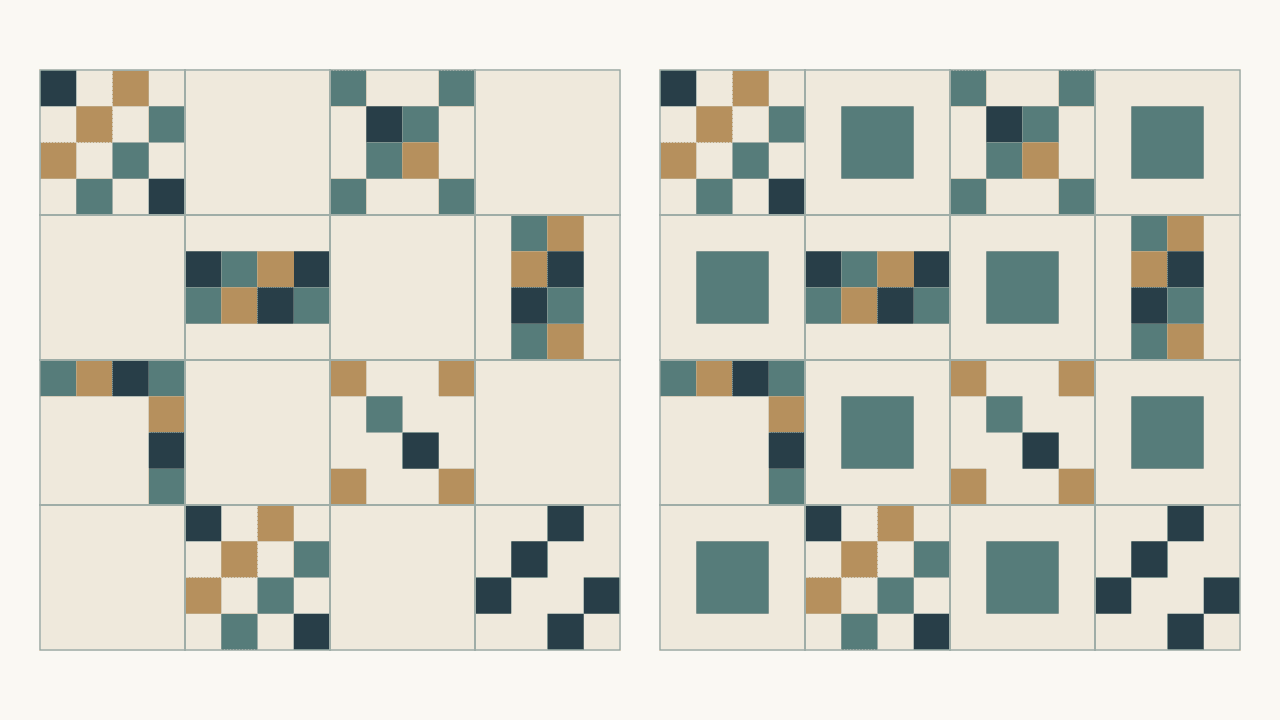
Alternate Blocks for Sampler Quilts: Plain or Pieced?
Plain alternate blocks give a busy sampler room to breathe; a simple repeated block adds rhythm. See how each changes your block count and quilt size.
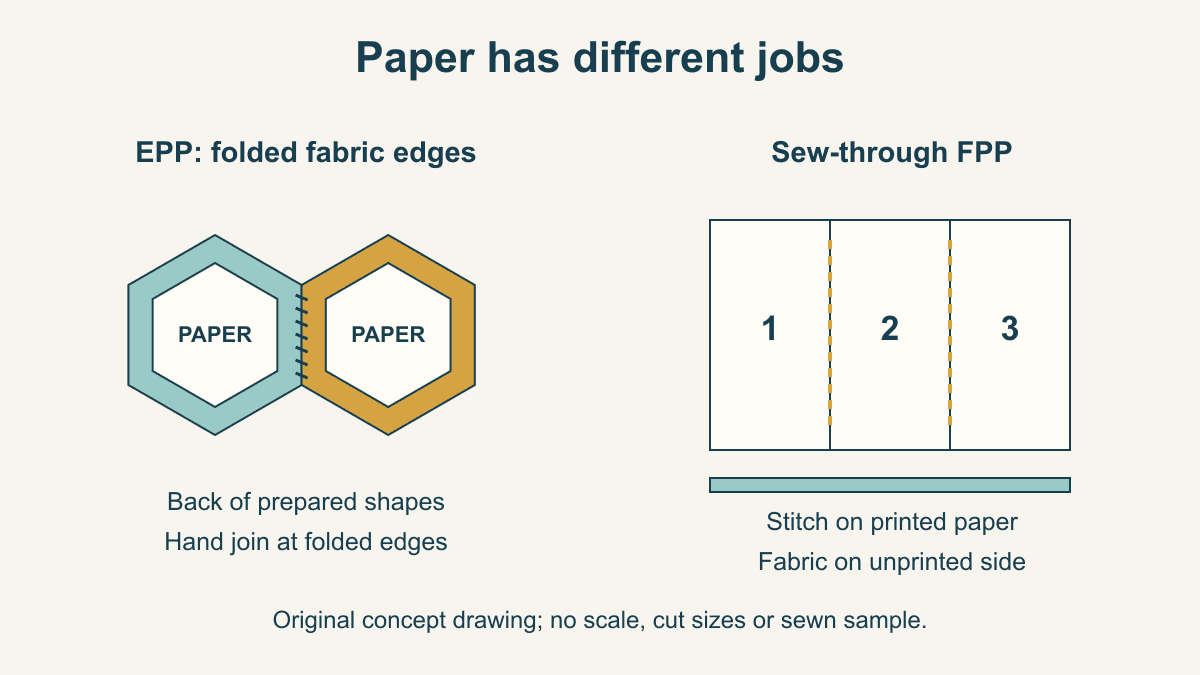
English vs Foundation Paper Piecing: Which Should You Try?
Compare what the paper does, where stitching happens and which project brief suits EPP or sew-through FPP before choosing a pattern.
Log Cabin Strip Width: How Wide Should Logs Be?
Most Log Cabin strips are cut 1 1/2 to 2 1/2 inches wide. See how each width changes block size, the center's weight and the number of seams.