


Build a Quilt Scrap Cutting System You Will Use
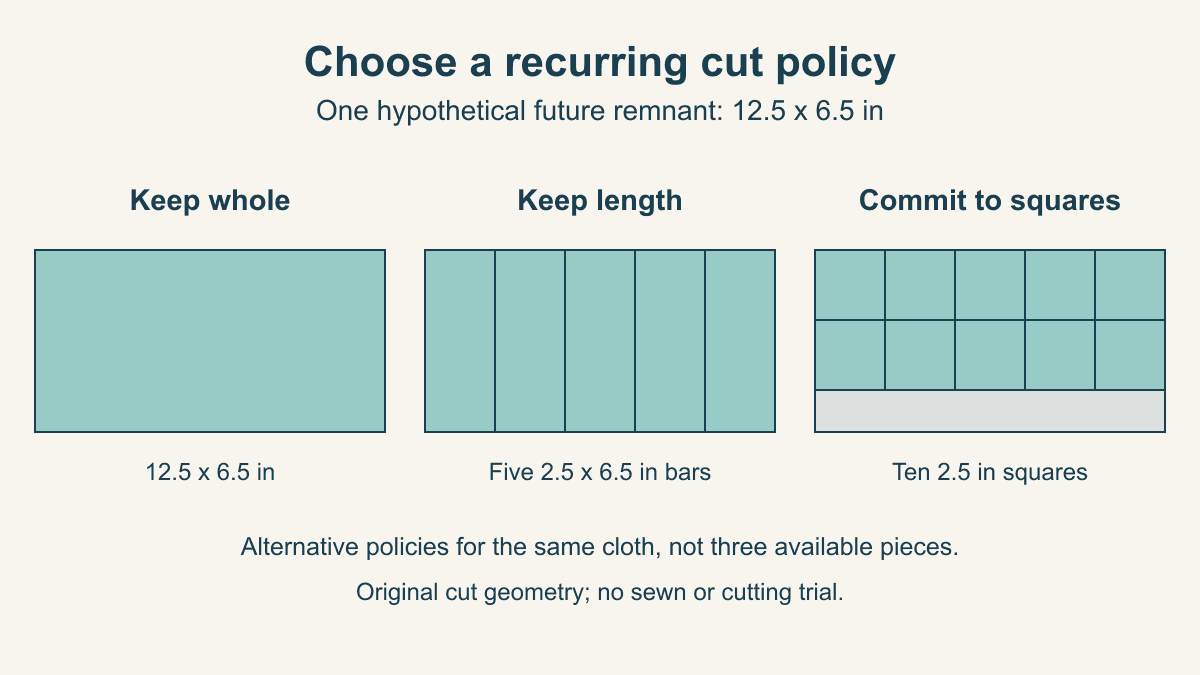
Start with one cut width that appears in patterns you actually use, and keep useful strips long until a project needs shorter pieces. That gives you prepared fabric while preserving more choices than cutting every leftover into small squares. If no size recurs in your projects, keep larger pieces whole for now.
A useful quilt scrap cutting system fits on a short worksheet: default cuts, no-cut exceptions, a stopping point and a review date. Below, one hypothetical remnant shows what three cutting policies keep available. For a count of what your existing leftovers can supply, use the usable-size inventory worksheet.
Choose a recurring need before a standard size
Look at the cutting charts for projects you repeatedly choose. List the shapes and cut dimensions that recur. A finished 2-inch square and a 2-inch cut square are different entries. Preserve each pattern's construction and trimming requirements when deciding which cuts to prepare.
For ordinary squares sewn with quarter-inch allowances on opposite edges, a 2-1/2-inch cut square contributes a nominal 2-inch finished patch. That does not make it a suitable starting square for every triangle method. Oversize-and-trim instructions can require more fabric than the finished size suggests.
Imagine a reader whose likely projects regularly ask for 2-1/2-inch squares and 2-1/2 x 6-1/2-inch bars. Those two needs justify considering a 2-1/2-inch strip width while preserving some length. They do not justify cutting every scrap into squares immediately.
Bonnie K. Hunter describes preparing scraps in usable sizes after completing projects in her own C&T Publishing article about scraps. Her emphasis is on having material ready for future work. Apply that idea to the shapes you use, rather than assuming another maker's standard sizes must become yours.
Our pattern-reading guide helps distinguish a chart of final pieces from strips that will be subcut later. Read that distinction before turning a recurring strip width into a stack of short pieces.
Compare keeping options with preparing cuts
An inventory-first policy leaves eligible larger pieces intact until a chosen project supplies the cutting requirement. Its benefit is flexibility: a rectangle can still become a bar, a square, a background patch or a motif window if its dimensions permit. Its cost is that future sewing starts with more selection and cutting work.
A standardize-first policy converts eligible new scraps into a limited vocabulary of cuts. Its benefit is that compatible projects can begin with prepared ingredients. Its cost is commitment: those ingredients may not fit the next project, and the original larger piece is gone.
A hybrid can standardize one dimension while keeping another. For example, cut a recurring strip width but leave the strips long until the next cutting chart determines their subcuts. That keeps fewer choices than a whole rectangle, but more choices than small squares.
None of these approaches requires processing the whole stash. Apply a trial policy to future leftovers from a defined group of projects, then decide whether the prepared shapes are actually being used.
Follow one future remnant through three policies
Assume a sound, grain-aligned usable rectangle measuring 12-1/2 x 6-1/2 inches, after any required preparation and edge correction. This is an input to the example, not a prediction of what every project will leave behind.
Its area is 12.5 x 6.5 = 81.25 square inches. Consider three alternative actions on that same piece:
| Policy | Prepared result | Choice kept |
|---|---|---|
| Keep whole | One 12.5 x 6.5-inch rectangle | Both cut dimensions remain open |
| Keep length | Five 2.5 x 6.5-inch bars | Each bar can remain long or be subcut |
| Make small squares | Ten 2.5-inch squares plus a residual strip | The small-square choice is committed |
The long-bar option divides the 12.5-inch width into five widths of 2.5 inches. Each keeps the full 6.5-inch length. Five bars therefore contain 5 x 2.5 x 6.5 = 81.25 square inches in this idealized aligned layout.
For small squares, five fit across and two fit down: 5 x 2 = 10 squares. The two rows occupy 5 inches of the 6.5-inch height, leaving one 12.5 x 1.5-inch residual strip. The squares use 10 x 2.5 x 2.5 = 62.5 square inches; the residual uses 12.5 x 1.5 = 18.75. Together they account for the original 81.25.
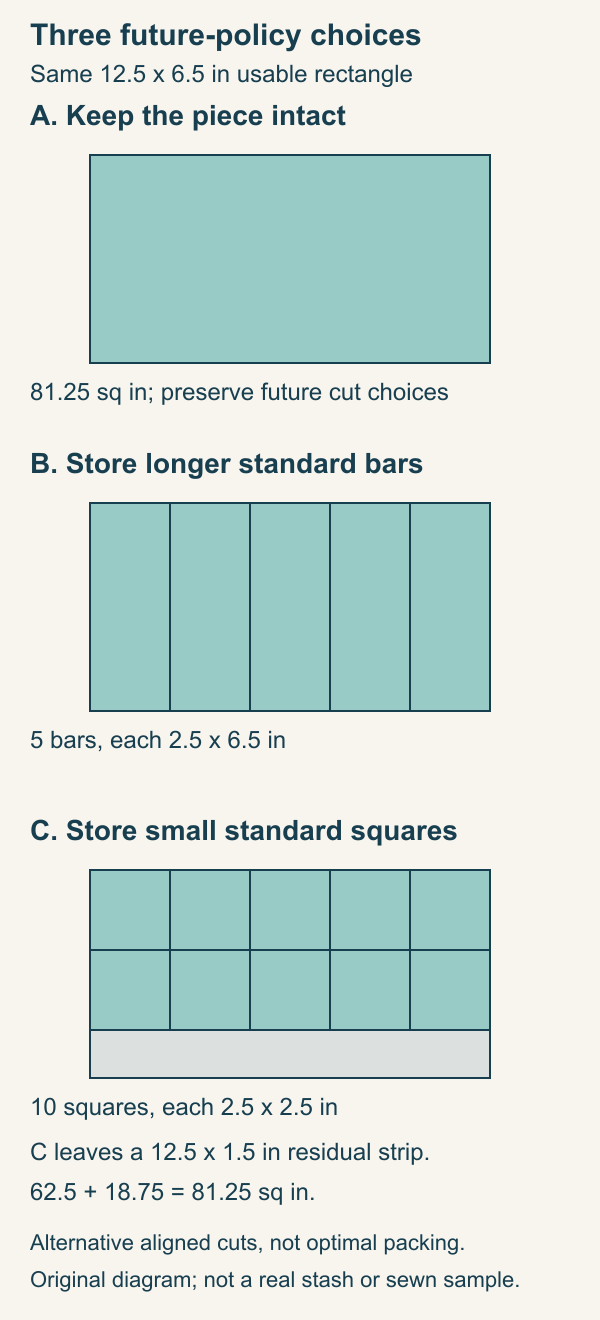
If the next project asks for unpieced 2.5 x 6.5-inch bars, the square-first version has lost that option. Sewing smaller fragments into a replacement would introduce seams and require a different construction plan. Equal total fabric area does not restore the original uncut shape.
If the next project needs small squares, the long bars can still be subcut into them. The whole rectangle can also supply them. The difference is when the decision is made and how much cutting remains at that point.
These counts assume the stated usable dimensions and simple aligned cuts. Actual edge correction, grain, print direction and cutting accuracy can change what is available. A policy is not permission to label an undersized piece as a full standard cut.
Write exceptions before reaching for the cutter
Give a large or distinctive piece a reason to remain whole. Possible exceptions include a planned background patch, a directional print, a useful larger motif, material already reserved for a project, or cloth whose suitability still needs checking.
Kate of Seamingly Kate proposes recurring strip sizes while explicitly keeping personality prints for future fussy cutting in her usable-scrap method. Her particular sizes and length threshold belong to her system. The useful principle here is that an exception is part of a cutting policy, rather than a failure to follow it.
Sherri McConnell similarly describes generally keeping her light and low-volume fabrics as larger pieces for backgrounds, with selected prepared-cut exceptions, in her scrap-sorting discussion at A Quilting Life. That is another example of choosing what to preserve according to expected use.
Do not copy an expert's exception automatically either. If you rarely use a particular category, record your own reason for keeping or passing it on. The aim is material with a defined future role, not an ever-growing category named "special."
Fill out a policy worksheet
Here is an example for the hypothetical reader who uses both small squares and longer bars:
| Policy field | Example rule |
|---|---|
| Recurring width | Prepare 2.5-inch widths only from eligible new leftovers |
| Length decision | Keep useful length; subcut squares when a project needs them |
| No-cut exceptions | Reserved background, directional motif and uncertain material |
| Prepared-cut limit | Pause at 40 squares or 10 bars awaiting use |
| Review event | Check use when a limit is reached or after three new batches |
The limits are illustrative management choices, not quantities for a complete quilt. Change them to reflect your projects and storage. If you hit the limit without using the prepared pieces, stop adding more of the same cut. Reconsider the assumed demand before converting another batch.
Label prepared cuts by their actual dimensions. Keep project reservations separate from the general supply, and record the reason for each no-cut exception. Count what remains available after pieces are assigned or used; a policy cannot make one piece available to two projects at once.
Review use, rather than the appearance of the bins
At the review point, record which prepared shapes were used, which needed recutting, and which remained untouched. Keep that short record with your cutting rules.
If long strips keep being shortened, more square preparation may be useful. If future patterns keep asking for larger pieces, preserve more cloth intact. If motif exceptions accumulate without a project, revisit the reservation rather than silently cutting them into the default shape.
Write your first policy now: one useful width, the lengths to keep, two no-cut exceptions and a limit on unused prepared pieces. Try it on the next suitable leftovers, then review what you use. When a project is chosen, the controlled-scrappy layout guide helps you assign those pieces color roles.
Related posts
Alternate Blocks for Sampler Quilts: Plain or Pieced?
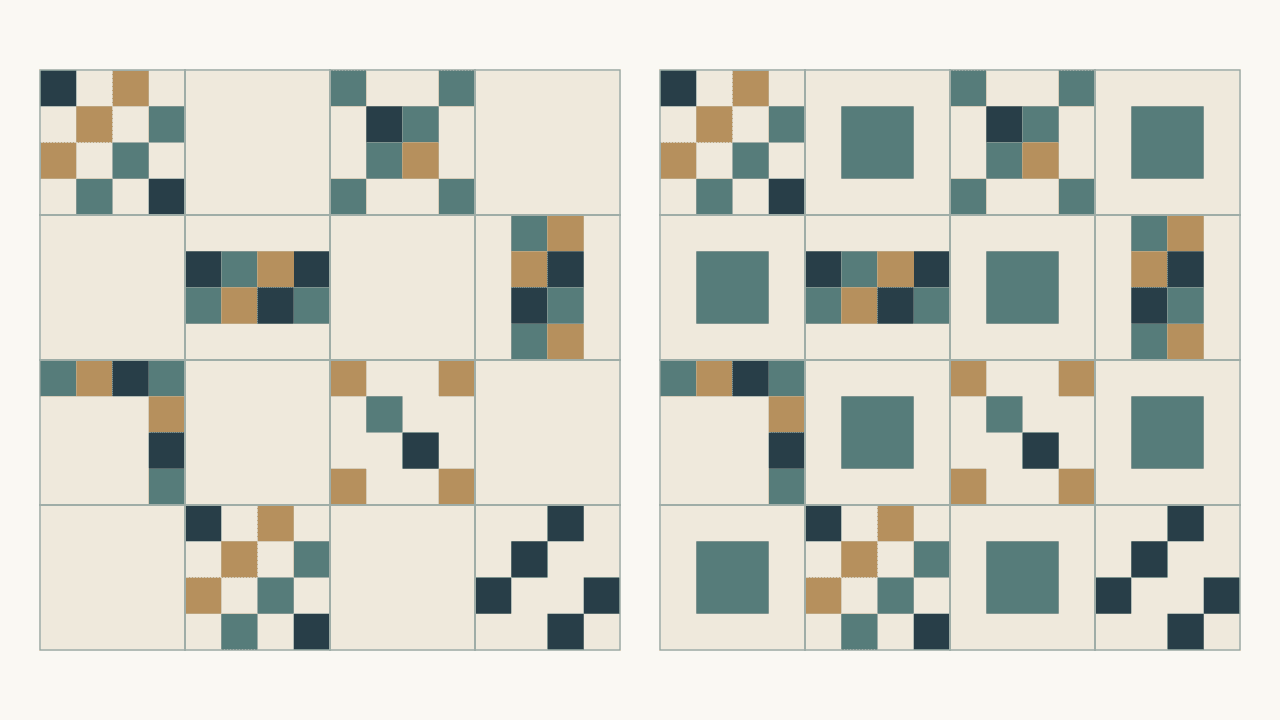
Plain alternate blocks give a busy sampler room to breathe; a simple repeated block adds rhythm. See how each changes your block count and quilt size.
English vs Foundation Paper Piecing: Which Should You Try?
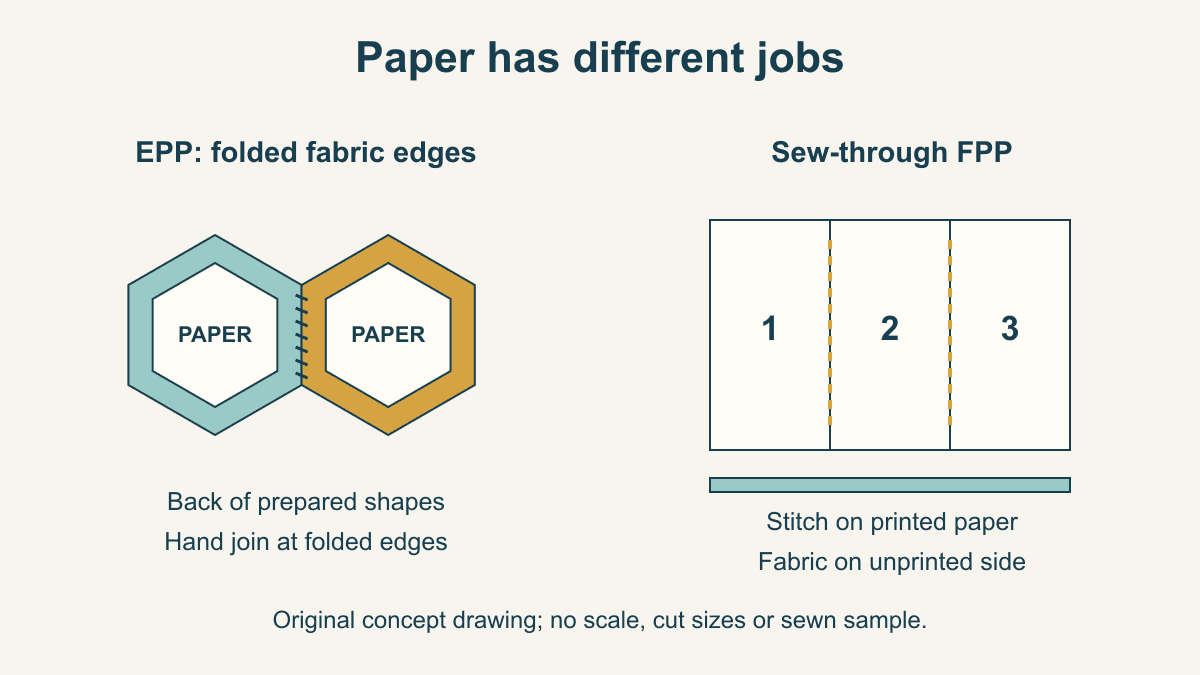
Compare what the paper does, where stitching happens and which project brief suits EPP or sew-through FPP before choosing a pattern.
Log Cabin Strip Width: How Wide Should Logs Be?
Most Log Cabin strips are cut 1 1/2 to 2 1/2 inches wide. See how each width changes block size, the center's weight and the number of seams.