


Which Unfinished Quilt Projects Should You Finish?
Choose an unfinished quilt project you still want and can move forward after one clear decision. Inventory what is actually complete, identify the next missing prerequisite, then choose whether to finish, redesign, pause or repurpose it. The oldest project does not automatically deserve the next sewing session.
Start with a few projects you can examine together. You need enough information to choose the next action, not a perfect catalog of every bag in the sewing room.
Find out what is in each project bag
Put the pattern or instructions, remaining fabric, completed units and notes together. Write down the pattern version if one exists. Count the units and measure representative pieces instead of relying on what you remember cutting years ago.
A label such as "almost done" hides very different situations. One quilt may need binding. Another may have a completed center but no border decision. A third may contain many sewn units that do not yet form the intended blocks.
Julie at The Crafty Quilter recommends inventorying unfinished stages and splitting large jobs into assembly, quilting and binding tasks. That gives you a better choice than treating every bag as one equal-sized commitment.
For each project, record five things: its current purpose, its actual stage, the materials you can identify, the instructions you have, and the next decision or task. Keep the record with the pieces.
Ask whether you still want this particular finish
Name who or what the quilt would serve now. The original recipient, room or occasion may have changed. You may still love the blocks while no longer wanting the original quilt.
Melanie McNeil's discussion of finishing UFOs asks makers to look at future work and materials rather than letting past spending decide everything. Her alternatives include smaller layouts, reusing blocks and passing work along.
Ask: if these pieces appeared in front of you today, would you choose to spend the remaining effort on this finish? A yes gives you a purpose. A no gives you information too. You can make a deliberate decision without inventing a deadline to force enthusiasm.
If someone else is waiting for the quilt, clarify the current agreement before changing the design or handing the work to another person. A shared commitment deserves a conversation, not a silent change in the project bag.
Find the prerequisite that is stopping progress
A prerequisite is something that must be known, found or decided before the next task makes sense. "Finish the quilt" is too broad. "Measure the top and choose backing" identifies work you can actually do.
Separate missing information from missing sewing. An instruction sheet you cannot find may be the first problem. Buying fabric before checking the intended unit size could leave you with more material and the same uncertainty.
Useful checks include:
- Are the completed units the size the next step expects?
- Do you have enough usable fabric for the remaining pieces?
- Are essential instructions, templates or layout notes available?
- Does the top still suit its intended use and recipient?
- Is a technique, tool or service needed before work can proceed?
- Are the materials sound enough for the proposed finish?
Older, fragile or unidentified textiles need an appropriate care assessment. Do not turn a triage session into an improvised washing, repair or unpicking experiment. Record that assessment as the next prerequisite when needed.
Work through three different bags
The following projects are hypothetical decision examples. They illustrate a worksheet rather than claimed finishes or measured sewing times.
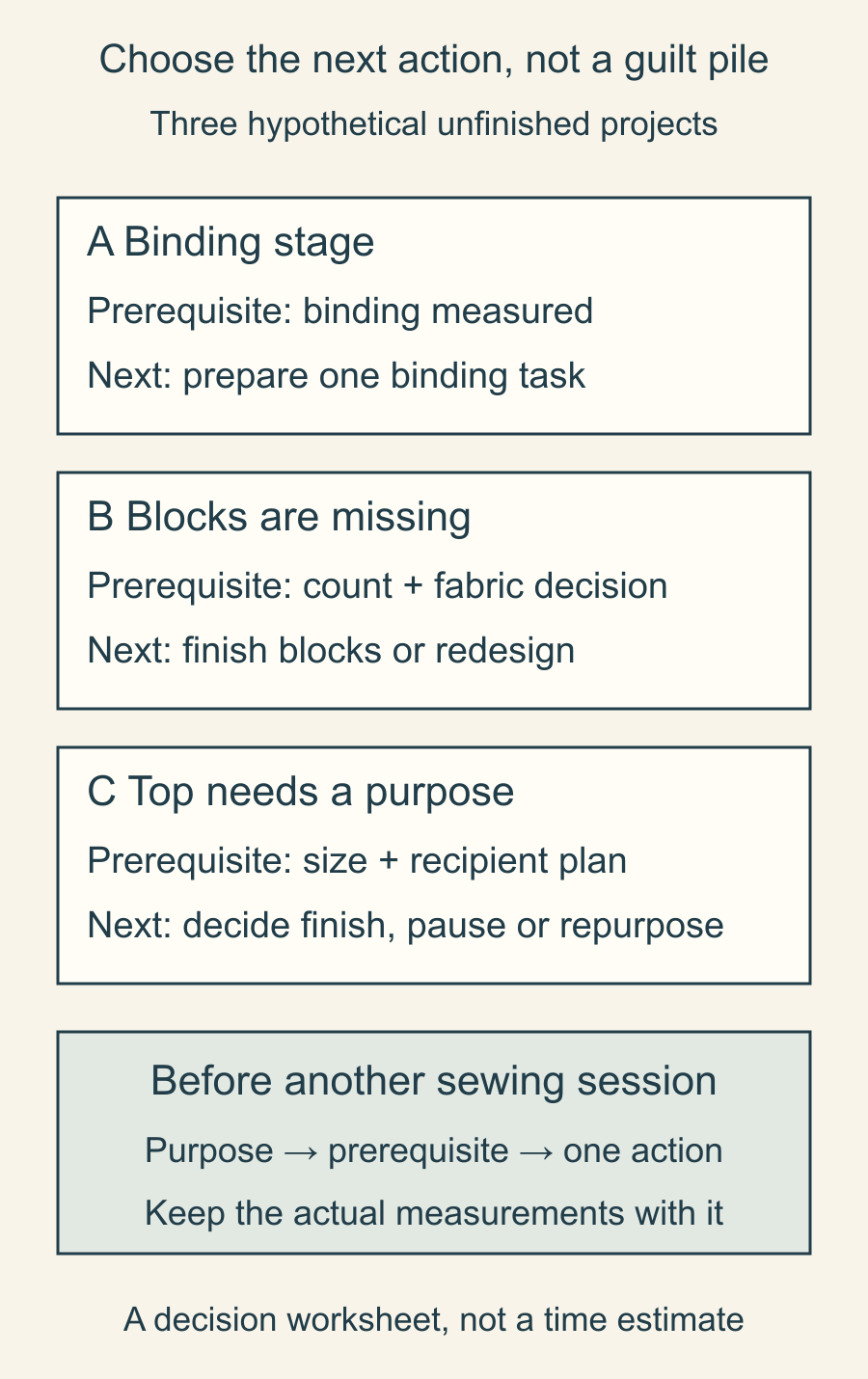
| Project | Actual stage | Missing prerequisite | Next choice |
|---|---|---|---|
| A | Quilted top awaiting binding | Binding plan and measured perimeter | Finish with one defined binding task |
| B | 18 of 24 planned blocks found | Remaining-unit count and fabric decision | Finish the six blocks or redesign |
| C | Complete top with no current recipient | Purpose, target size and finishing plan | Choose a use, pause or repurpose |
A has a clear path. Before calling it the quickest finish, check that the binding fabric and finishing method are available. Its next action could be measuring and preparing the binding plan. You do not need to predict the whole evening to begin that task.
B needs a decision before a batch of sewing. Eighteen completed blocks leave six short of a 24-block plan. Count and measure those 18, then check the remaining material. Decide whether the intended six blocks are feasible or whether a revised layout better uses the work you have.
C needs a purpose. Quilting it immediately may commit money and effort before its size or use is settled. Rachel Rossi's UFO management discussion includes allowing a top to wait when its recipient or finishing purpose is undecided. That can be a sensible, recorded pause.
Choose one of four states
Finish when the intended result still matters and the next step is clear. Write that step in physical terms: locate the pattern page, measure the top, count the blocks or prepare one component.
Redesign when useful work remains but the original finish no longer fits. First measure the existing units. Sketch a possible smaller or different layout before cutting them apart. Our sampler-layout guide covers arranging mixed blocks once that decision is made.
Pause when you want the project but a real prerequisite is missing. Label the missing item and a reason to revisit it. A pause without a note can become another mystery bag; a labeled pause tells your future self what is needed.
Repurpose or pass along when another use better serves the materials. Ask the recipient what they accept before offering an unfinished top or a box of pieces. Keep pattern and provenance information with the work, and respect any commitments attached to it.
Keep only the next active project at the front
You can inventory several bags without making them all active. Choose one project and put its next task, instructions and needed materials together. Return the others to their labeled states.
Once you have chosen a finish, our quilt timing guide can help you distinguish hands-on work from calendar time. Make estimates from your actual remaining tasks rather than comparing your pace with someone else's finish count.
If redesign is the next step, use a measured layout sketch. The Quilt Editor guide explains the layout tools when a digital study would help. Keep the physical counts and missing-material notes with the project itself.
Open one unfinished bag today. Count what is there, name the purpose you want now, and write the single prerequisite that comes next. Whether you choose to finish it or release it, the project will stop being an unexplained obligation.
Plan your next quilt
Lay out blocks and try colors in QuiltLab's grid editor before you cut.
Free forever, no card needed.
Get quilting tips by email
QuiltLab updates, tips and quilting inspiration. Unsubscribe anytime.
Related posts
Write Clear Quilting Bee Instructions
Specify block sizes, fabric roles and a first-sample check so contributors know what to make and when to ask before continuing.
How to Size a Quilt Block Pillow Front
Size a pillow front from your actual block, then account for borders, the closure seam and the panel's measured size after quilting.
Quilt Pattern Testing Checklist for a Useful Brief
Give testers an exact assignment, useful measurement checkpoints and a clear way to report questions before they start cutting.