


Quilting with Large Prints? Start with the Seams
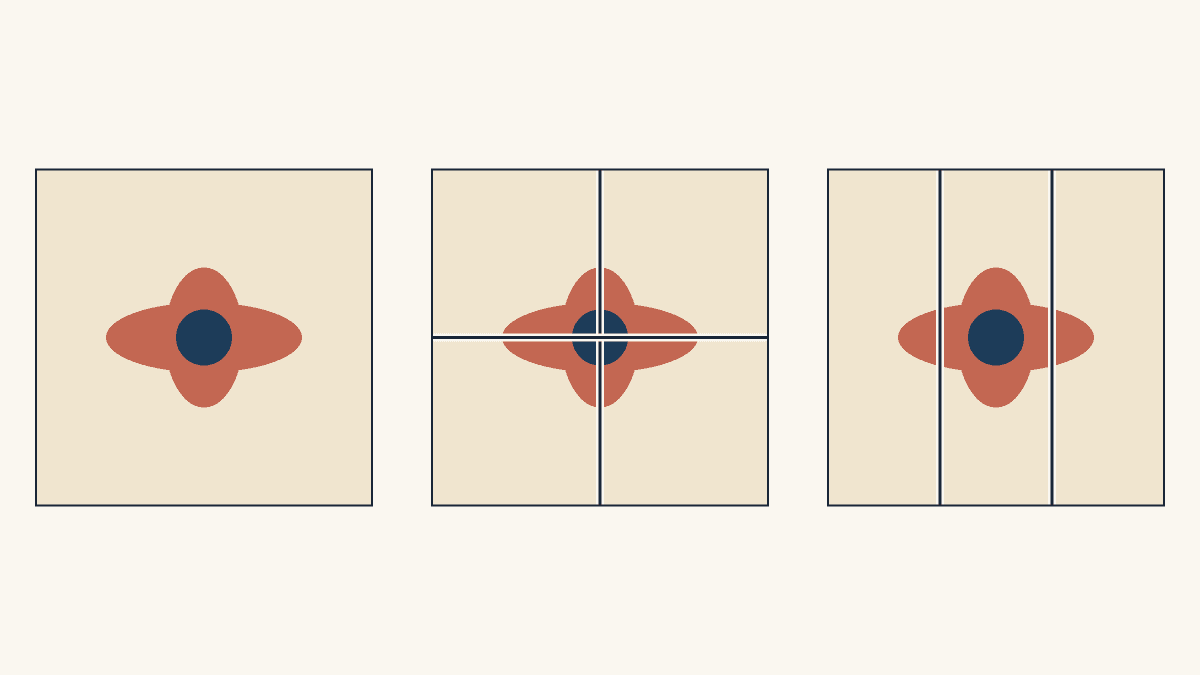
When quilting with large prints, check the finished pieces inside the block before choosing the pattern. For a whole flower or animal, start with a piece wide and tall enough to hold it between the seams. If you want fragments and texture, choose where the seams can cross deliberately.
A 12-inch block could be one large square, four smaller squares or three narrow bands. All three cover the same area, but they give the print different uninterrupted spaces. Below, moving the same flower two inches helps one block and hurts another.
Decide which part of the print matters
Put the fabric where you can see a full repeat. Choose what you want a viewer to notice: the complete flower, its center, or the colors left after the flower is divided.
Those are different design goals. A print doesn't have to remain recognizable to be useful. You might like its scattered coral shapes more than its complete flowers. The choice becomes easier once you name what should survive.
Leila Gardunia's fabric-selection lesson connects print scale with the size of the individual quilt pieces. Large pieces can celebrate a large print; small-scale fabrics can help a pieced block's structure stay clear. Use that relationship to inspect the pattern drawing, rather than relying on the block's overall measurement.
Start with one dimensioned repeat
Our drawing repeats every 12 inches horizontally and vertically. Each coral flower measures 7 inches wide by 5 inches tall, with a 2-inch-wide navy center. These are dimensions we assigned to an illustration, not measurements taken from fabric.
We drew the repeat and finished-window studies for this article and haven't sewn them. Seam lines show where a feature meets a piece boundary; the drawings aren't a pattern-matched cutting plan. Use your pattern's allowances and position every eventual cut on the actual cloth.
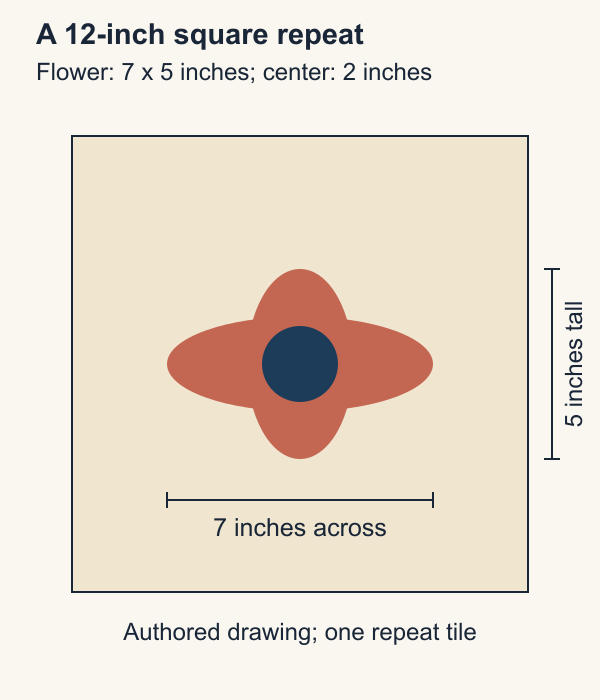
On your own print, measure the important motif with a ruler after preparing the cloth as you intend to use it. Then find the next occurrence in each direction. A wide space between flowers can matter as much as the flower's size when you place several pieces.
Anneliese Johnson's big-print advice at Bits 'n Pieces includes checking scale, placing focal motifs strategically and giving busy prints quieter neighbors. A window over the cloth helps turn that advice into a specific choice.
Compare three blocks at the same finished size
Keep the outside square at 12 x 12 inches for all three studies:
- Whole square: one uninterrupted 12 x 12-inch field.
- Four Patch: four 6 x 6-inch finished windows, meeting at the middle.
- Three vertical bands: three 4 x 12-inch finished windows.
Each block has 144 square inches of finished area. The Four Patch divides that into 4 x 36, while the bands divide it into 3 x 48. The band has more area than one Four Patch square, but it is narrower. Area alone won't tell you whether a flower fits.
Our 7-inch-wide flower fits the whole square. It cannot fit completely inside either a 6-inch square or a 4-inch-wide band in the orientation shown. The two-inch center is small enough for either, depending on placement.
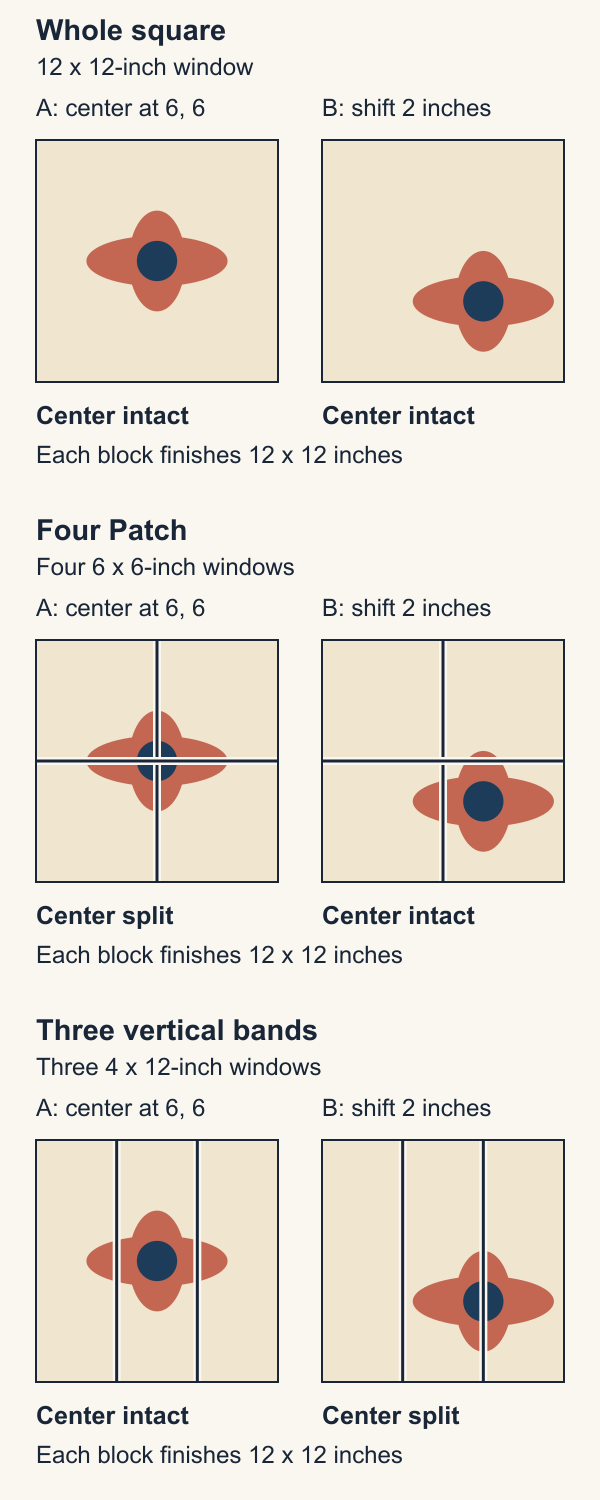
If the whole flower is essential, the whole square is the useful choice among these three maps. A different pattern might offer another large uninterrupted piece. If only the center needs to stay intact, the other maps deserve a closer look.
Move the print and check the seams again
In placement A, the flower's center sits six inches from the block's left and top edges. The Four Patch's seams also meet there, so both run through the center.
The bands give a different answer. Their vertical seams fall four and eight inches from the left edge. The navy center spans five to seven inches, which keeps it inside the middle band. The coral petals cross the band seams, but the center remains whole within one piece.
Now shift the drawing two inches right and two inches down to make placement B. The center sits eight inches from the left and top. Its edges span seven to nine inches in each direction.
That puts the complete center inside the Four Patch's lower-right square, which runs from six to twelve inches in both directions. But the band seam at eight inches now cuts through it.
| Seam map | Continuous finished piece | Center in A | Center in B |
|---|---|---|---|
| Whole square | 12 x 12 inches | Intact | Intact |
| Four Patch | 6 x 6 inches | Split | Intact |
| Vertical bands | 4 x 12 inches | Intact | Split |
The shift didn't make a piece larger. It changed where the feature met its edges. The full flower still fits the whole square in B: its right edge reaches 11-1/2 inches and its bottom reaches 10-1/2 inches. It still crosses internal seams in both pieced maps.
Use that distinction when a pattern's first mockup disappoints you. Check whether a small shift can protect the feature you chose. If the complete motif is wider than every available piece, moving it cannot create the missing width.
Choose what fragmentation contributes
A split motif can work well when the print is supplying movement or color rather than a picture. Look at several blocks together. Do the coral fragments form a rhythm you like? Does a navy sliver draw attention to an unintended corner? Does one patch show almost entirely the print's background?
Keep a few quieter fabrics beside those pieces while you compare. Slightly Biased Quilts' large-scale print lesson suggests solids or smaller prints as one way to give large motifs room. You can also let the large print dominate when that's the effect you want.
Don't judge only the most attractive piece. Put a representative petal fragment, a center and a mostly-background section beside the neighboring fabrics. If they all do a useful job, a deliberately fragmented version may suit the quilt better than a row of complete flowers.
Our color-theory guide helps when those pieces need different visual roles. For a print whose top must stay upright as blocks turn, use the separate directional-print guide.
Test the piece map before cutting the repeat
Draw the actual finished block outline on paper and add every internal seam. Mark the feature you want to keep, then move a copy of that seam map over the cloth. Try more than one position and record the one you prefer.
For a rectangular piece with nominal quarter-inch seams on opposing edges, the cut dimensions are half an inch larger than the finished dimensions. In these simple maps, that means a 12-1/2-inch whole square, 6-1/2-inch Four Patch squares, or 4-1/2 x 12-1/2-inch bands. Follow your pattern's construction method and check the first assembled unit before cutting a batch.
Keep the finished window and the cutting boundary separate as you mark the fabric. Our fussy-cutting guide explains that step and how to count usable repeats. If you're dividing a small amount of special fabric between possible tops, our limited-fabric planning example covers that different decision.
Choose one feature now and trace its position on the block's seam map. If a seam crosses something you want whole, try another placement or another piece geometry. If you like the fragments, keep them on purpose and test the first block with its neighbors.
Related posts
Freezer Paper Foundation Paper Piecing or Sew-Through?
Compare sewing through a foundation with sewing beside folded freezer paper, using one simple unit and a realistic plan for sixteen repeats.
Pinked Edges on Precuts: Where to Measure the Seam
Peaks or valleys? Compare Moda and C&T guidance, then use a three-strip check to choose a consistent seam reference for your actual precuts.
Wonky Log Cabin Quilt Blocks That Trim to One Size
Keep the irregular strips and still make blocks that fit. Plan an 8-inch finished block, check the trimming square and protect the outer seams.