


Quilt Sashing with Cornerstones: Count Every Square
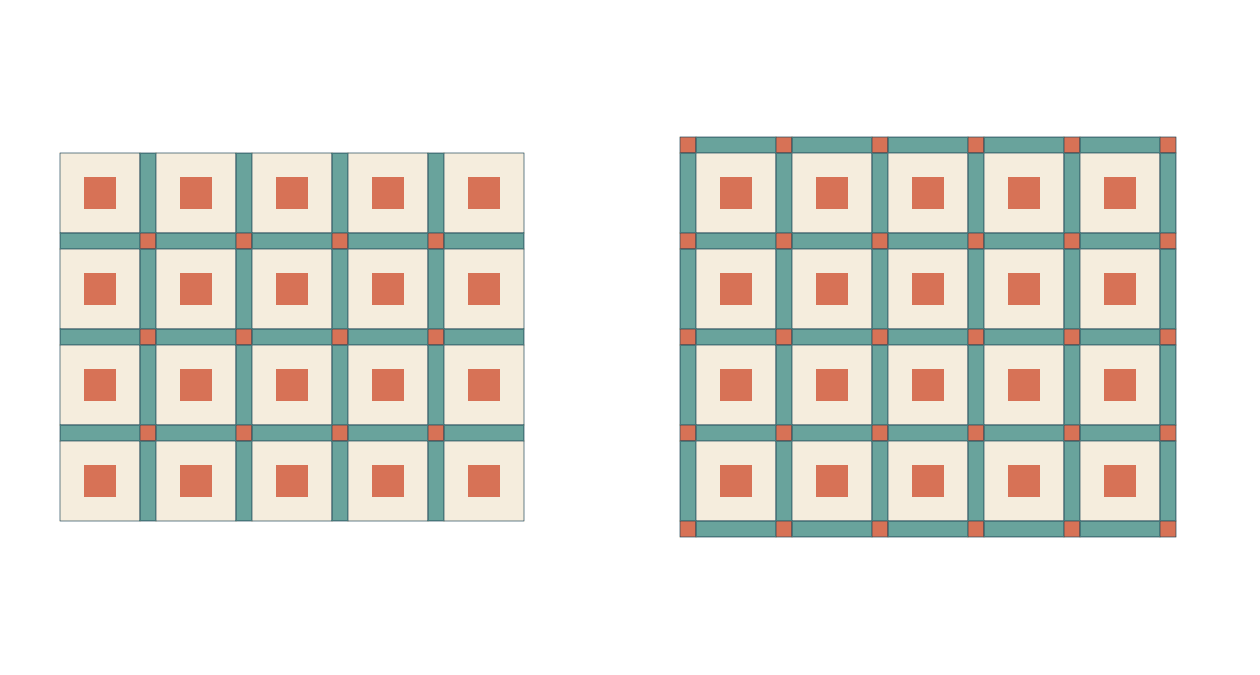
Make the cornerstone's finished square size match the finished sashing width. Then count the crossings on your map. With C block columns and R rows, internal sashing needs (C - 1) x (R - 1) cornerstones. Add a complete outer sashing frame and the count becomes (C + 1) x (R + 1).
For a five-column, four-row quilt with 10-inch blocks and 2-inch sashing, that means 12 cornerstones inside the block field, or 30 with the outer frame. The two maps below show how to count the strip segments too, so every square has a place before you cut.
Give the intersection square a clear job
A cornerstone occupies the square where horizontal and vertical sashing meet. It can repeat an accent from the blocks, make the intersections more visible or blend into the sashing so the frame reads continuously.
Ula's guide at Designed to Quilt distinguishes those intersection squares from the strips and explains that their finished size follows the sashing width. In this plan, a 2-inch-wide sashing strip meets a 2 x 2-inch finished cornerstone. The square fills the crossing; it is not extra space added on top of the strip widths.
Our block drawings contain larger coral squares at their centers. The smaller coral cornerstones repeat that accent fabric between blocks. The twenty block-center motifs are part of the blocks and are not included in the cornerstone count.
Elizabeth DeCroos's cornerstone guide at Epida Studio shows how an intersection accent can contribute to the larger design. It also presents two ways to organize assembly. Use her construction guide when choosing how to assemble the counted pieces.
Fix the width, then draw the two maps
The width remains 2 inches in both studies. If you are still choosing it, use the sashing-width comparison first. This article starts after that choice and focuses on intersections, perimeter pieces and counts.
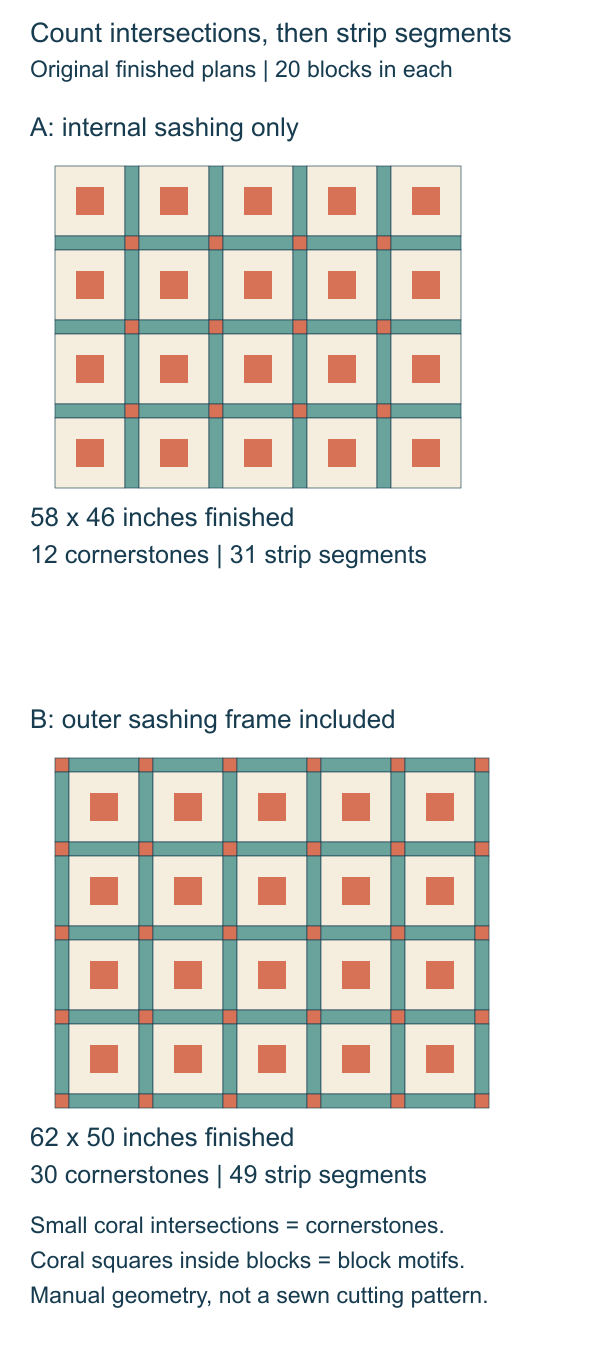
Plan A has sashing only between blocks. Its outside edges are the edges of the blocks themselves. Plan B also has sashing along all four outside edges, with cornerstones at the resulting perimeter intersections.
This is an outer sashing frame made from the same short-segment system. A separate border can be planned later; quilt border ideas covers that different design decision. No additional border is included in either map here.
Count the internal crossings and segments
Five columns leave four internal column gaps. Four rows leave three internal row gaps. A cornerstone sits wherever those two gap sets cross:
4 x 3 = 12 internal cornerstones.
Now count strip segments between blocks and cornerstones, rather than imagine each entire sashing line as one piece:
- Vertical segments: 4 rows x 4 column gaps = 16.
- Horizontal segments: 5 columns x 3 row gaps = 15.
- Total segments: 16 + 15 = 31.
Each drawn segment spans the 10-inch finished side of a block and is 2 inches wide. At every crossing, the 2-inch square is counted separately. Treating a line through several blocks as one segment would describe a different component breakdown.
For C columns and R rows, the corresponding internal counts are (C - 1) x (R - 1) cornerstones, R x (C - 1) vertical segments and C x (R - 1) horizontal segments. These formulas assume a regular rectangle of same-size blocks and a cornerstone at every crossing shown.
Add the perimeter once
With the outer sashing frame, five block columns have six sashing columns: four internally and one on each outside edge. Four block rows have five sashing rows: three internally and one at the top and bottom.
That gives 6 x 5 = 30 cornerstones. Another way to check it is to start with the twelve internal squares and count the additional perimeter positions:
- Six along the top and six along the bottom, including the outer corners: 12.
- Three remaining positions on the left and three on the right: 6.
- Added perimeter squares: 12 + 6 = 18; total 12 + 18 = 30.
The side count excludes the four outer corners because the top and bottom counts already include them. Counting those corners again would inflate the result.
Strip segments also change:
- Vertical segments: 4 rows x 6 sashing columns = 24.
- Horizontal segments: 5 columns x 5 sashing rows = 25.
- Total: 24 + 25 = 49.
| Component | Internal only | With outer sashing |
|---|---|---|
| Blocks | 20 | 20 |
| Cornerstones | 12 | 30 |
| Vertical strip segments | 16 | 24 |
| Horizontal strip segments | 15 | 25 |
For this framed arrangement, the general cornerstone count is (C + 1) x (R + 1). The segment counts are R x (C + 1) vertically and C x (R + 1) horizontally. Different perimeter treatments need their own map rather than borrowing these totals.
Check the dimensions and the component area
The internal plan measures:
- Width: (5 x 10) + (4 x 2) = 58 inches.
- Height: (4 x 10) + (3 x 2) = 46 inches.
The outer sashing adds 2 inches on each side, making 62 x 50 inches. Changing the cornerstone color would leave those dimensions unchanged, because the intersection cells still occupy the same space.
An area check helps catch a missed component. Each block contributes 100 square inches, each strip segment 20, and each cornerstone 4:
- Internal: (20 x 100) + (31 x 20) + (12 x 4) = 2,668, which equals 58 x 46.
- Framed: (20 x 100) + (49 x 20) + (30 x 4) = 3,100, which equals 62 x 50.
These are visible finished areas, not fabric purchasing amounts. Seams, joins, trimming, print direction and usable fabric width still affect a cutting and yardage plan. An area total does not measure those losses.
Keep nominal seam allowances separate
For straight pieces with nominal quarter-inch allowances, a cornerstone finishing at 2 inches would be cut 2 1/2 inches square. A 2 x 10-inch finished segment would nominally be 2 1/2 x 10 1/2 inches before joining. A block finishing at 10 inches would likewise measure 10 1/2 inches unfinished at its outside edges.
Those additions account for two quarter-inch allowances across each dimension. Check the assembled size after stitching and pressing.
The American Patchwork & Quilting editors' seam guide explains why checking a sewn sample matters. Measure the actual unfinished blocks, verify the chosen construction method and make a small sample before cutting a complete set.
Mark and check your own map
Write internal only or outer sashing included beside the diagram. Record five columns, four rows, 10-inch finished blocks, 2-inch finished strips and a cornerstone at every shown crossing. Keep the component counts with that specific map.
Keep the strip and cornerstone counts on your worksheet. QuiltLab has no dedicated sashing/cornerstone control or automatic cutting list; the Quilt Editor guide shows its supported layout measurements.
For different sampler blocks, sampler quilt layouts helps you settle the common block footprint and setting first. Once the arrangement is fixed, trace every intersection and edge on your own map. The count should follow the drawn pieces, including the perimeter choice you actually intend to make.
Related posts
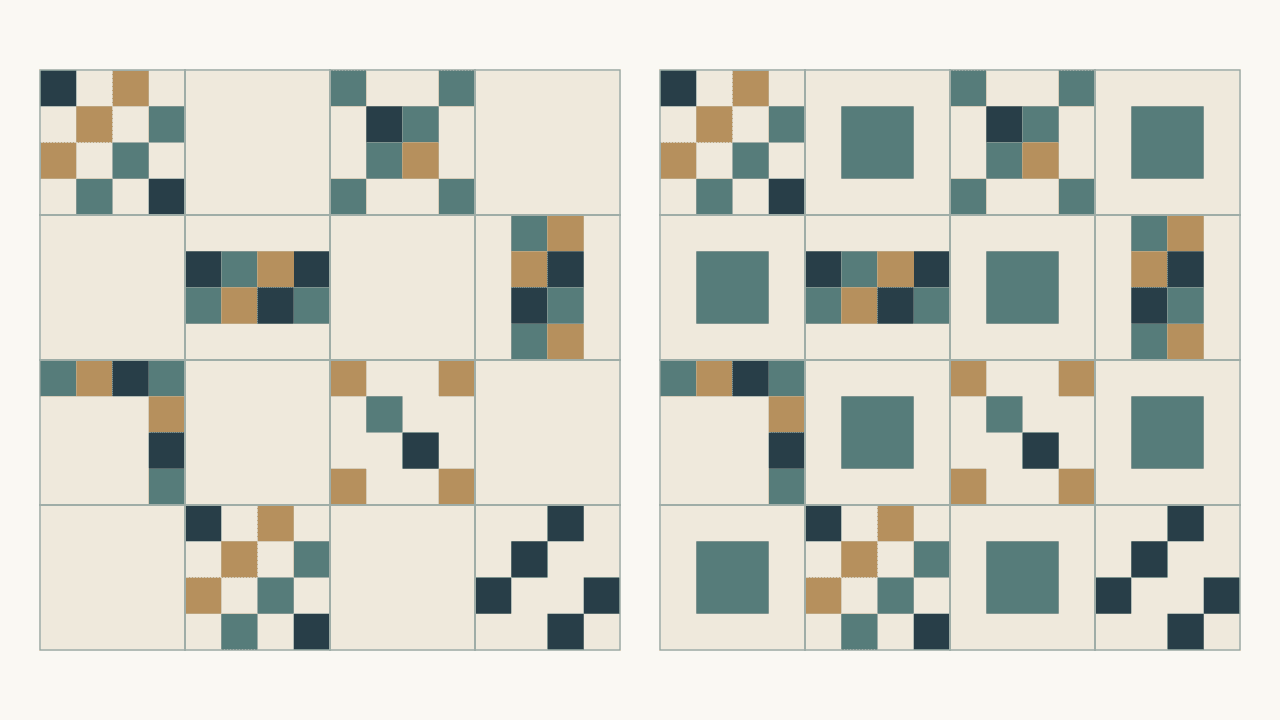
Alternate Blocks for Sampler Quilts: Plain or Pieced?
Plain alternate blocks give a busy sampler room to breathe; a simple repeated block adds rhythm. See how each changes your block count and quilt size.
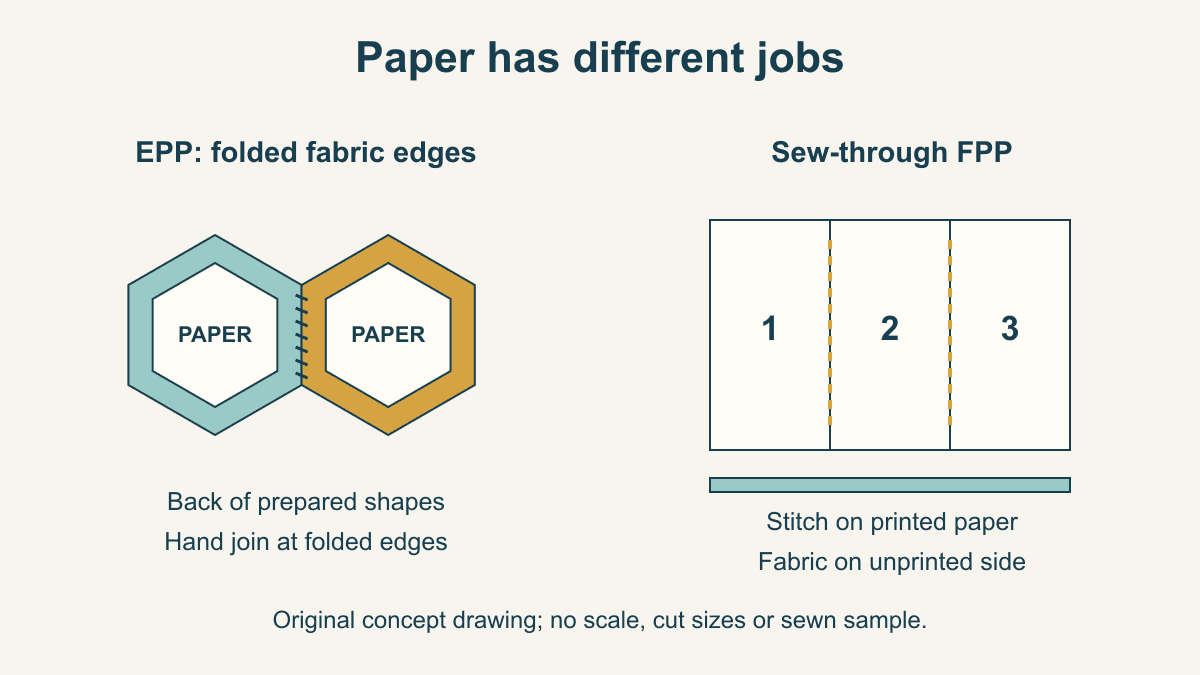
English vs Foundation Paper Piecing: Which Should You Try?
Compare what the paper does, where stitching happens and which project brief suits EPP or sew-through FPP before choosing a pattern.
Log Cabin Strip Width: How Wide Should Logs Be?
Most Log Cabin strips are cut 1 1/2 to 2 1/2 inches wide. See how each width changes block size, the center's weight and the number of seams.