


Quilted Table Runner Size: How Long and Wide Should It Be?
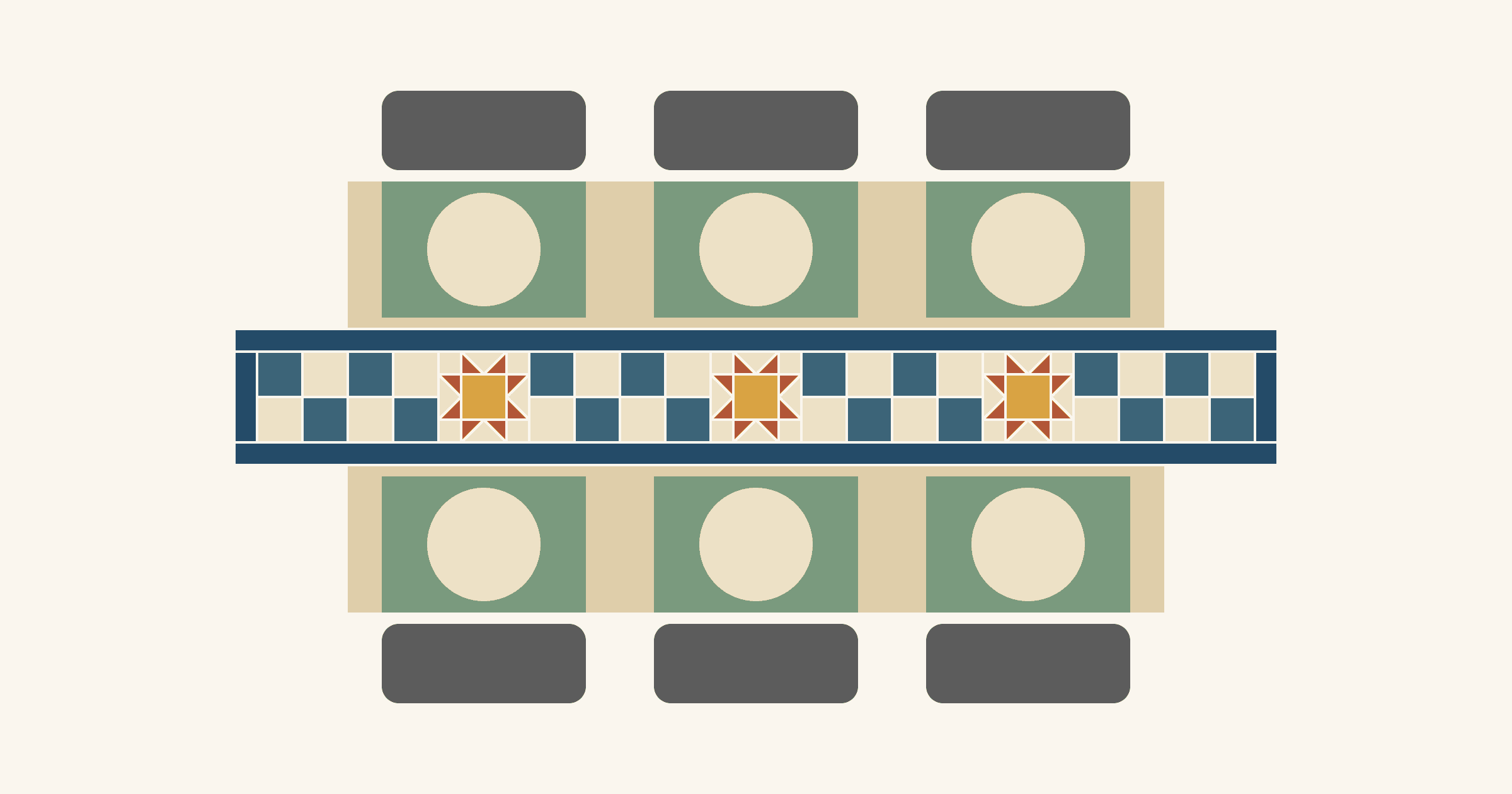
Most table runners are 12 to 18 in wide and hang 6 to 12 in past each end of the table, according to party-linen supplier CV Linens' runner fit guide. On a 6 ft (72 in) table, that means a runner 84 to 96 in long. A quilted runner has two more limits: it has to fit between the place settings, and its length has to come out in whole blocks.
For a dining table, make the runner about one-third as wide as the table, but no wider than the clear strip between the placemats. Aim for a drop of 9 or 10 in, near the middle of the range, so washing doesn't pull it short. Then pick a block size that divides evenly into the spacing between chairs, so a feature block can sit in front of every seat. Below we work all of it out for a 72 x 38 in table that seats six.
Measure the table you have
Runner patterns are written for someone else's table. Before you choose one, or draw your own, write down four things:
- Table length and width. Measure the tabletop itself.
- Placemat depth. How far your placemats reach in from the edge. If you set the table without them, measure to the far side of a dinner plate.
- Chair spacing. Center to center along each long side.
- End seats. Whether anyone sits at the ends of the table.
Amy Smart of Diary of a Quilter sizes the runner in her quilted table runner tutorial by taking the batting to her own table. As she puts it, "you can make any size quilted table runner you want."
Our example table is 72 x 38 in. Three chairs sit on each long side, 24 in apart, so their centers fall 12, 36 and 60 in from one end. The placemats are 12 x 18 in, and nobody sits at the ends.
How wide should a quilted table runner be?
CV Linens says party decorators typically use a runner about one-third the width of the table, wide enough for the base of a centerpiece but not so wide that it overlaps the placemats. Check both limits:
- One-third of 38 in is 12 2/3 in.
- Two 12 in deep placemats take 24 in, which leaves 38 - 24 = 14 in clear down the middle.
A 12 in runner fits both, with 1 in of bare table between the runner and each placemat. We built that 12 in from an 8 in block and a 2 in border on each side: 8 + 2 + 2 = 12. A 10 in block with 1 in borders, or a 12 in block with no border, comes out at the same width.
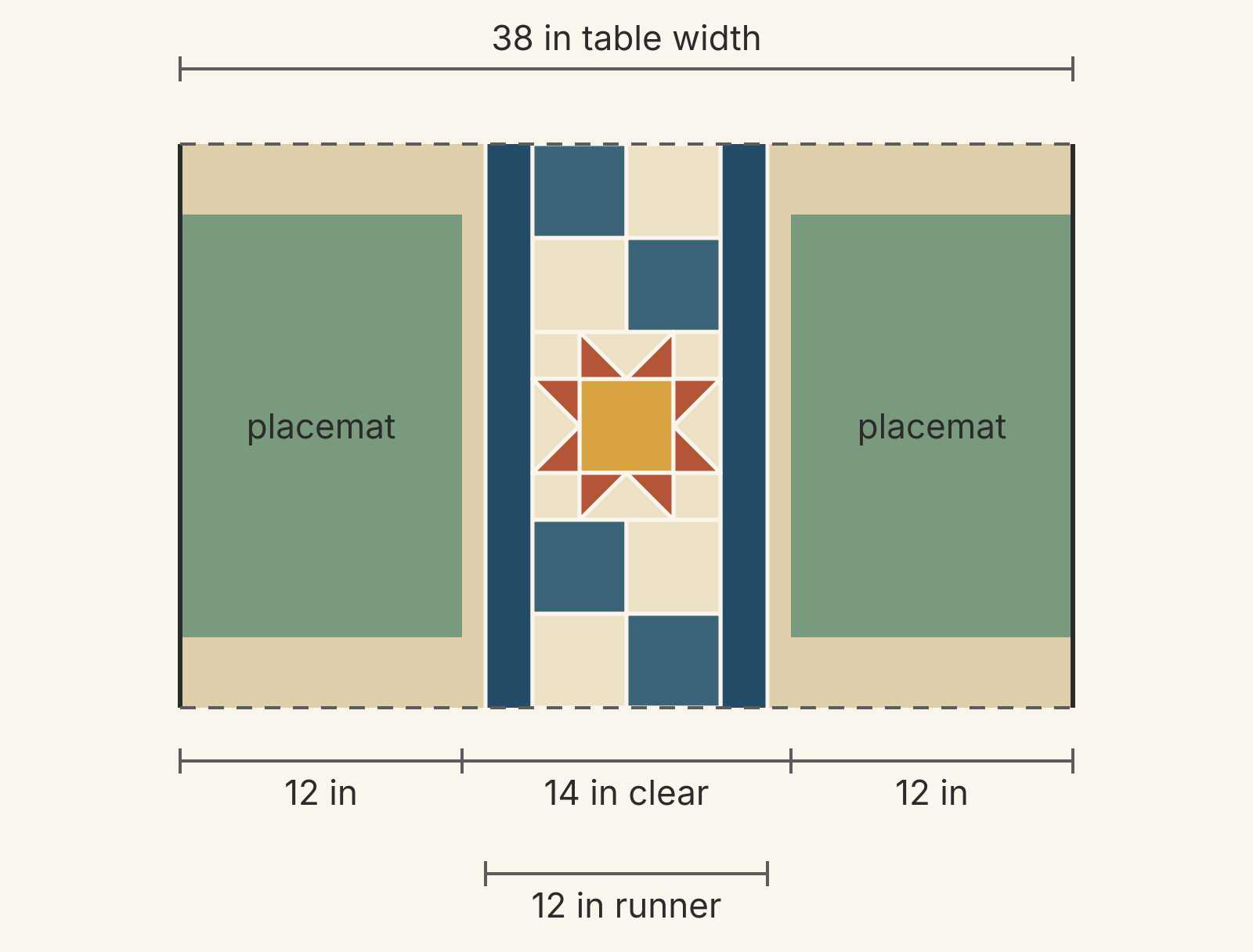
If your placemats are deeper or your table is narrower, the clear strip shrinks, and the strip wins over the one-third rule. On a 36 in table with the same placemats, only 12 in stays clear, so a 12 in runner would touch the placemats along both edges. Go down to a 10 in runner there, such as an 8 in block with 1 in borders, to keep an inch of bare table on each side.
How long should a quilted table runner be?
Runner length = table length + two drops. With CV Linens' 6 to 12 in drop, our 72 in table takes a runner between 84 and 96 in long.
Quilt designer Faith Jones of Fresh Lemons Quilts shows the same math in her Sugarplum Table Runner on WeAllSew. It finishes 12 x 84 in from seven 12 in blocks, which leaves a 10 in drop on each end of her 64 in table. To change the length, she suggests removing blocks, adding blocks, or adding equal sections of background fabric between them.
If someone sits at the end of your table, a drop lands in their lap. In that case, plan a runner that stays on the tabletop.
Fit whole blocks into the length
A runner's length is its block count times the block size, plus the two end borders. With 8 in blocks and 2 in borders:
| Blocks | Runner length | Drop each end | Table edge falls |
|---|---|---|---|
| 10 | 84 in | 6 in | Mid-block |
| 11 | 92 in | 10 in | On a seam |
| 12 | 100 in | 14 in | Mid-block |
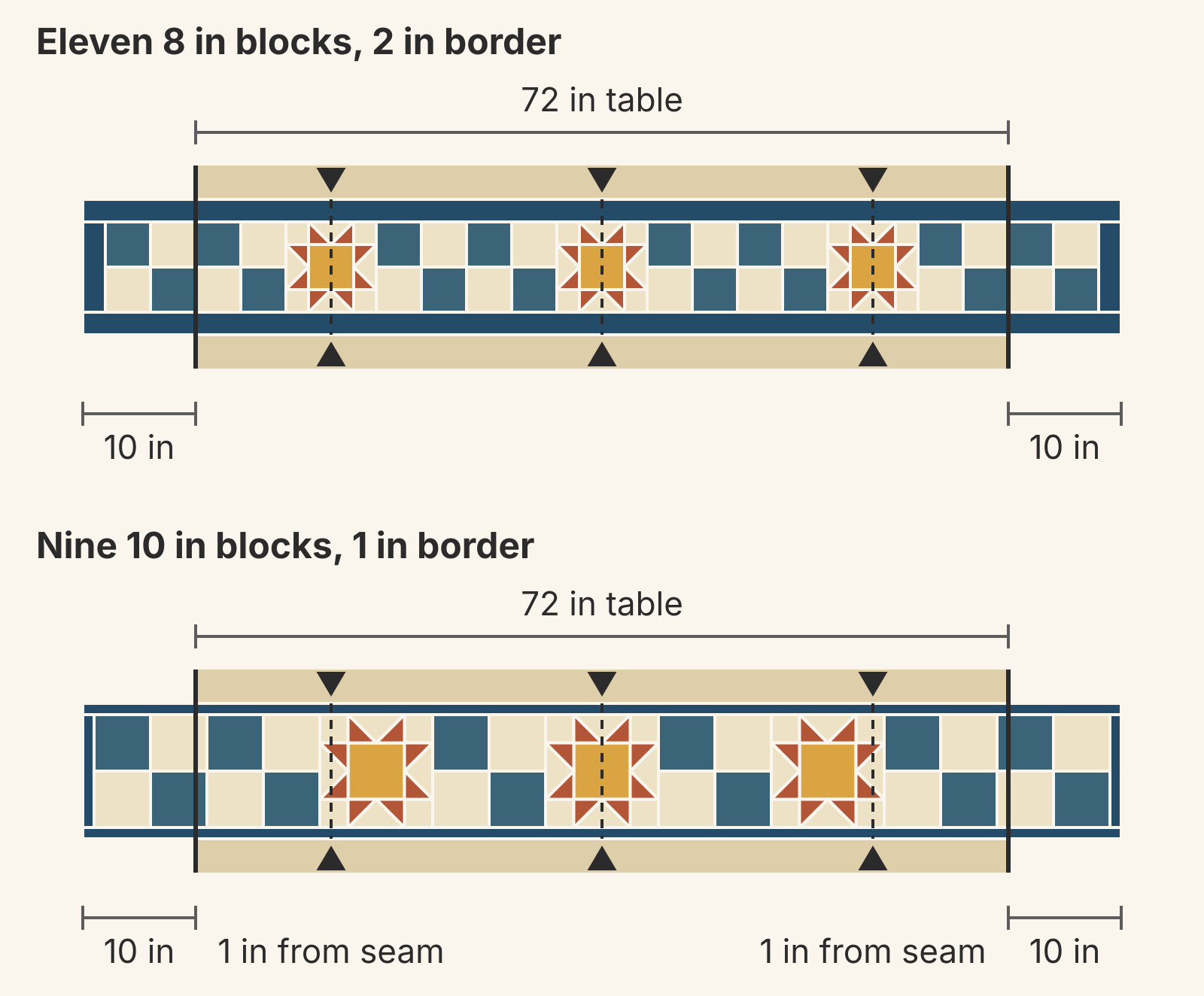
Twelve blocks hang too far. Ten fit, but the 6 in drop sits at the bottom of the range. Eleven blocks make a 12 x 92 in runner with a 10 in drop, and that drop is exactly one 2 in border plus one 8 in block. Each table edge lands on a seam, so the end blocks hang down whole and the other nine blocks (9 x 8 = 72 in) cover the tabletop.
The same check works for any block size. Subtract the end border from the drop. If what's left is a whole number of blocks, the table edge falls on a seam.
Line the blocks up with the chairs
Our chairs sit 24 in apart, and the middle one sits at the center of the table. Any block size that divides evenly into 24 (6, 8 or 12 in, for example) repeats in step with the chairs. With an odd number of blocks, one block sits at the center of the table, in front of the middle chair, and the other chairs land on block centers too.
| Block | Border | Blocks per 24 in | Lines up with chairs |
|---|---|---|---|
| 6 in | 3 in | 4 | Yes |
| 8 in | 2 in | 3 | Yes |
| 10 in | 1 in | 2 2/5 | No |
| 12 in | none | 2 | Yes |
In our 11-block runner, blocks 3, 6 and 9 sit exactly in front of the chairs. That's where we put the feature blocks, 8 in Sawtooth Stars, with simpler Four Patches between them. If a centerpiece will cover the middle block, you can swap that star for a plainer one.
Nine 10 in blocks with 1 in borders also make a 12 x 92 in runner. But 10 in doesn't divide into 24 in. The middle chair faces a block center, while the two outer chairs sit 1 in from a seam. The table edges also cut across the end blocks, so 1 in of each end block lies on the table and the rest hangs down.
With two or four chairs a side, the center of the table falls between two chairs. For 8 in blocks and 24 in spacing, use an even number of blocks: a seam then sits at the center, and a block center lands in front of every chair. For other sizes, draw the table to scale on graph paper, mark each chair center and check where the block centers land.
A runner is seen from both long sides of the table, so a block with an obvious top reads upside down to half the diners. Stars and Four Patches look the same from either side, which is one reason they suit runners.
For more on how block size changes piece size and the work involved, see choosing quilt block size. For other border widths and corners, see quilt border ideas.
Leave room for shrinkage
Washing shortens a quilted runner. Amy Smart warns in the same tutorial that a runner "will shrink when you wash it," and suggests cutting a little bigger. The Warm Company says Warm & Natural batting shrinks about 3% the first time it's washed.
At 3%, our 12 x 92 in runner comes out near 11 5/8 x 89 1/4 in, and each drop goes from 10 in to about 8 5/8 in. That's still inside the 6 to 12 in range. The 10-block runner's 6 in drop would shrink to about 4 3/4 in, which is why we aimed for 10. The seams that met the table edges also move about 1 in onto the tabletop. Unwashed fabric can shrink as well. With prewashed fabric and a low-shrink batting, plan on less change; the same FAQ puts Warm & White at about 0 to 1%. Our guide to deciding whether to prewash quilt fabric covers when washing first is worth it.
When the runner should stay on the table
If people sit at the ends, or you just prefer a bare edge, keep the runner on the tabletop. Use an odd number of blocks again, so the repeat stays centered on the chairs.
Seven 8 in blocks with 2 in borders make a 12 x 60 in runner. That leaves 6 in of bare table at each end, and the chairs face blocks 1, 4 and 7.
A round table works the same way across its diameter. Measure straight through the center, add two drops or leave the ends bare, and then fit whole blocks into that length.
Plan the layout before you cut
Take the four notes from your own table, then work out two numbers: the width budget (table width minus two placemat depths) and the length in whole blocks. Check both against the chairs before you cut any fabric. Plan the long borders too. On a 92 in runner they run 88 in or more, longer than any strip cut across the width of fabric, so join strips or cut them along the length. Mitered corners take longer strips still; our comparison of mitered and butted borders shows how to work out their length.
To see the layout at full length, open the Quilt Editor and start a Grid quilt. In Layout, set 1 column, 11 rows and 8 in blocks. Then choose Add border under Borders and set its Finished width to 2. The status bar shows the quilt top as 8 x 88 in and the overall size as 12 x 92 in. Place your feature block in rows 3, 6 and 9 and the simpler block everywhere else. QuiltLab doesn't work out yardage, cutting or binding, so take those from your finished sizes. You can do all of this on the Free plan.
Quilt Editor guide →Set rows, columns, block size and borders, and read the finished sizeRelated posts
How to Design a Bargello Quilt: Plan the Wave on Paper
A bargello wave is a staircase of stepped columns. Number your strips, write one row per column, and see how column width turns a zigzag into a curve.
Borderless Quilt Design: Plan an Edge That Looks Finished
With no border, the outer blocks and the binding make the edge. Compare whole and halved motifs on one 48 x 60 inch quilt, then pick the binding color.
Crosshatch Quilting: How to Make the Lines Meet at the Edges
Space a 45-degree crosshatch so the lines meet in a V at every edge and corner. Choose the edge step first, mark dots around the quilt, then connect them.