


Finished vs Unfinished Size: Why Triangle Unit Charts Disagree
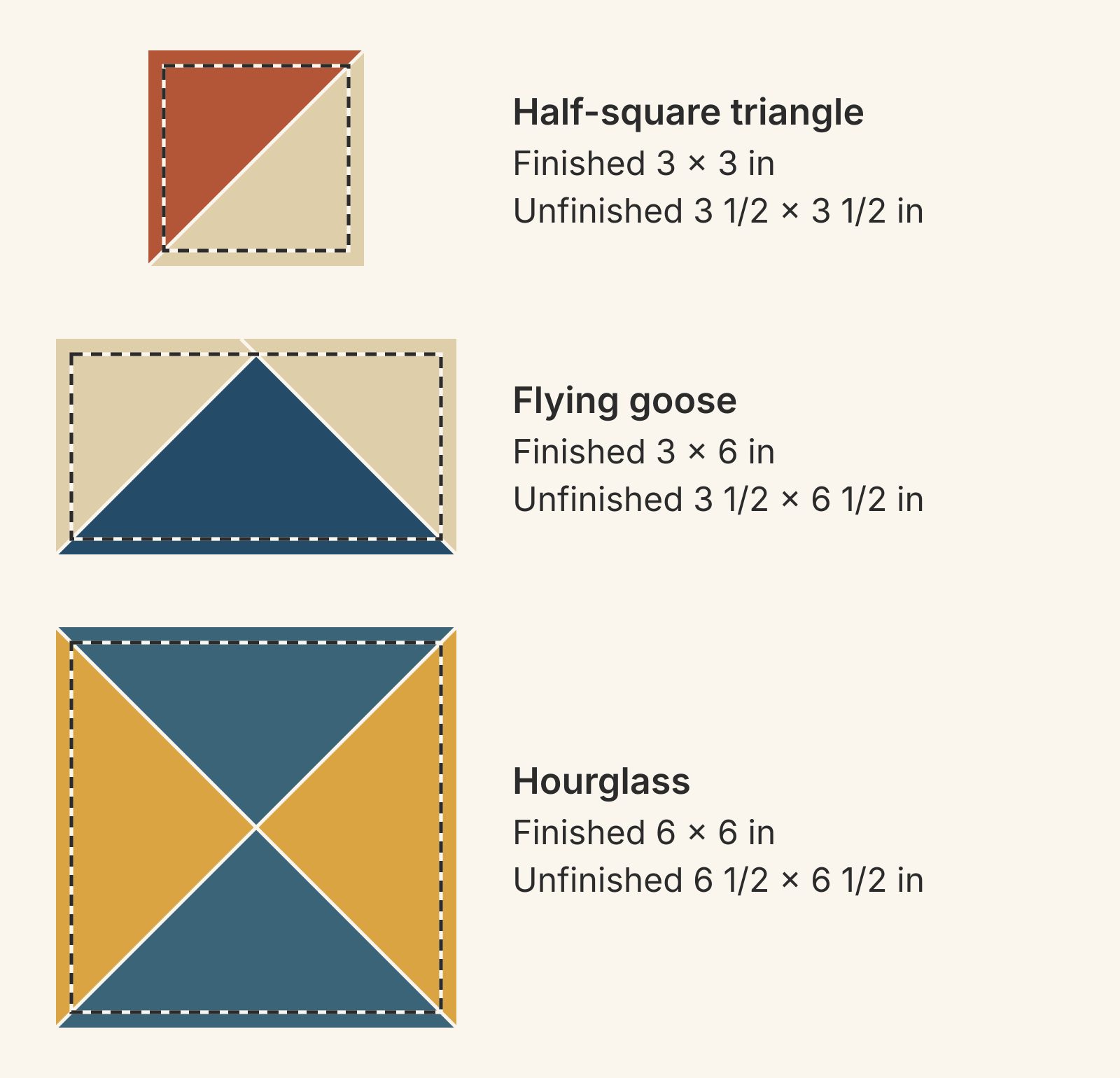
A triangle unit's unfinished size is its finished size plus 1/2 inch in each direction. That half inch is a 1/4-inch seam allowance on every side. A half-square triangle (HST) that finishes at 3 inches measures 3 1/2 inches before you sew it to anything, as both Sarah Stearns's HST charts and the Thangles FAQ put it. A 3 x 6-inch flying goose measures 3 1/2 x 6 1/2, and a 6-inch hourglass measures 6 1/2.
The cut size is a third number, and it's the one that changes from chart to chart. Stearns's own charts list 3 7/8, 5 1/2 and 7 3/4-inch starting squares for the same 3-inch HST, one for each method. When two charts disagree, translate both to the finished size first. Then take your cut sizes from one method, and check each sewn unit against its unfinished size before it goes into a block.
One unit, three sizes
Every triangle unit has three measurements, and patterns use all three.
| Size | What it measures | 3-inch HST |
|---|---|---|
| Finished | The unit inside its seams, once it's sewn into the quilt | 3 x 3 in |
| Unfinished | The unit before it's joined to anything; also called the trim size | 3 1/2 x 3 1/2 in |
| Cut | The fabric you start with | 3 7/8 in squares for two at a time; other methods differ |
The step from finished to unfinished is the same half inch for every unit shape, because the outside seams are the same. The cut size has more to cover. It also pays for the diagonal seams inside the unit, and each method sews those seams differently.
Why two charts give different numbers for the same unit
It's usually one of four things.
The chart names a different size. One chart's "3-inch HST" row means 3 inches finished. A pattern that says "make sixteen 3 1/2-inch HSTs" means the same unit, measured unfinished. Mix them up and you're half an inch off. An HST trimmed to 3 inches finishes at 2 1/2.
The chart is for a different method. In every one of Stearns's charts, the 3-inch row is the same HST, 3 1/2 inches unfinished. Only the starting squares change with the method: 3 7/8 inches for two at a time, 5 1/2 for four at a time and 7 3/4 for eight at a time. Her strip method uses a 3 1/2-inch strip instead. Bigger squares make more units, and the unit stays the same.
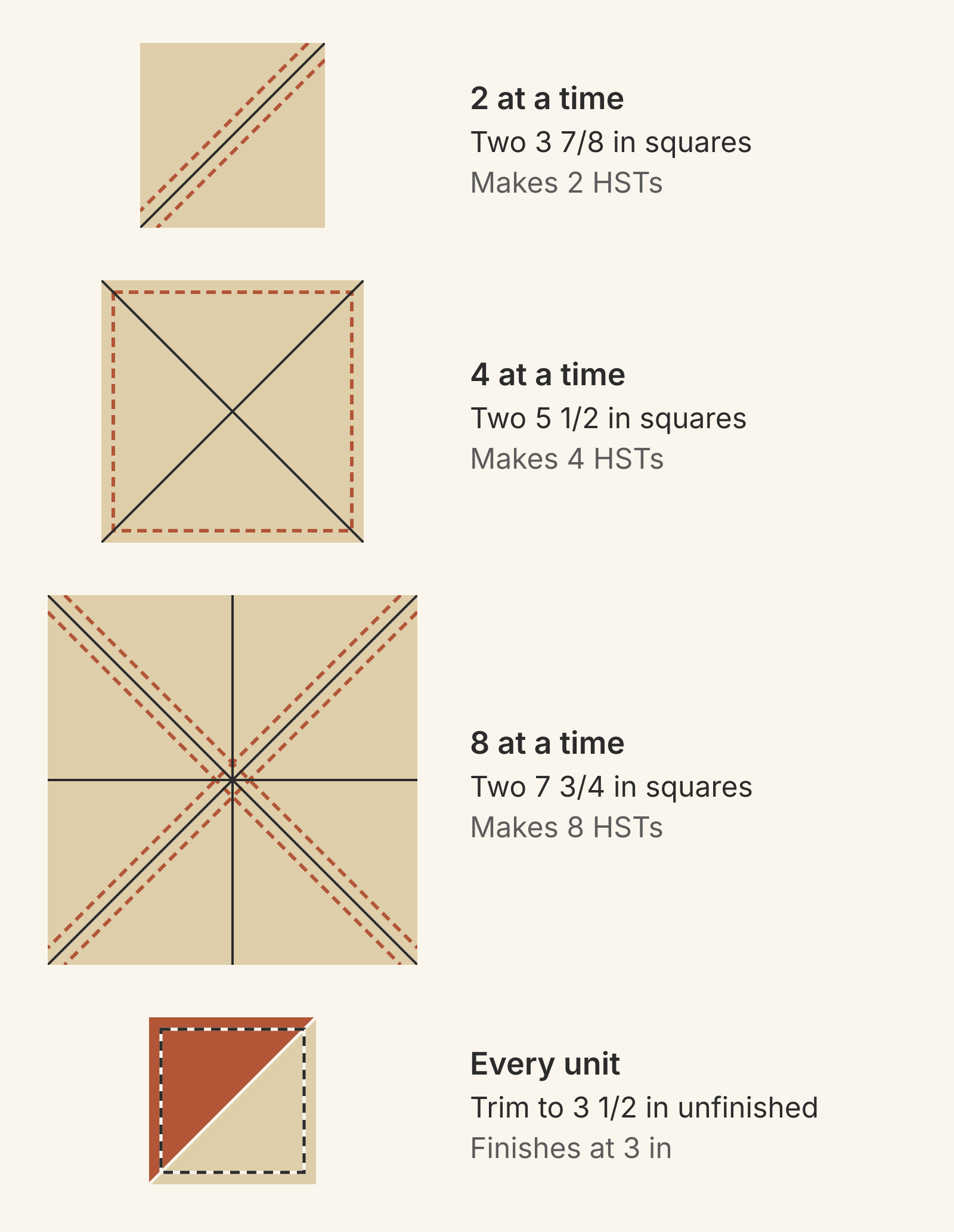
One chart cuts to size and the other cuts big to trim. For two-at-a-time HSTs, the usual rule is finished size + 7/8 inch, which leaves almost nothing to trim. Some designers cut finished + 1 inch and trim instead. The Thangles FAQ works through both: 3 7/8-inch squares make a 3-inch finished HST, and 3-inch squares trimmed to 2 1/2 make a 2-inch one. Hourglass units split the same way. Lynn Woll at Create Whimsy cuts two squares 1 1/4 inches larger than the finished size, so 4 1/4-inch squares for a 3-inch hourglass. In her hourglass lesson on The Quilt Show, Julie Cefalu starts with squares 1 1/2 inches larger and trims. For the same 3-inch hourglass, her rule gives 4 1/2-inch squares. Our hourglass size chart lists both rules side by side for units from 2 to 6 inches.
Flying geese have two numbers, in either order. Marcia Hohn's flying geese page at Quilter's Cache notes that a goose is twice as wide as it is tall. "2 x 4" and "4 x 2" describe the same goose, and the larger number is the width along its base. Her 2 x 4-inch finished goose starts from a 2 1/2 x 4 1/2-inch rectangle and two 2 1/2-inch squares one at a time, or from one 5 1/4-inch square and four 2 7/8-inch squares four at a time. So the same goose can show up in a chart as 2 x 4, 2 1/2 x 4 1/2, or 5 1/4 and 2 7/8, depending on which size the chart lists.
Work back from any number to the finished size
Start with the pattern's own words. "Finished," "unfinished," "trim to," "measures" and "cut" each name a size. When a chart or pattern gives a bare number, these clues usually settle it.
| You see | It's usually | Finished size |
|---|---|---|
| HST squares ending in 7/8, such as 3 7/8 in | Cut size, two at a time | Subtract 7/8: 3 in |
| HST "trim to" or "measures" 3 1/2 in | Unfinished size | Subtract 1/2: 3 in |
| Goose 2 1/2 x 4 1/2 in | Unfinished size, or the one-at-a-time rectangle | Subtract 1/2 each way: 2 x 4 in |
| Goose from a 5 1/4 in square and four 2 7/8 in squares | Cut sizes, four at a time | 5 1/4 - 1 1/4 = 4 wide; 2 7/8 - 7/8 = 2 tall |
| Hourglass squares ending in 1/4, such as 4 1/4 in | Cut size, two at a time | Subtract 1 1/4: 3 in |
The Thangles FAQ uses the first row to match any pattern to its papers: subtract 7/8 from the cut size and you have the finished size.
The goose ratio is a second check. A standard goose finishes exactly twice as wide as it is tall, so 3 1/2 x 6 1/2 can't be a finished size. Its finished size, 3 x 6, fits the ratio.
Translate a sample list of HST, geese and hourglass sizes
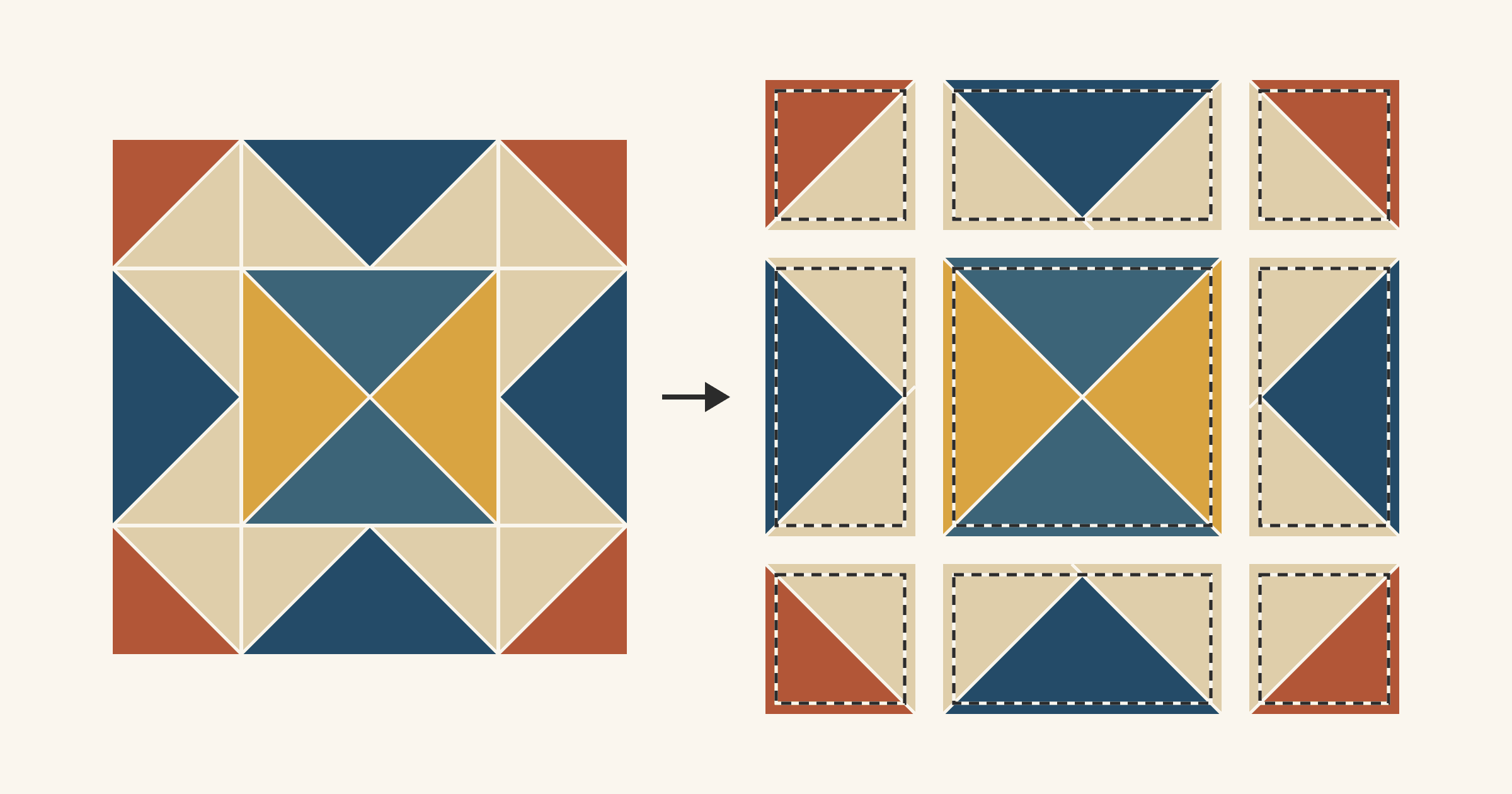
Here's a sample list of the kind you get when you work from a pattern, a chart and a friend's notes at once. We wrote it to mix all three kinds of numbers. It's for a 12-inch finished block with HSTs in the corners, flying geese on the sides and an hourglass in the center.
- Corners: 4 HSTs from 3 7/8-inch squares.
- Sides: 4 flying geese, 3 1/2 x 6 1/2 inches.
- Center: one 6-inch hourglass.
| Unit | As written | Finished | Unfinished |
|---|---|---|---|
| Corner HST | 3 7/8 in squares (cut) | 3 x 3 in | 3 1/2 x 3 1/2 in |
| Side goose | 3 1/2 x 6 1/2 in (unfinished) | 3 x 6 in | 3 1/2 x 6 1/2 in |
| Center hourglass | 6 in (finished) | 6 x 6 in | 6 1/2 x 6 1/2 in |
Here's how each line gives itself away:
- HSTs: the 7/8 ending marks a two-at-a-time cut size, and 3 7/8 - 7/8 = 3 inches finished.
- Geese: 3 1/2 x 6 1/2 isn't twice as wide as tall, so it's the unfinished size.
- Hourglass: the block finishes at 12 inches and each corner at 3, which leaves 12 - 3 - 3 = 6 finished inches for the center.
Now choose one method per unit and take its cut sizes. The HST row keeps the list's own 3 7/8-inch squares, and the hourglass row uses Woll's 1 1/4-inch rule. Hohn's goose formulas give the geese rows. One at a time, the rectangle is the goose's unfinished size and each square is half the finished width + 1/2 inch. Four at a time, the large square is the finished width + 1 1/4 inches and the small squares are the finished height + 7/8 inch. If you're not sure which goose method suits your fabrics, compare one at a time and four at a time.
| Unit | Method | Cut | Makes |
|---|---|---|---|
| HST | Two at a time | 2 light and 2 dark squares, 3 7/8 in | 4 |
| Goose | One at a time | 4 rectangles 3 1/2 x 6 1/2 in and 8 squares 3 1/2 in | 4 |
| Goose | Four at a time | 1 square 7 1/4 in and 4 squares 3 7/8 in | 4 |
| Hourglass | Two at a time | 1 light and 1 dark square, 7 1/4 in | 2, with 1 spare |
These cuts leave almost nothing to trim. If your 1/4-inch seam still wanders, cut big instead: 4-inch HST squares and 7 1/2-inch hourglass squares, trimmed to the unfinished sizes above.
Look down the cut column. The 3 7/8-inch squares show up for both the HSTs and the four-at-a-time geese. The 7 1/4-inch squares show up for the geese and the hourglass. The shapes explain it. The goose's big triangle and each quarter of the hourglass are the same quarter-square triangle, long side on the unit's edge, so both get 1 1/4 inches. The goose's small sky triangles are half-square triangles, like an HST's halves, so both get 7/8. A cut size alone can't tell you which unit it's for. Label each stack with its unit as well as its size.
Check the units before you sew the block
Measure each unit against its unfinished size before you join it: 3 1/2 inches for the HSTs, 3 1/2 x 6 1/2 for the geese and 6 1/2 for the hourglass. Units that share a full edge should match along it. Each HST is as tall as the goose beside it, 3 1/2 inches. The goose's long side matches the hourglass at 6 1/2.
Then check the rows:
- Top row: HST, goose and HST add up to 3 1/2 + 6 1/2 + 3 1/2 = 13 1/2 inches. Two seams take 1/2 inch each, which leaves 12 1/2 inches.
- Middle row: goose, hourglass and goose give the same 12 1/2 inches, and the row is 6 1/2 inches tall.
- Rows stacked: 3 1/2 + 6 1/2 + 3 1/2 - 1 = 12 1/2 inches.
The block measures 12 1/2 inches unfinished and finishes at 12: 3 + 6 + 3.
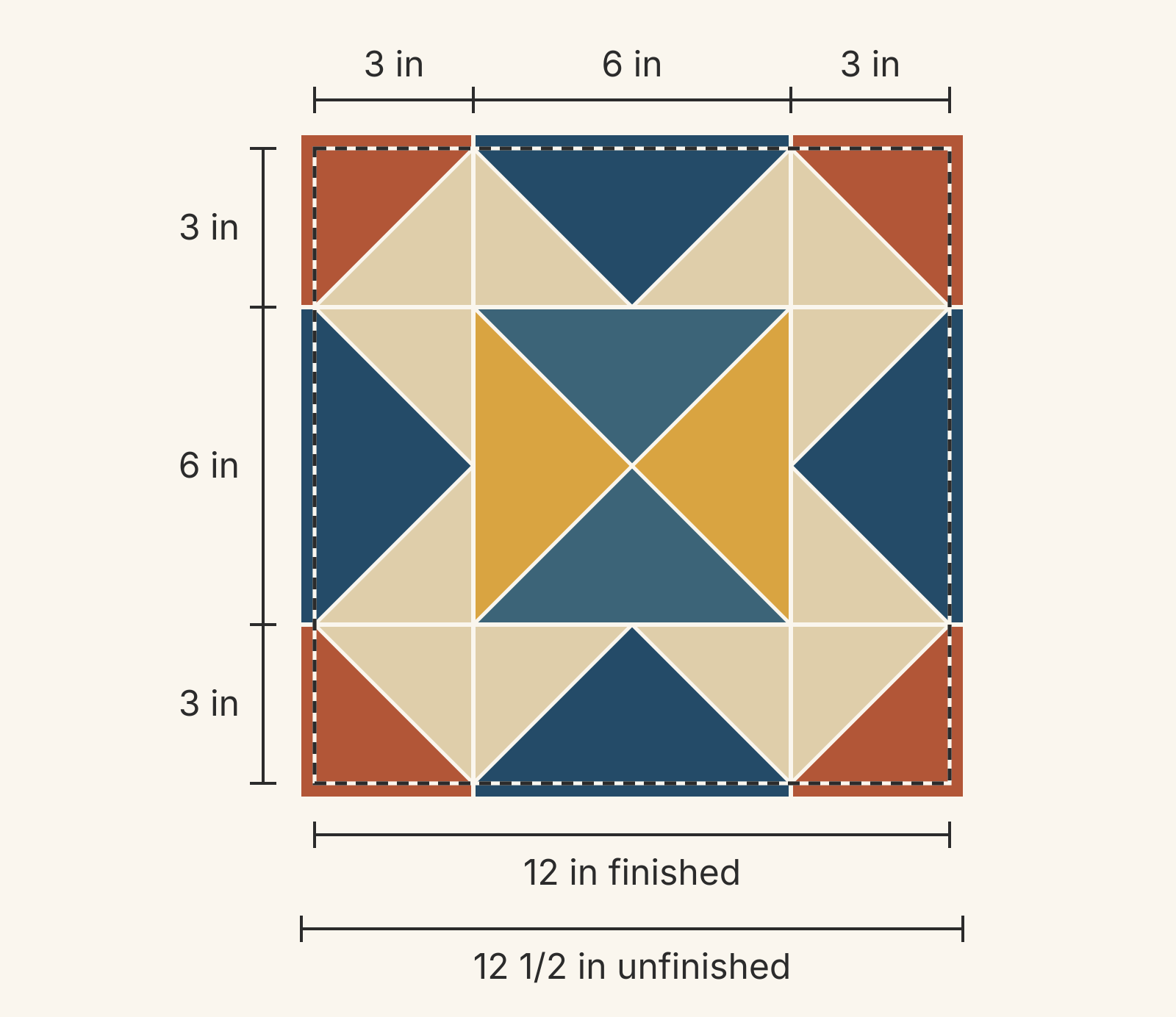
If a unit comes out half an inch small, it was probably trimmed to its finished size. Four HSTs trimmed to 3 inches would make a top row of 3 + 6 1/2 + 3 - 1 = 11 1/2 inches, an inch shorter than the middle row. On a goose, the point should sit on the finished line, 1/4 inch in from the raw edge, so the seam lands right on it.
Plan in finished sizes, then cut from one chart
Before you cut, write your plan in finished sizes. Pick one method for each unit and copy its cut sizes into your notes, with the unfinished size beside each one so you know what to trim to. When another chart or pattern disagrees with your notes, translate its numbers back to finished before you change anything. For the starting-square math behind the HST rules, see two-at-a-time HSTs and the eight-at-a-time batch plan. How to read a quilt pattern covers the same three sizes for plain squares, rectangles and whole quilts.
The QuiltLab Block Editor doesn't work out cut sizes for triangle units, so keep the unfinished and cut columns in your notes. It's a good place for the finished half of the plan. Draw the sample block at 12 inches with its units at their finished sizes, then select a piece to check its width and height in inches. When you place the block in the Quilt Editor, the Layout section of Properties shows the quilt's finished size.
Draw the block at finished size →Block Editor guide: draw pieces, check their dimensions and save the blockRelated posts
How to Design a Bargello Quilt: Plan the Wave on Paper
A bargello wave is a staircase of stepped columns. Number your strips, write one row per column, and see how column width turns a zigzag into a curve.
Borderless Quilt Design: Plan an Edge That Looks Finished
With no border, the outer blocks and the binding make the edge. Compare whole and halved motifs on one 48 x 60 inch quilt, then pick the binding color.
Crosshatch Quilting: How to Make the Lines Meet at the Edges
Space a 45-degree crosshatch so the lines meet in a V at every edge and corner. Choose the edge step first, mark dots around the quilt, then connect them.