


Crumb Quilt Blocks: How Small Can the Scraps Be?
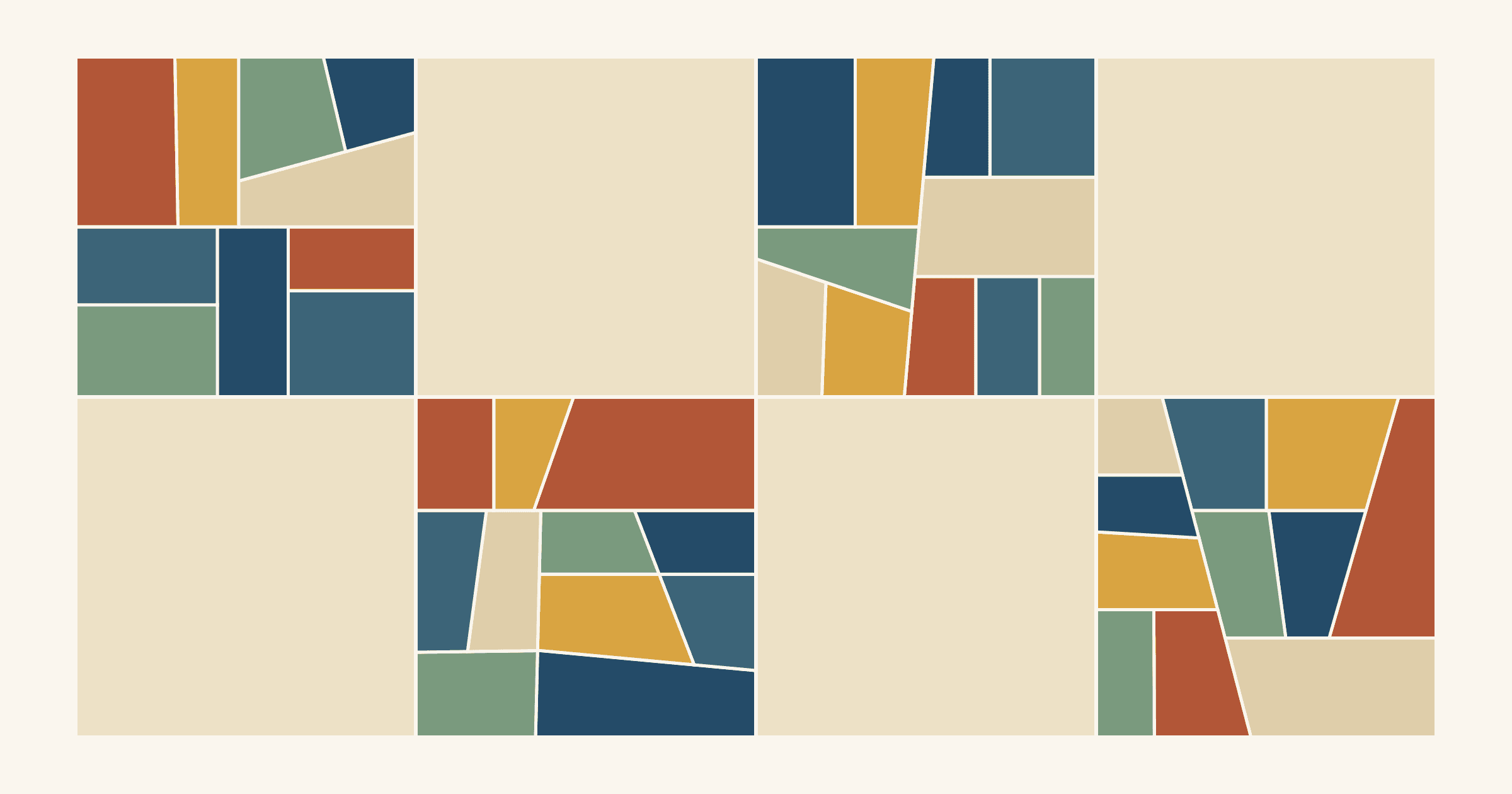
Crumb quilting tutorials commonly put the smallest scrap between 1 and 1 1/2 inches. Kristen Hubert of Scrap Fabric Love says a crumb is typically smaller than 2 1/2 in square and at least 1 in wide. Jean Boyd's QUILTsocial tutorial starts crumb blocks with scraps as small as 1 1/2 in square. At 1 inch and below, the seams start to take over. With a 1/4 in seam on every side, a 1 in square shows only a 1/2 in square, a quarter of the fabric you sewed.
For your first crumb quilt blocks, use a 1 1/2 in floor. Every piece you sew should hold a 1 1/2 in square, so at least 1 in of it shows. Drop to 1 in when you want a finer texture. A block sewn from crumbs that small has more than twice the seams. Below, we work out what small crumbs cost in a 6 in block and in a 48 x 60 in lap quilt. We drew these diagrams for this article and haven't sewn them.
What does a 1/4 in seam take from a small scrap?
Every edge of a crumb gets sewn. A piece in the middle of a block is joined on all sides. A piece on the block's edge loses its outer 1/4 in when the block is joined to its neighbor. So every piece shows 1/2 in less than its cut size, in both directions.
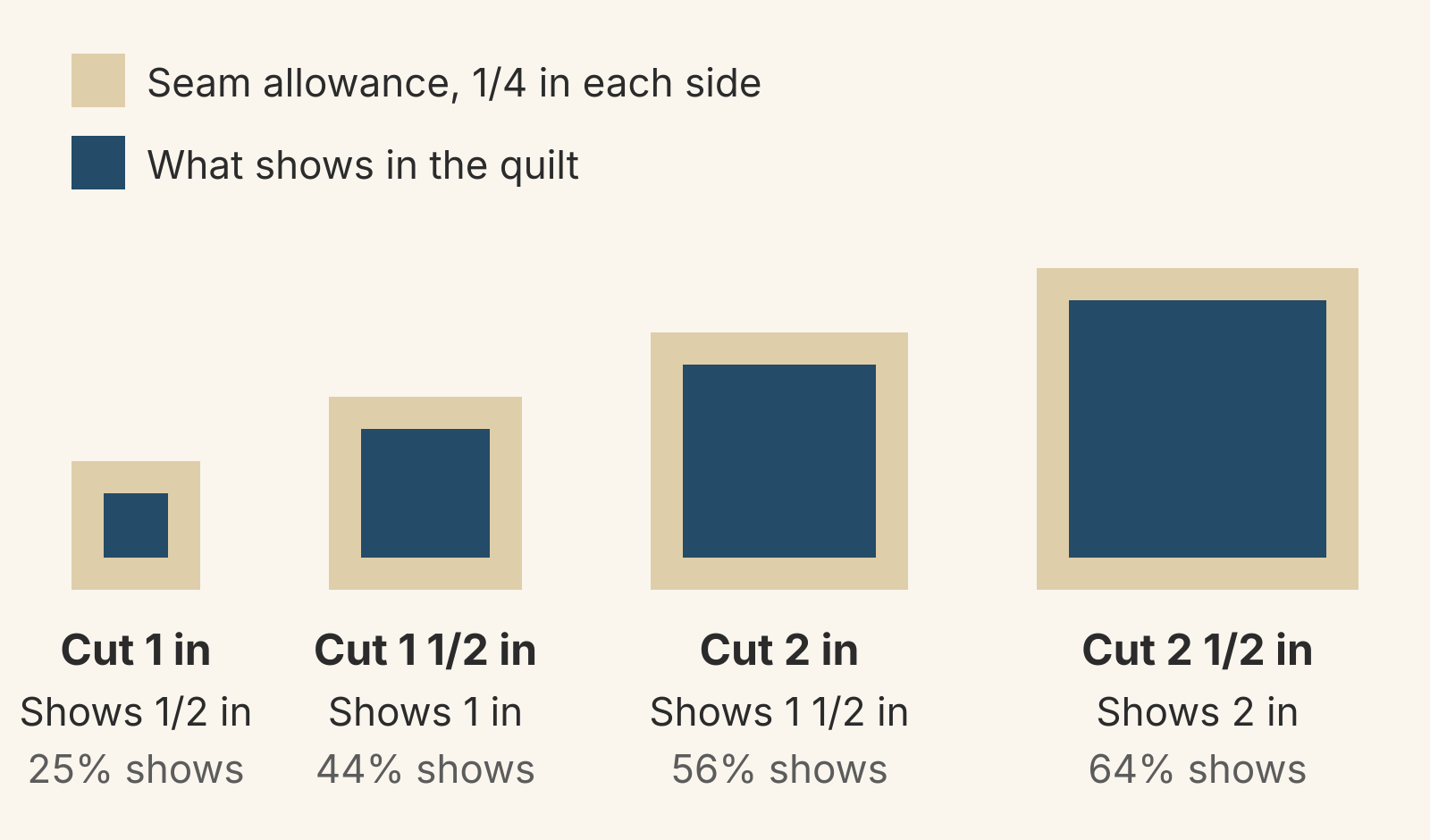
| Cut square | Shows | Share that shows |
|---|---|---|
| 1 in | 1/2 in | 25% |
| 1 1/2 in | 1 in | 44% |
| 2 in | 1 1/2 in | 56% |
| 2 1/2 in | 2 in | 64% |
The loss is always 1/2 in, so it hurts more the smaller the scrap. A 2 1/2 in square keeps almost two thirds of its area; a 1 in square keeps a quarter. Length doesn't rescue a narrow piece either. A 5 x 1 in strip still shows only 1/2 in across.
Small pieces also mean more cut edges, and crumbs are often cut off the grain. Jean Boyd likes batiks for crumb work because their edges don't fray or stretch. She calls that "really important because of all the bias edges that occur when crumb quilting."
How do you check an irregular scrap?
Crumbs come in odd shapes, so one measurement can mislead you. A test that works on any shape: can a 1 1/2 in square fit inside it? Lay a small square ruler, or the 1 1/2 in lines of a long ruler, over the scrap. If the square fits, the scrap goes in the crumb bin. If it doesn't, it goes out.
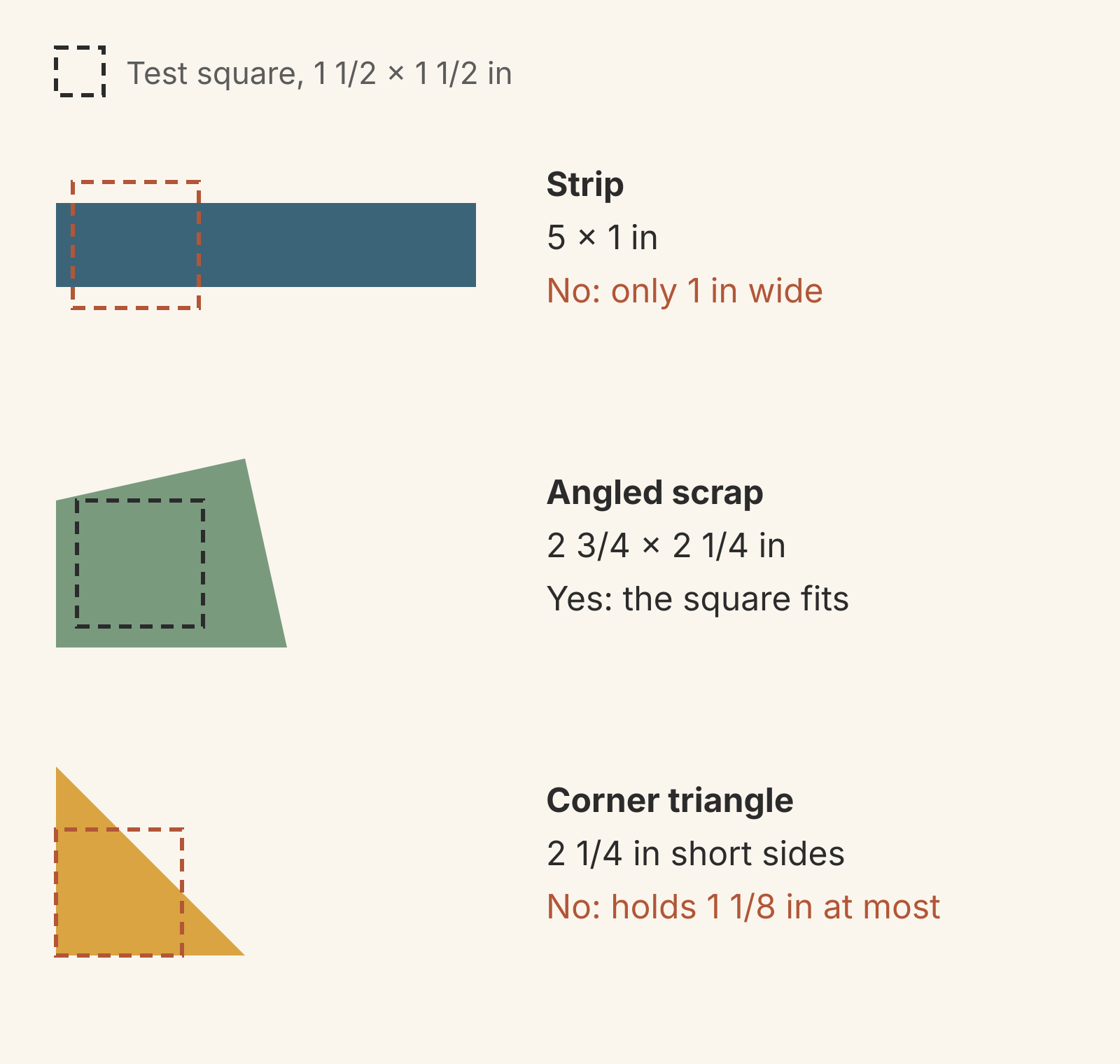
Two shapes fool the eye. Long strips look generous, but a 5 x 1 in strip can't hold the square anywhere along its length. Strips at least 1 1/4 in wide that fail the test can go into string quilt blocks instead. Triangles hold less than their sides suggest. A corner triangle with 2 1/4 in short sides holds a 1 1/8 in square at most. The biggest square that fits is half the short side, so it takes 3 in short sides to hold a 1 1/2 in square.
Apply the same test when you trim. As each unit grows, Jean Boyd will "straighten one edge so it's ready to sew to the next set." That trim can shave a crumb you already sewed. Leave at least 1 1/4 in of that piece beyond its seam line, or move the cut. The next seam takes another 1/4 in, which leaves the 1 in your floor promised.
Your floor can be lower. Leanne of Devoted Quilter, writing for Penny Spool Quilts, saves anything at least 1 in square. Her advice is to "think about the smallest pieces you'd really be happy to work with," then discard or donate anything smaller. That's the right way to set a floor: choose it on purpose, then hold every piece to it.
What do small crumbs cost a 6 in block?
A lower floor lets smaller crumbs into the bin, and a block sewn from them is a different block. We drew three 6 in finished crumb blocks, each from crumbs close to one size. A crumb's size here is the biggest square it holds when cut, the same square test as above. Every block is built only from straight seams across each unit, the way crumb units are joined.
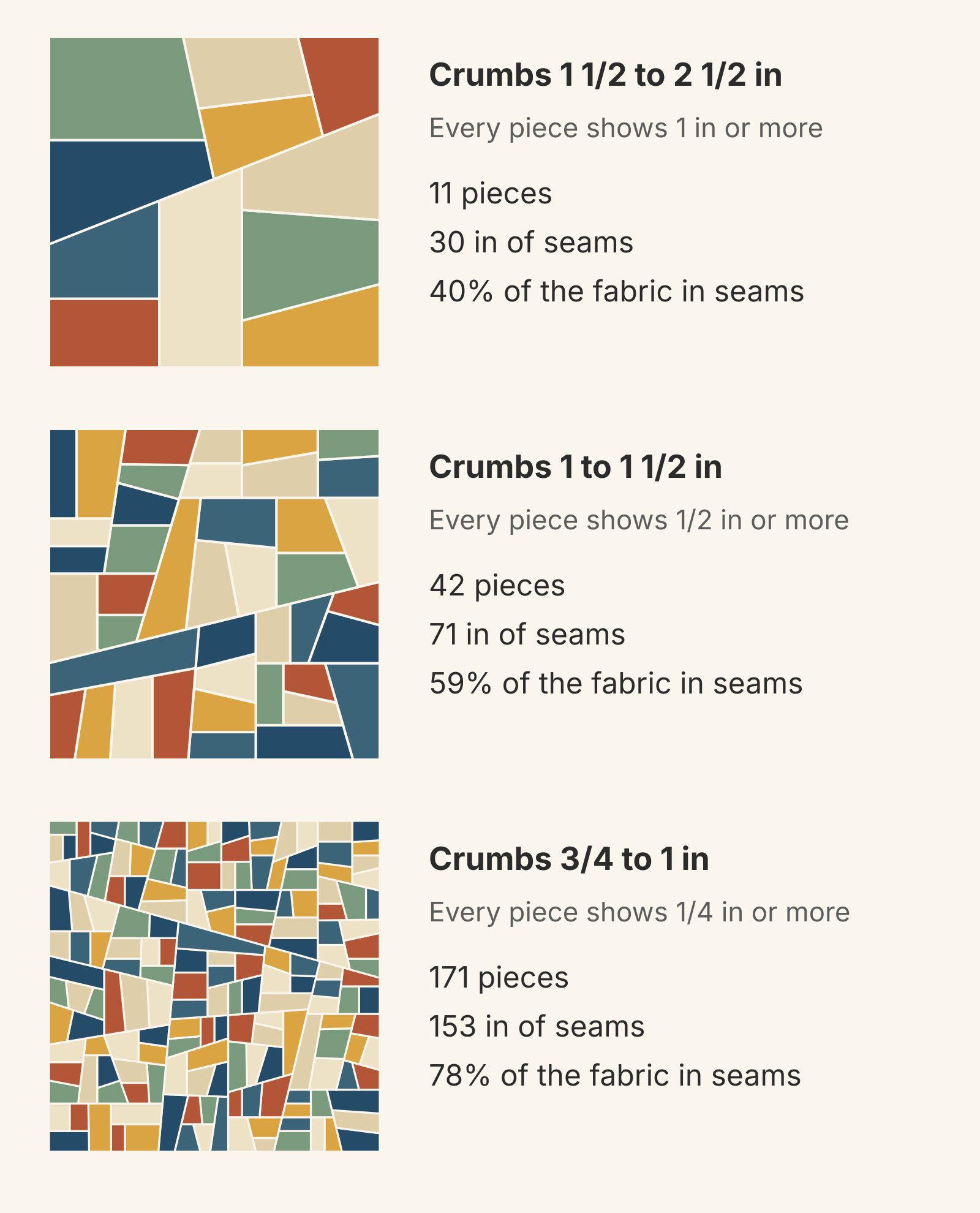
| Crumb size | Pieces | Seams inside the block | Fabric in seam allowances |
|---|---|---|---|
| 1 1/2 to 2 1/2 in | 11 | 30 in | 40% |
| 1 to 1 1/2 in | 42 | 71 in | 59% |
| 3/4 to 1 in | 171 | 153 in | 78% |
Each step down roughly quadruples the pieces and more than doubles the seams. That's geometry: halve the width that shows and about four pieces fit in the same space, with about twice as much seam line between them. These drawings are typical, too. Across twelve layouts we drew at each size, the piece counts ran 10 to 13, 36 to 47, and 164 to 177.
The last column counts the allowance hidden behind every piece. In the 1 to 1 1/2 in block, more than half the crumb fabric you sew ends up in its seams. That's good news if your goal is to empty the scrap bin. It's bad news for bulk.
Jean Boyd mentions multiple seams to stitch over in crumb blocks. Leanne presses her seams open as she goes, because "crumb blocks end up with a lot of seams." Pressed open, a piece that shows only 1/2 in has its two allowances meeting behind it, so no part of it is a single layer of fabric. Our guide to pressing seams open or to the side counts the fabric layers each way.
The look changes as well. In the block of bigger crumbs you can still see each print. In the block of 3/4 to 1 in crumbs, the prints blur into speckled texture and the seam lines become part of the design. As Kristen Hubert puts it, "the smaller your crumbs are, the more intricate and detailed your crumb quilting will become."
Write your smallest-scrap rule
Put the rule on a card by the scrap bin, so you don't have to decide piece by piece. Here's a version for a first crumb quilt:
| Rule | Example |
|---|---|
| Floor | Every piece holds a 1 1/2 in square when you sew it |
| Trims | Leave 1 1/4 in beyond a seam line when you straighten an edge |
| Offcuts | Trimmings that pass the square test go into the next unit |
| Below floor | Out of the bin: discard, donate or save for another kind of project |
| Block size | Build each unit past 6 1/2 in, then trim to 6 1/2 in |
| Test block | Sew one, count its pieces and measure it before making more |
Leanne recycles offcuts the same way: "If they're big enough, I just stitch them to the next chunk I'm making!" Jean Boyd cuts her crumb fabric into 6 1/2 in squares with a 6 1/2 in square ruler, and uses that size as her guide for how big to grow each piece.
Want some finer texture without lowering the whole floor? Allow 1 in pieces in a few accent units and keep the rest of the block at 1 1/2 in. Write the exception on the card too, so it doesn't creep into every block.
Plan the whole quilt before you sew 80 blocks
Here's the worked example: a 48 x 60 in lap quilt of 6 in finished blocks. That's 8 blocks across and 10 down, or 80 blocks. Suppose every crumb block matched the drawings above:
| Plan | Crumb blocks | Crumbs to sew | Seams inside the blocks |
|---|---|---|---|
| All crumb, crumbs 1 1/2 to 2 1/2 in | 80 | 880 | About 66 yd |
| All crumb, crumbs 1 to 1 1/2 in | 80 | 3,360 | About 157 yd |
| Alternate plain, crumbs 1 to 1 1/2 in | 40 | 1,680 | About 79 yd |
Sewing every block from 1 to 1 1/2 in crumbs nearly quadruples the crumbs in the same quilt. That's the worst case for a 1 in floor. A real bin mixes sizes, so its count lands between the first two rows. Alternating crumb blocks with plain 6 1/2 in squares cuts the count in half, and gives the eye somewhere to rest. The 852 in of seams that join the blocks to each other are the same in every plan, so they aren't in the table.
For a first crumb quilt, use the 1 1/2 in floor in every block. If you love the texture of tiny crumbs, set those blocks with plain alternates. Even in the worst case, the seams stay within about 13 yd of the all-crumb plan with bigger crumbs. Kristen Hubert notes that quilters often add sashing to break crumb blocks up, and our guide to alternate blocks for sampler quilts shows how plain squares change a block count.
You can also cut crumb fabric into something other than squares. Emily Bailey's book Crumb Quilts explains how to cut crumb fabric to size and use it as a quilt block, a background or a piece of applique. A crumb shape on a plain background keeps the seams in one place.
Try the layout in QuiltLab first
Once your test block is sewn, you can preview the quilt before committing to 40 or 80 blocks:
- Photograph the block straight on. In the Swatch Editor, choose File > Upload Image, crop to the block, check the dimensions in the inspector, then Save and name it.
- In the Block Editor, check that the block is 6 in, draw one square piece that fills it, and choose the crumb swatch as its fabric. Save a second block in your plain fabric.
- In the Quilt Editor, start a Grid quilt with 6 in blocks, 8 columns and 10 rows, and place the two blocks alternately. Then try an all-crumb version.
Every crumb block will look the same in the preview, so judge balance and contrast, not individual prints. QuiltLab doesn't count crumbs or seams, so count those on your test block.
Quilt Editor: Arrange Blocks and Fabric →Set up a Grid layout, choose block size and counts, and place blocksYour next step
Pick your floor and cut a test square that size from template plastic, or mark it on your ruler. Then sew one 6 1/2 in crumb block and count its pieces. If you land near a dozen and the block lies flat, keep going. If you're near 40, decide now whether the quilt gets plain alternate blocks.
Your crumbs are what's left after the bigger cuts. To sort those first, see sorting quilt scraps by size and building a scrap cutting system. When it's time to choose colors, How to Make a Scrappy Quilt Look Planned covers fabric roles and placement.
Related posts
How to Design a Bargello Quilt: Plan the Wave on Paper
A bargello wave is a staircase of stepped columns. Number your strips, write one row per column, and see how column width turns a zigzag into a curve.
Borderless Quilt Design: Plan an Edge That Looks Finished
With no border, the outer blocks and the binding make the edge. Compare whole and halved motifs on one 48 x 60 inch quilt, then pick the binding color.
Crosshatch Quilting: How to Make the Lines Meet at the Edges
Space a 45-degree crosshatch so the lines meet in a V at every edge and corner. Choose the edge step first, mark dots around the quilt, then connect them.