


Starch vs Sizing for Quilting: Which Should You Use Before Cutting?
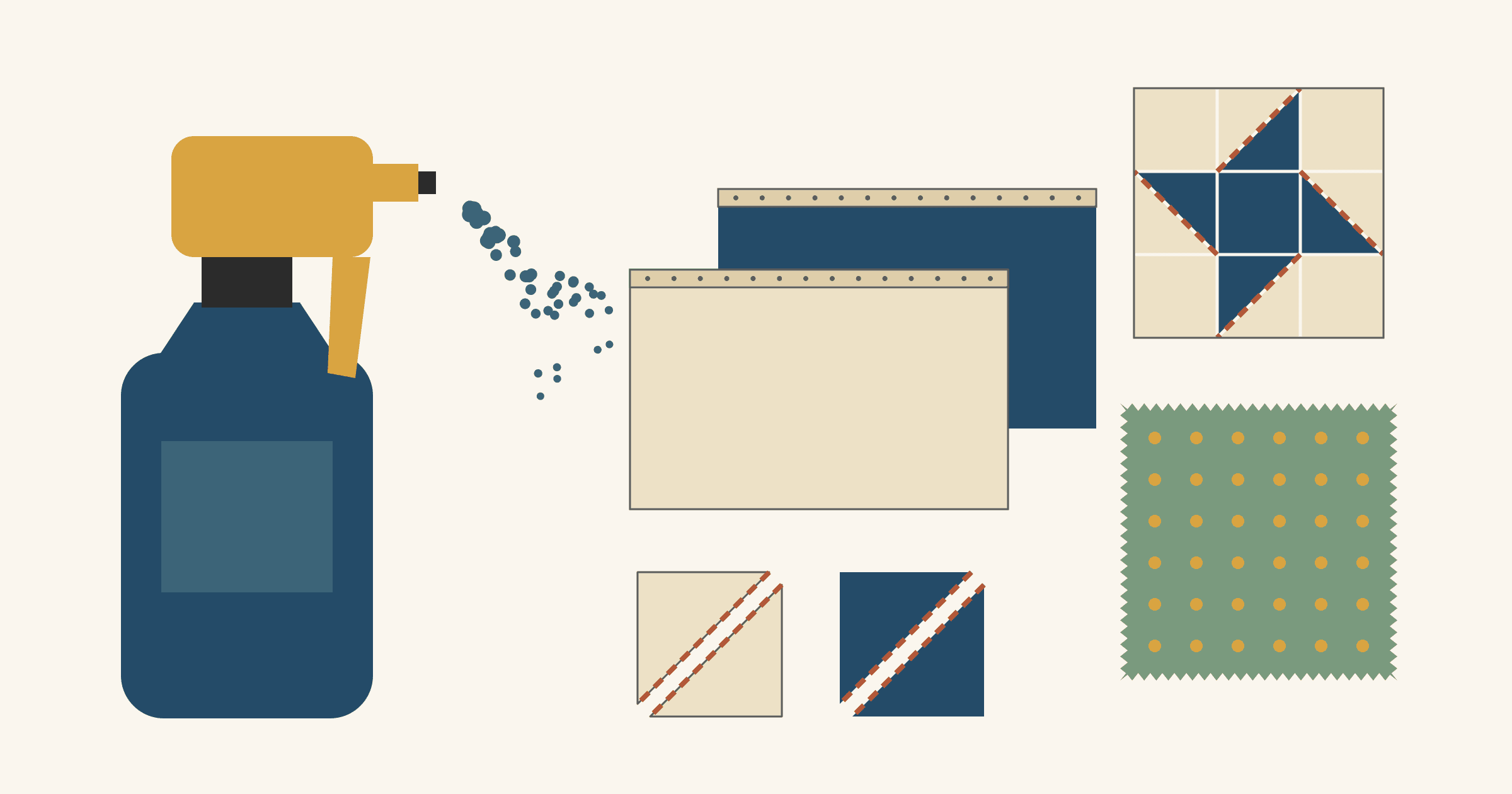
Starch makes quilting cotton crisp and firm. Sizing gives it light body with little or no stiffness. Faultless, which makes both, says in its ironing spray FAQ that the difference is the ingredients: spray starches are generally made with corn starch, and its Magic Light Hold sizing has none. For piecing, reach for starch. Moda Fabrics and Julie Cefalu of The Crafty Quilter both say it makes cutting and piecing more accurate. Treat the yardage before you cut it, so the pieces are cut at their final size.
Starch matters most on fabric that will become triangles, bias edges or small pieces. Choose sizing or a starch-free spray when you want only a little body, when the fabric is dark enough to show white flakes, or when it will be stored. Leave charm squares and other small precuts as they came, and check before you treat fabric you plan to fuse. The star quilt at the end uses all three choices.
What starch and sizing each do
Faultless describes its starches as giving "crisp body and professional stiffness." Its sizing is meant to make fabric feel more like it did when new: "light body, little to no stiffness." Sizing also leaves a smoother surface, so the iron glides a little more easily.
Julie Cefalu puts the quilting side plainly in What type of spray starch to use for quilting? at The Crafty Quilter. Starch "will make your cuts more accurate and it will be easier to sew and match seams." Sizing adds body without making fabric too stiff, but it "doesn't give as much stiffness." She also points out that most fabric on the bolt is treated with sizing during manufacturing. That finish is part of why new yardage feels crisper than washed fabric.
A third group, the starch alternatives, runs from light to heavy. Mary Ellen Products sells Best Press as a "Starch and Sizing Alternative" with no flaking or white residue on dark fabrics. Cefalu finds it "more like sizing than starch" in how stiff it gets. Moda Fabrics' starch product sheet for shops rates the sprays it carries by weight. Best Press is light, Magic Premium Quilting & Crafting Spray is medium, and Terial Magic is heavy.
| Treatment | What it gives | Choose it for | Watch for |
|---|---|---|---|
| Spray or liquid starch | Crisp, firm hold | Bias edges, small pieces, soft or washed cotton | White flakes on dark fabric; corn starch in storage |
| Sizing | Light body, little or no stiffness | A little body; dark, synthetic or blended fabric | Too little hold for loose bias edges |
| Starch-free spray or alternative | Light to firm, depending on the product | Dark fabric; fabric that will be stored | Check the product's weight before you buy |
| No treatment | The factory finish on unwashed fabric | Precuts, fabric you'll fuse, large on-grain pieces | Washed fabric may feel limp |
So the choice comes down to two questions. How much hold do the pieces need? And is corn starch a problem for this fabric or this project?
Which pieces need starch
Moda's sheet lists the handling reasons: starch helps cutting accuracy, starched fabrics "slip less against each other when you are matching points," and small pieces are "less likely to fray or stretch on the bias." It also restores body to fabric you've prewashed. Check your cutting list for these:
- Bias edges. Bias is the stretchiest direction in woven cloth, and every triangle cut from a square has bias edges. Cut once on the diagonal, the long edge is bias. Cut twice, the two short edges are. The side and corner triangles in an on-point setting have them too. Half-square triangles made four at a time have bias on all four outside edges.
- Small pieces. The same stretch matters more on a small piece. An edge that grows 1/16 in is about 4% of a 1 1/2 in unit, but less than 1 1/2% of a 4 1/2 in block.
- Soft or washed fabric. Prewashed cotton has lost its factory finish. Moda's sheet also singles out flannel as a fabric worth starching.
If none of those apply, the fabric may not need anything.
When sizing or a starch-free spray is the better choice
Pick by the fabric and by how long it will wait.
- Dark fabric. Starch that doesn't soak in can leave white flakes, which show on navy or black. Faultless says its starch-free Premium sprays and its sizing are often a better choice for dark, synthetic and blended fabrics. Moda suggests spraying the right side and pressing on the wrong side, so any flakes or marks end up on the wrong side.
- Blends and synthetics. Faultless says its starch-free formulas are "more easily absorbed by synthetic fibers."
- Fabric that will be stored. If you want to "starch and store" something, Faultless recommends its sprays that don't contain corn starch. Cefalu notes that starch can attract silverfish. She starches only the fabric she's about to use, just before using it.
Starch-free doesn't always mean soft. Faultless's Premium Firm Finish+, for one, contains no corn starch. Read the label for both the ingredients and the weight.
When to skip treatment
- Small precuts. Moda's sheet says "Never pre-wash precuts." Sherri McConnell, who designs fabric for Moda, writes in her fabric preparation basics at A Quilting Life not to wash the smaller Moda precuts. Starch is one of her options for yardage. Wet starch shrinks cotton the way washing does, and a 5 in charm square that draws up can't be recut to 5 in. Leave charm squares, layer cakes and jelly roll strips as they came.
- Fabric you'll fuse. In its FAQ on fusible interfacing, Pellon suggests prewashing or pre-steaming fabric "to remove any shrinkage or finish that might interfere with the fusing process." Read your fusible's instructions before adding a finish to fabric you'll fuse, including appliqué fabric.
- Large on-grain pieces of unwashed cotton. Big squares and strips cut on the straight grain already have the factory finish. Starch them only if they feel limp.
- Fabric that isn't washable. Faultless says its sprays are for colorfast, washable fabrics and never for anything labeled "Dry Clean Only."
Treat the yardage, then cut
Moda's sheet explains why the order matters: "The moisture in the starch will shrink your cotton fabric as if you had preshrunk it." Treat the fabric, let it dry, press it, then cut. That way a 2 3/8 in square still measures 2 3/8 in after treatment. The sheet also suggests treating only the fabric a project needs, cut into manageable pieces, unless you need a long piece for lengthwise borders.
How much you apply sets how stiff the fabric gets. Moda's sheet says misting and ironing at once gives the lightest stiffness, and saturating and air drying gives "a firm, paper like stiffness." McConnell's method for yardage is the firm one: spray until the fabric is wet, dry it on a rack, then iron. If you'd rather spray and press in one go, follow Faultless's instructions. Spray lightly and evenly, wait 15 to 20 seconds for the spray to soak in, and build a stiffer finish with two light coats instead of one heavy one. Faultless warns that too much spray can stick and burn onto the iron's soleplate.
Wet starching acts a little like prewashing. If you haven't settled whether to prewash this quilt's fabrics, decide that before you treat the yardage.
Worked example: one star quilt, three treatments
Here's a 31 1/2 in square wall quilt. It has 24 Friendship Star blocks alternating with 25 charm squares in 7 rows of 7, with a charm square in each corner. Each star finishes at 4 1/2 in, the size a 5 in charm square finishes at. It's a 3 x 3 grid of 1 1/2 in units: four background corners, a navy center and four star points.
The cut sizes follow the usual rules. Squares are the finished size plus 1/2 in, so 2 in. This plan cuts the triangles first, from squares the finished size plus 7/8 in: 2 3/8 in squares, each cut once on the diagonal. It's the same 7/8 in as for two-at-a-time half-square triangles. The quarter-inch seams on all three sides of each triangle need about 0.85 in of extra square, which rounds up to 7/8 in.
| Fabric | Cut for 24 stars | Handling need | Treatment |
|---|---|---|---|
| Background solid, yardage | 96 squares 2 in; 48 squares 2 3/8 in, cut into 96 triangles | 96 bias edges, small pieces | Spray starch, saturated and dried, then cut |
| Navy print, yardage | 24 squares 2 in; 48 squares 2 3/8 in, cut into 96 triangles | 96 bias edges, dark enough to show flakes | Starch-free spray in two light coats, then cut |
| Charm squares | 25 squares 5 in, used whole | Precut, every edge on grain | None |
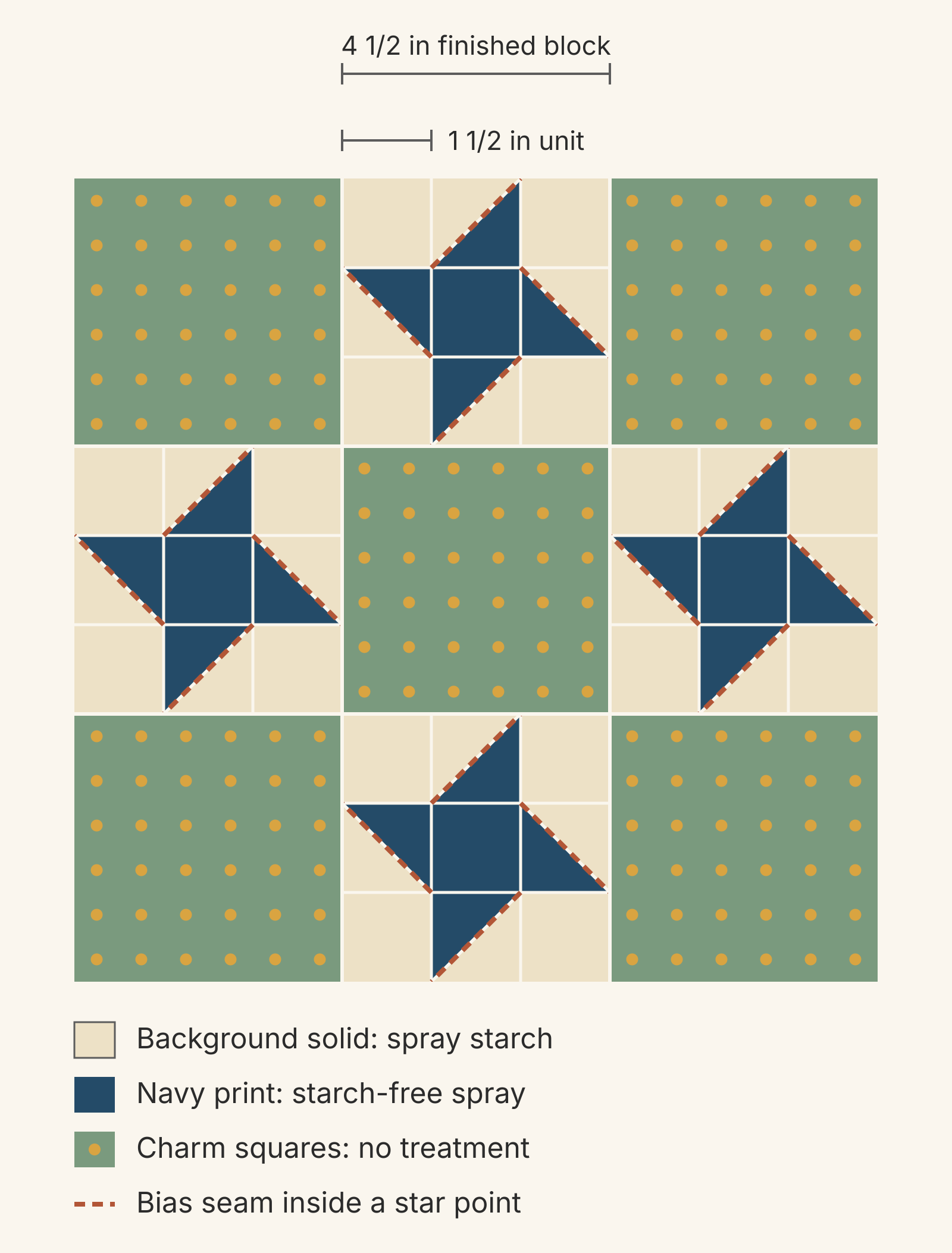
Each triangle's long edge is about 3 3/8 in of bias. Every star point joins a background triangle to a navy triangle along those edges, so the quilt has 96 bias seams. Both fabrics need hold, and the navy also needs a spray that won't flake. Choose a starch-free spray with some hold, such as Faultless's Premium Firm Finish+, and use two light coats, as Faultless advises for a stiffer finish. Spray the navy on the right side and press it on the wrong side.
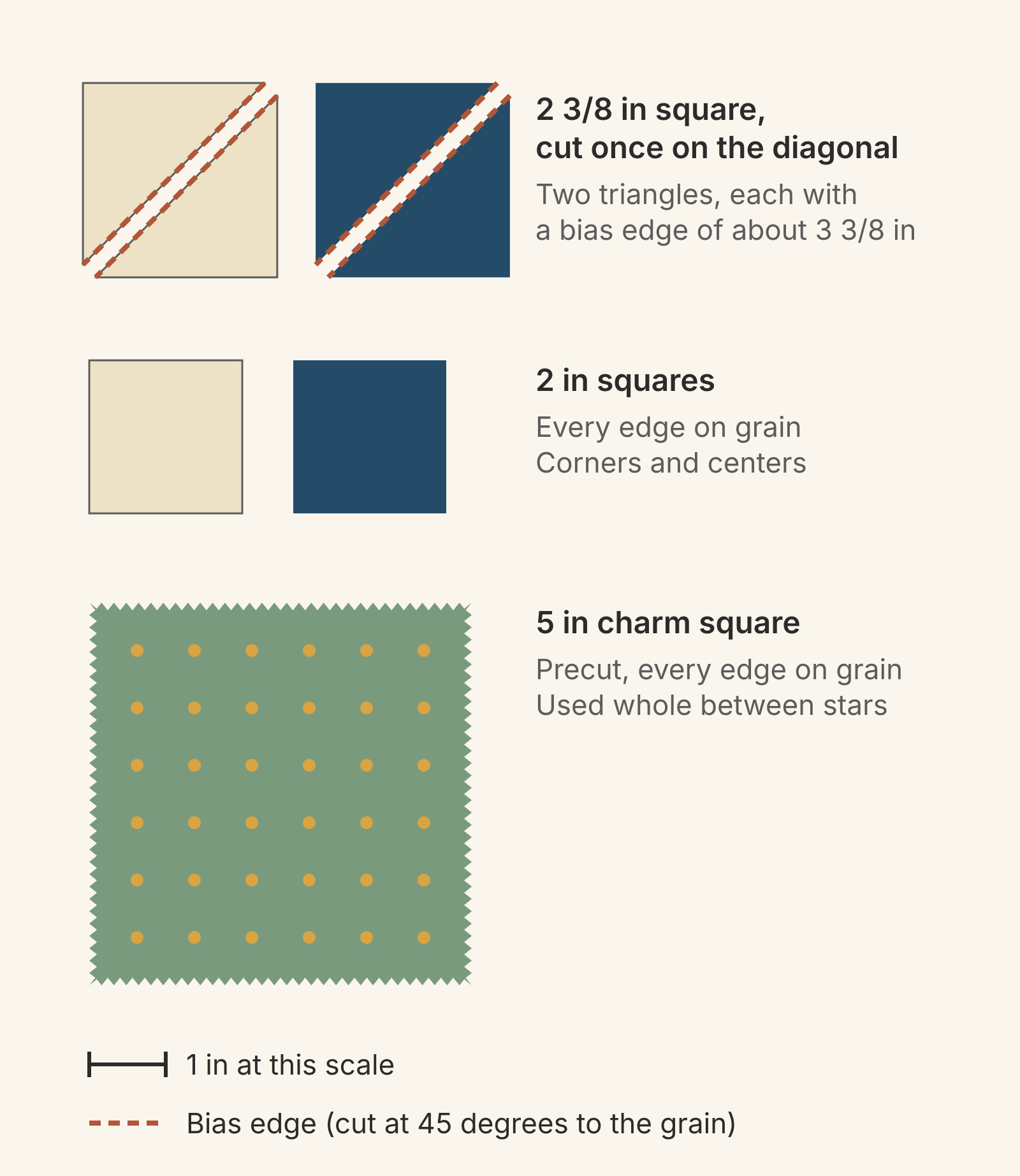
The charm squares get nothing. They're precut to their final size, every edge is on grain, and at 5 in they're the biggest pieces in the quilt.
If you make the star points two at a time instead, the starting squares are still 2 3/8 in. But you sew along the diagonal before you cut it, so the bias edges are already stitched when you cut the units apart. The navy may then need only a light starch-free spray.
Test one piece before you cut 96
Treat a scrap of each yardage, about 10 in square, the way you plan to treat the rest. Measure it before and after so you know how much it draws up. Once it's dry and pressed, check the navy for flakes. Then cut one 2 3/8 in square from each and cut it once on the diagonal. Sew one star point and see whether it measures 2 in square.
If the triangles still stretch, add another light coat. If the navy flakes, change products before you treat the whole piece.
Your next step
Go through your pattern's cutting list and mark each fabric: bias edges, small pieces, dark, precut or fused. Treat only the yardage that needs it, just before you cut, and note which product you used in your quilt materials record.
If you're drafting your own block, draw it in QuiltLab's Block Editor and select each piece to see its width and height. The triangles and the smallest pieces are the ones to stiffen. Those sizes are the shapes you drew, with no seam allowance, so add the allowances yourself to get cut sizes like the 2 in and 2 3/8 in squares. Then place the blocks in a Grid layout in the Quilt Editor, which shows the quilt's finished dimensions.
Block Editor: Draw and Reuse Quilt Blocks →Draw pieces, check their measurements and assign fabricsRelated posts
Pin Basting vs Spray Basting: Which Fits Your Quilt and Room?
Pins 3 to 4 inches apart hold until you remove them; spray is faster but lasts only as long as its label says. Choose by quilt size, surface and can.
How to Prepare a Quilt for Longarm Quilting
The checklist longarm quilters ask for, with the reason behind each step, then one 64 x 80 inch top checked against two real service sheets.

Should You Prewash Quilt Fabric? Decide by Precuts, Yardage and Color
Most quilters can skip prewashing good quilting cotton as long as every fabric in the quilt gets the same treatment. Here's when precuts, flannel, a wide backing or a deep red change the answer.