


What Size Should String Quilt Blocks Be? Foundations and Color Rules
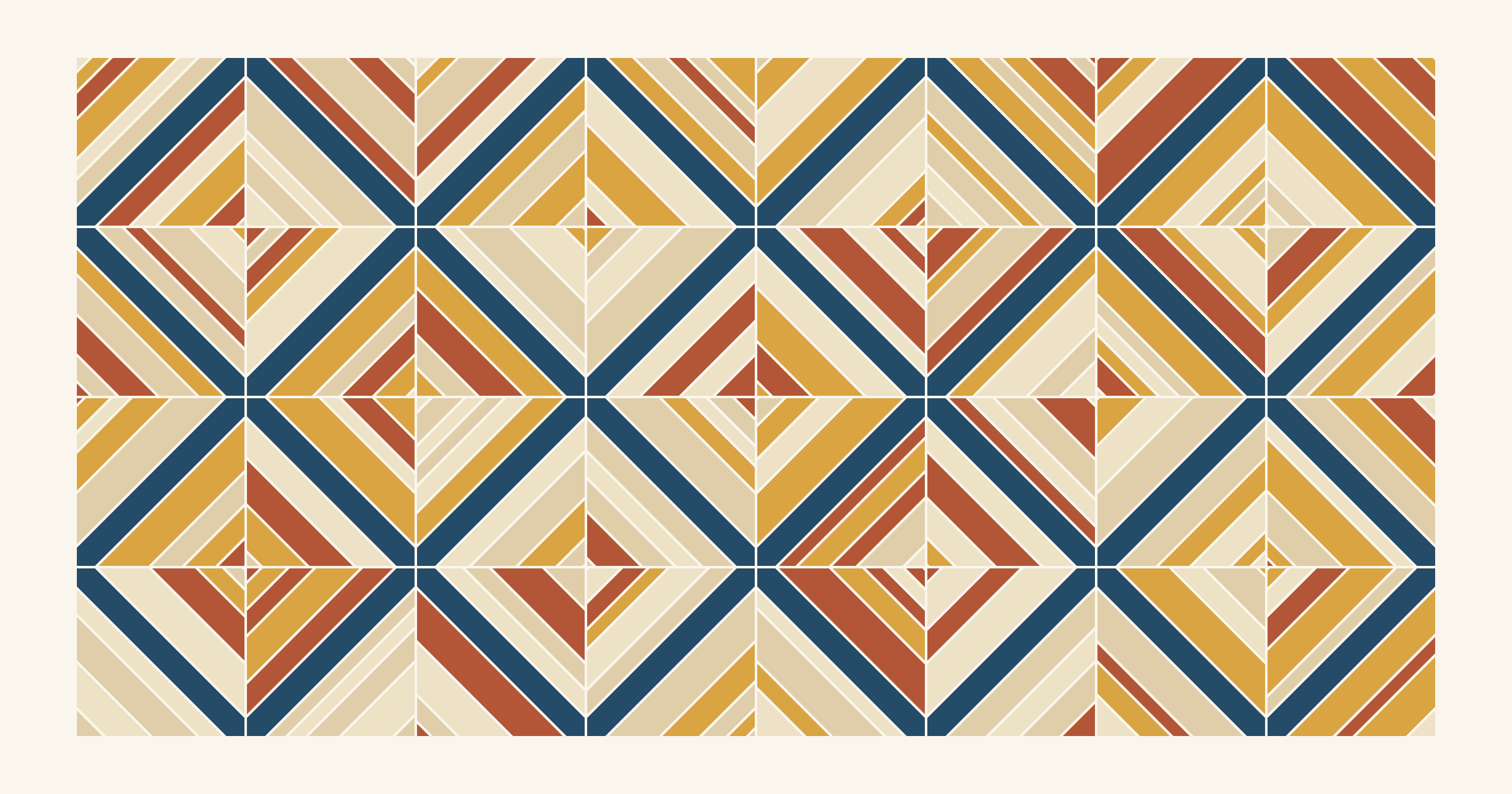
For a first string quilt, cut 10 in square foundations and trim each sewn block to 9 1/2 in, so it finishes at 9 in. Run a 2 in center strip corner to corner and keep the other strings 1 1/4 to 2 1/2 in wide. The foundation, trim and center strip follow the HeartStrings Quilt Project block guidelines, which allow strings up to 3 in. The narrower string range comes from Sherri McConnell of A Quilting Life, who sews 8 in blocks on 8 1/2 in squares of thin muslin.
Strings are irregular, so the planning goes into two rules you write down before you sew. The first is a foundation envelope: the foundation size, the trim, and how wide and how long a string can be. The second is a color rule: one thing that stays the same in every block. Below we work out both for a 54 x 72 in quilt of 48 blocks. We drew these diagrams for this article and haven't sewn them.
What size foundation should you cut?
Start from the finished block and work outward. A block finishes 1/2 in smaller than you trim it, because the 1/4 in seams that join it to its neighbors take that much. HeartStrings then cuts the foundation another 1/2 in bigger and trims back. Its guidelines explain that "starting too large and trimming back helps avoid buckling of the foundations."
| Finished block | Trim to | Foundation | Longest string |
|---|---|---|---|
| 6 in | 6 1/2 in | 7 in | 11 in |
| 8 in | 8 1/2 in | 9 in | 13 3/4 in |
| 9 in | 9 1/2 in | 10 in | 15 1/4 in |
| 12 in | 12 1/2 in | 13 in | 19 1/2 in |
The last column is the string that runs corner to corner across the foundation, plus 1/2 in past each end, rounded up to the next 1/4 in. Bigger blocks need longer strings. If your string bin is mostly short ends, a 7 in foundation will use them better than a 13 in one.
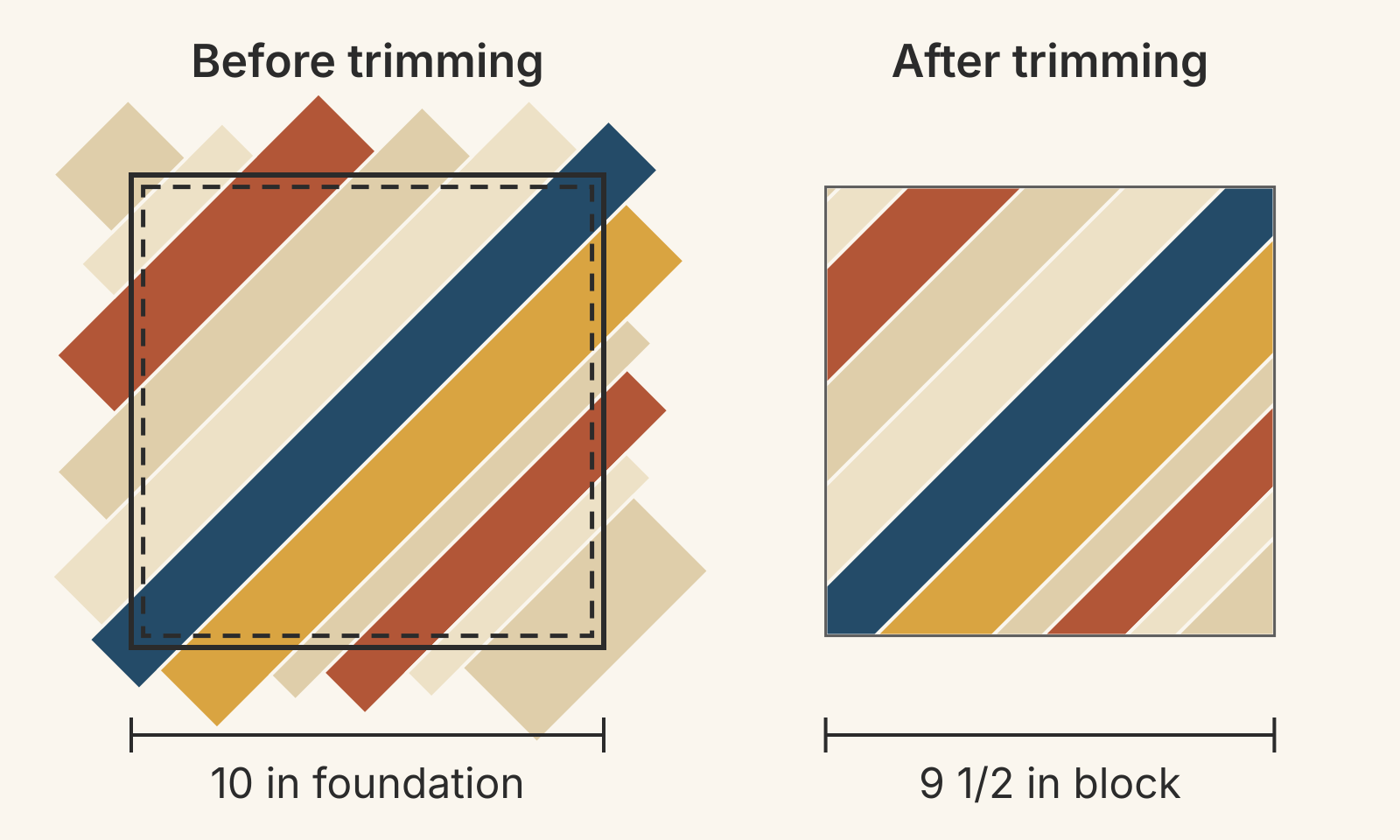
You can also trim even with the foundation edge. Sherri McConnell does that with her 8 1/2 in squares. Bonnie Hunter does it too in her String X quilt, sewing strings about 1 to 2 in wide onto 4 1/2 x 10 1/2 in rectangles. Cut the foundation at the trim size and you skip the margin, along with the room it gives you to straighten a block that drifted.
The foundation itself can be fabric or paper:
- Thin muslin stays in the quilt. Sherri McConnell says a fabric foundation "helps the blocks maintain their shape," and there's no paper to remove. Keeping the muslin thin stops the blocks from getting bulky. She also notes that dryer-sheet foundations limit the size of the block.
- Paper tears away after trimming. Bonnie Hunter uses old phone book pages and printer misprints. For her String Spiderweb she sews with a short stitch, about 1.5 on a digital machine, and a denim needle so the paper tears off easily.
Can you skip the foundation? You can, but think about the edges first. When the strings run on the diagonal, every block edge crosses them at 45 degrees, so all four edges are bias. A foundation holds those edges steady while you trim and join blocks. The strings get sewn onto it much like foundation paper piecing, just with no printed lines to follow.
How wide and how long should strings be?
Width. A string sewn on both sides loses 1/4 in to each seam. A 1 1/4 in string shows 3/4 in, and a 2 1/2 in string shows 2 in. Go much below 1 1/4 in and the block fills with seams. Go much above 2 1/2 in and a 9 1/2 in block holds only a few wide stripes, which is why we stop short of the HeartStrings 3 in limit. HeartStrings also allows strings that aren't the same width down their whole length. If you cut a tapered string, check it against your minimum at its narrowest point.
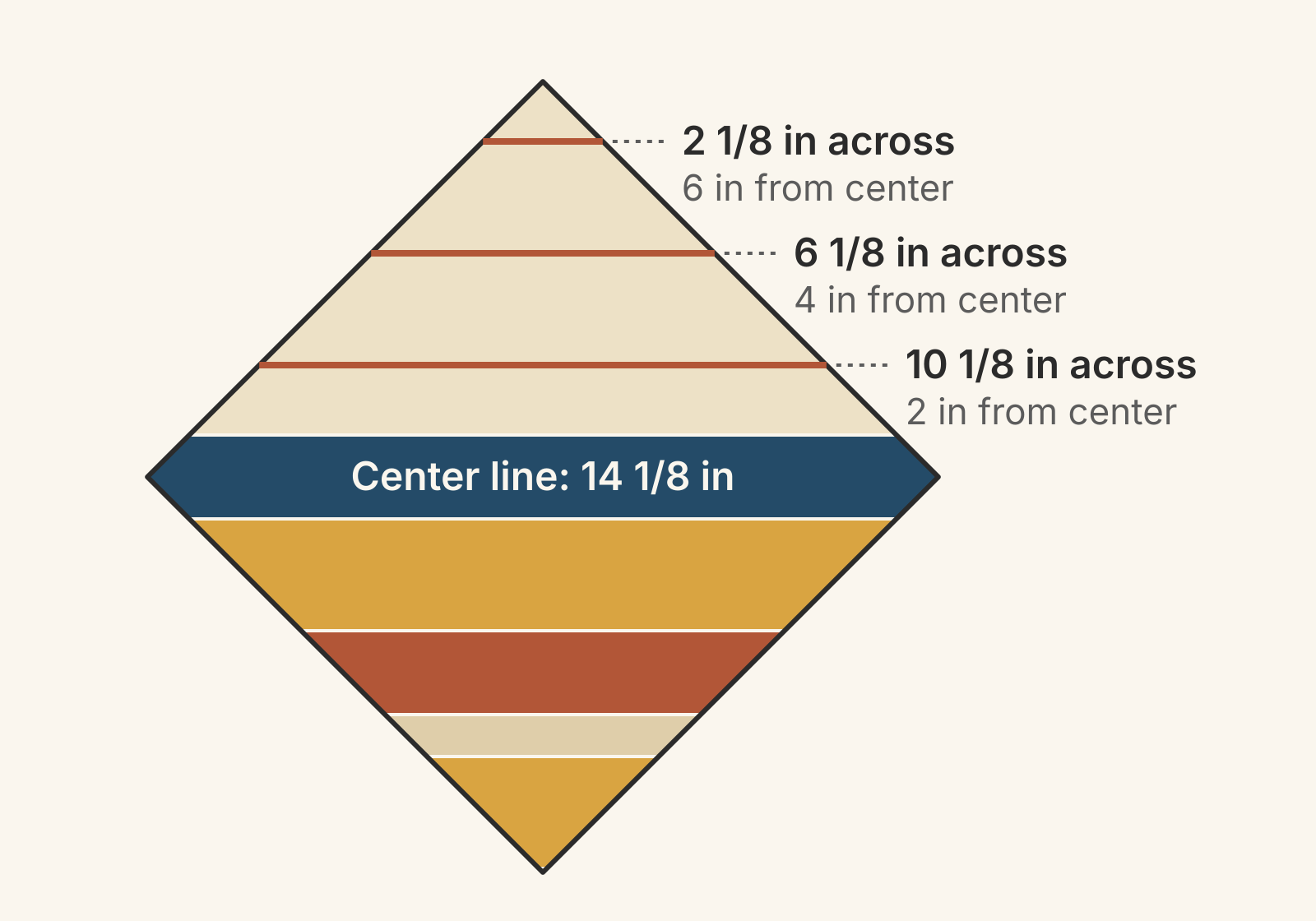
Length. On the diagonal, the space for a string depends on how far it sits from the center line, the corner-to-corner diagonal. On a 10 in foundation that line is 14 1/8 in long. For every inch you move away from it, the space gets 2 in shorter.
| Distance from center line | Space across foundation | Cut at least |
|---|---|---|
| 0 in (center strip) | 14 1/8 in | 15 1/4 in |
| 2 in | 10 1/8 in | 11 1/4 in |
| 4 in | 6 1/8 in | 7 1/4 in |
| 6 in | 2 1/8 in | 3 1/4 in |
To get the cut length, add 1 in so each end runs 1/2 in past the edge, then round up to the next 1/4 in. Measure a string's distance at its sewn edge, the one nearer the center, because that edge is its longest. The corner is just over 7 in from the center line, so the last string on each side can be a scrap.
That gives you a sorting rule. A string shorter than 11 1/4 in can't sit within 2 in of the center line. Pieces under 5 in only fit in the last 2 in before each corner. Bonnie Hunter makes the same point about her String Spiderweb block: the smaller pieces go toward the points. Ends too short for even the corners can go into crumb quilt blocks.
Write the foundation envelope on a card
Here's the envelope for a 9 in finished block. Tape it above your sewing machine.
| Rule | Setting |
|---|---|
| Foundation | 10 in square of thin muslin or paper |
| Trim | 9 1/2 in, centered, with the center strip corner to corner |
| Center strip | 2 in wide, at least 15 1/4 in long |
| String width | 1 1/4 to 2 1/2 in cut, measured at the narrowest point |
| String length | 15 1/4 in minus twice its distance from the center line |
| Short pieces | Under 5 in, only near the corners |
Pin or glue the center strip before the first seam. Sherri McConnell warns that if it slides before it's sewn down, the block will be a little "off-centered." HeartStrings asks for the center strip to run evenly through two corners after trimming, and the card's trim rule does the same.
Choose a color rule: one constant, one limit
String blocks have no fixed fabric positions, so a color rule has to tie 48 of them together. Give the quilt one element that never changes and one limit on everything else.
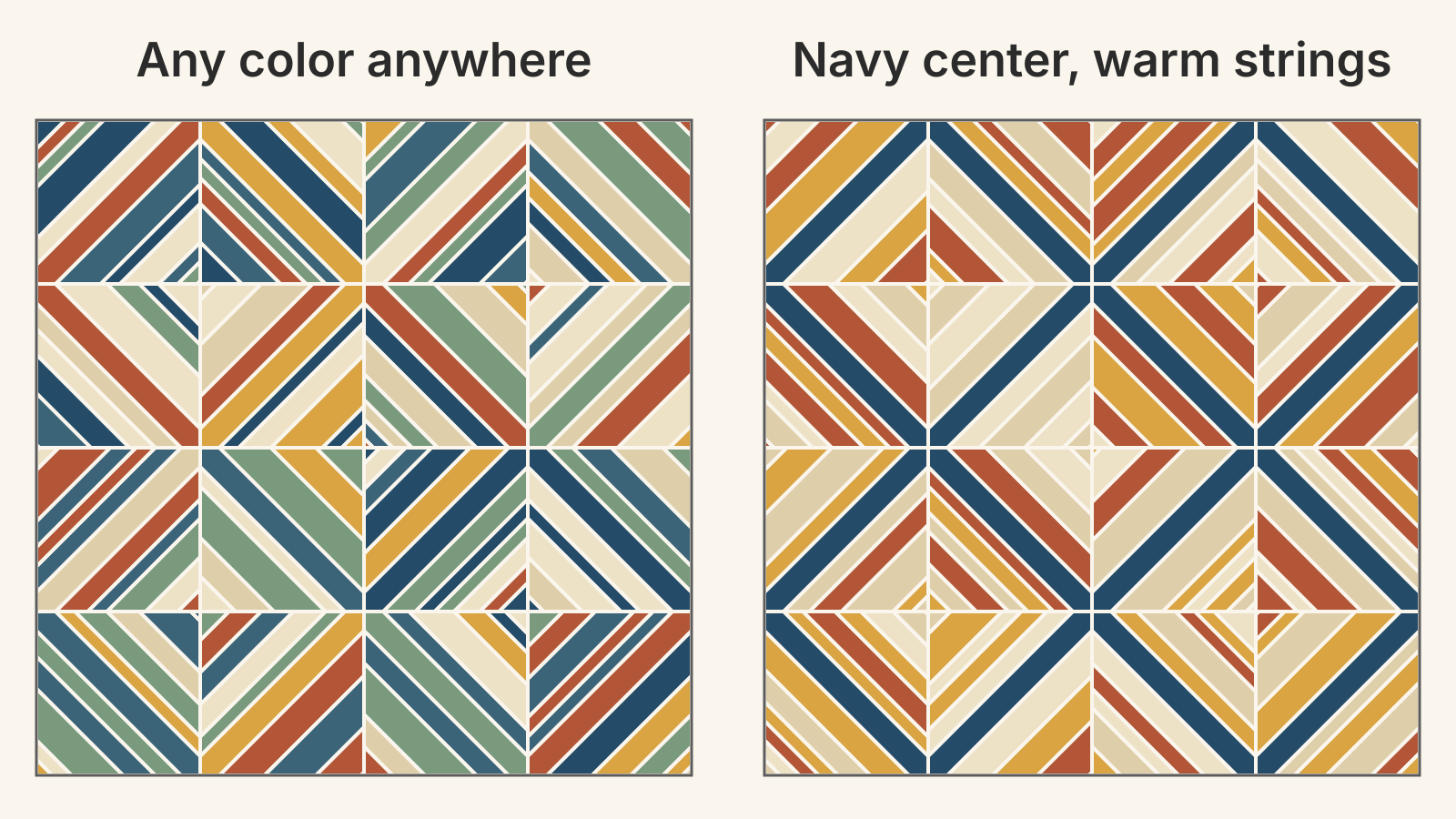
The constant. HeartStrings puts the same color in every center strip: "Traditionally we've used red or blue centers for our blocks but you can choose any one color and use it for your set of blocks." The center doesn't have to be a solid, but it should read as one, like a tone-on-tone print. When you turn the blocks, those centers join across the quilt, and the eye follows them through the scraps.
The limit. Narrow what the strings can be. Our example allows only warm strings: rust, mustard, tan and cream. A single collection works too, or anything that is clearly lighter than the center. Whatever you choose, leave the center color out of the strings. A navy string beside a navy center erases the line exactly where it should be strongest.
A rule also makes sewing faster. Sherri McConnell noticed that each of her finished string blocks used about 6 to 10 fabrics. Before a retreat, she packed coordinated piles of 10 to 12 strips, and each pile made two or three blocks. Your rule decides what goes in a pile, so you don't have to judge every string at the machine.
For a first string quilt, pick a center color you have plenty of. Then allow two to four string colors that all stand apart from it.
Worked example: 48 blocks for a 54 x 72 in quilt
Six blocks across and eight down at 9 in finished makes 48 blocks and a 54 x 72 in top before borders, a generous throw. It's also one of the two set sizes HeartStrings asks for, 24 or 48 blocks. Here is what to cut, assuming 42 in of usable fabric width:
| Part | Count | Cut size | From 42 in wide fabric |
|---|---|---|---|
| Foundations | 48 | 10 x 10 in | 12 strips 10 in wide, 3 1/3 yd |
| Center strips | 48 | 2 x 15 1/4 in | 24 strips 2 in wide, 1 1/3 yd |
| Strings | About 480 | 1 1/4 to 2 1/2 in wide | Scraps |
Each 10 in strip of muslin gives four foundations. Each 2 in strip of navy gives two center strips, 30 1/2 in in all, and leaves an 11 1/2 in piece you can't use for a center. Keep that piece out of the string bin, because navy breaks the color rule. Buy a little extra of both fabrics so you can straighten the edges first.
The string count comes from the average width. Strings averaging 1 7/8 in cut show about 1 3/8 in each, so about five fill each side of the center strip. That's 10 strings per block and about 480 for the quilt. From the center out, their minimum lengths run about 13 3/4, 11, 8 1/4, 5 1/2 and 2 3/4 in, two of each per block. That's about 82 in of string per block. If you pack piles for two or three blocks, as Sherri McConnell did, each pile needs 20 to 30 strings, and 48 blocks takes 16 to 24 piles.
Sew one block, trim it to 9 1/2 in and measure it before you make the other 47. If the center strip misses a corner, fix your starting position now. To place the ruler by the block's seams rather than its raw edges, see our guide to squaring up quilt blocks.
Turn the blocks: stripes or diamonds?
Because the center strip runs corner to corner, the turn of each block decides the layout. Turn every block the same way and the centers line up into long diagonal stripes. Give every other block a quarter turn, like a checkerboard, and the centers meet at the corners in a lattice of diamonds, as in the right-hand section above.
You can preview both before you sew all 48:
- Photograph your trimmed test block straight on. In the Swatch Editor, choose File > Upload Image, crop just inside the edges to the 9 in finished area, set Width and Height to 9 in, then choose Save and name the swatch.
- In the Block Editor, check that the block is 9 in, draw one Rectangle that fills it, and choose your string swatch as its fabric.
- In the Quilt Editor, choose New, then Grid. Under Layout, set 9 in blocks with 4 columns and 4 rows. Choose your block in the sidebar's Blocks tab and click each cell to place it. Click one block and choose Rotate clockwise in the Transform section of Properties, or press R. Repeat on every other block to see the diamonds, then go up to 6 columns and 8 rows and fill the new cells for the full quilt.
Every block in the preview shows the same photo, so judge whether the center color carries across the quilt rather than the individual strings. QuiltLab doesn't count strings or work out yardage. The numbers in this post are worked by hand.
Quilt Editor: Arrange Blocks and Fabric →Set up a Grid layout, choose block size and counts, and place blocksYour next step
Cut one 10 in foundation and one 2 x 15 1/4 in center strip, then sort a handful of strings by length. Sew a test block and trim it to 9 1/2 in. Check three things: the center strip runs through both corners, no string shows less than 3/4 in, and every string color stands apart from the center. When all three pass, copy the envelope and your color rule onto a card and cut the other 47 foundations.
If your strings are mixed in with other leftovers, sort the scraps by size first. To keep a strip width or two coming from future projects, see building a scrap cutting system. For fabric roles in pieced scrap blocks, How to Make a Scrappy Quilt Look Planned picks up where the color rule leaves off.
Related posts
How to Design a Bargello Quilt: Plan the Wave on Paper
A bargello wave is a staircase of stepped columns. Number your strips, write one row per column, and see how column width turns a zigzag into a curve.
Borderless Quilt Design: Plan an Edge That Looks Finished
With no border, the outer blocks and the binding make the edge. Compare whole and halved motifs on one 48 x 60 inch quilt, then pick the binding color.
Crosshatch Quilting: How to Make the Lines Meet at the Edges
Space a 45-degree crosshatch so the lines meet in a V at every edge and corner. Choose the edge step first, mark dots around the quilt, then connect them.