


How to Test Fabric for Bleeding Before Sewing Darks to Lights
To test fabric for bleeding, put a small piece of the dark fabric in hot water, squeeze it a few times, and lay it on a white paper towel. If the water or the towel picks up color, the fabric bleeds. Quilt teacher Toby Lischko shows this test in National Quilters Circle's video on fabric bleeding, with a bowl of hot water and a paper towel.
When a quilt puts darks next to white or cream, add a second, slower test. Seal a wet piece of each dark against a wet piece of your actual light fabric and check it over several hours. Run both tests in the water you'll wash the quilt in, and write down the conditions. A clean result means the fabric didn't bleed under those conditions. It can't promise the fabric never will.
What a bleed test tells you
A bleed test answers one narrow question: did dye leave this piece of fabric, in this water, at this temperature, in this time? Each part of that question matters.
The Canadian Conservation Institute's note on colorfastness testing is written for museum textiles, and it's careful about this. It tests each color separately, with water at the planned wash temperature, and then again with the planned detergent. It still calls the test "not foolproof" and warns that dyes sometimes run unexpectedly during washing or drying.
The water itself can change the answer. Becky Goldsmith designs with Linda Jenkins as Piece O' Cake. In her post on washing fabric, she writes that in their experience bleeding is mostly due to water chemistry. Fabric washed in one place may bleed, and the same fabric may not bleed somewhere else. A test in your sink tells you about your water. A quilt given to someone in another town will meet theirs.
So write down the water, the temperature and the time with every result. The record table below has a line for each.
Which fabrics to test
Test every dark or saturated fabric that will touch a light one. In her video, Lischko says the fabrics that bleed are usually batiks, and usually solid ones; printed batiks tend not to, because they carry other colors. She names blacks, navies and some purples, plus some oranges, reds and yellows. Most regular printed cottons don't bleed, she says, but she still checks the dark colors.
Quilter and author Suzy Webster tested a pile of unwashed batik scraps in her post on testing fabric for bleeding. In her experience, teal, purple, dark blue and red are the worst offenders.
Let your layout make the list. A navy that only touches other darks matters less than a navy that meets a cream background all over the top. Include mediums such as mustard or orange if they touch white; Lischko points out that orange dye can come out of a yellow.
Test 1: the hot-water soak
The soak is quick, and it shows you loose dye in the water. You need a clear glass, a kitchen thermometer, white paper towels and a sheet of white paper.
- Cut a 2 in. square from the dark fabric.
- Fill the glass with about 1 cup of water at least as hot as the quilt's wash. Measure it and write the number down.
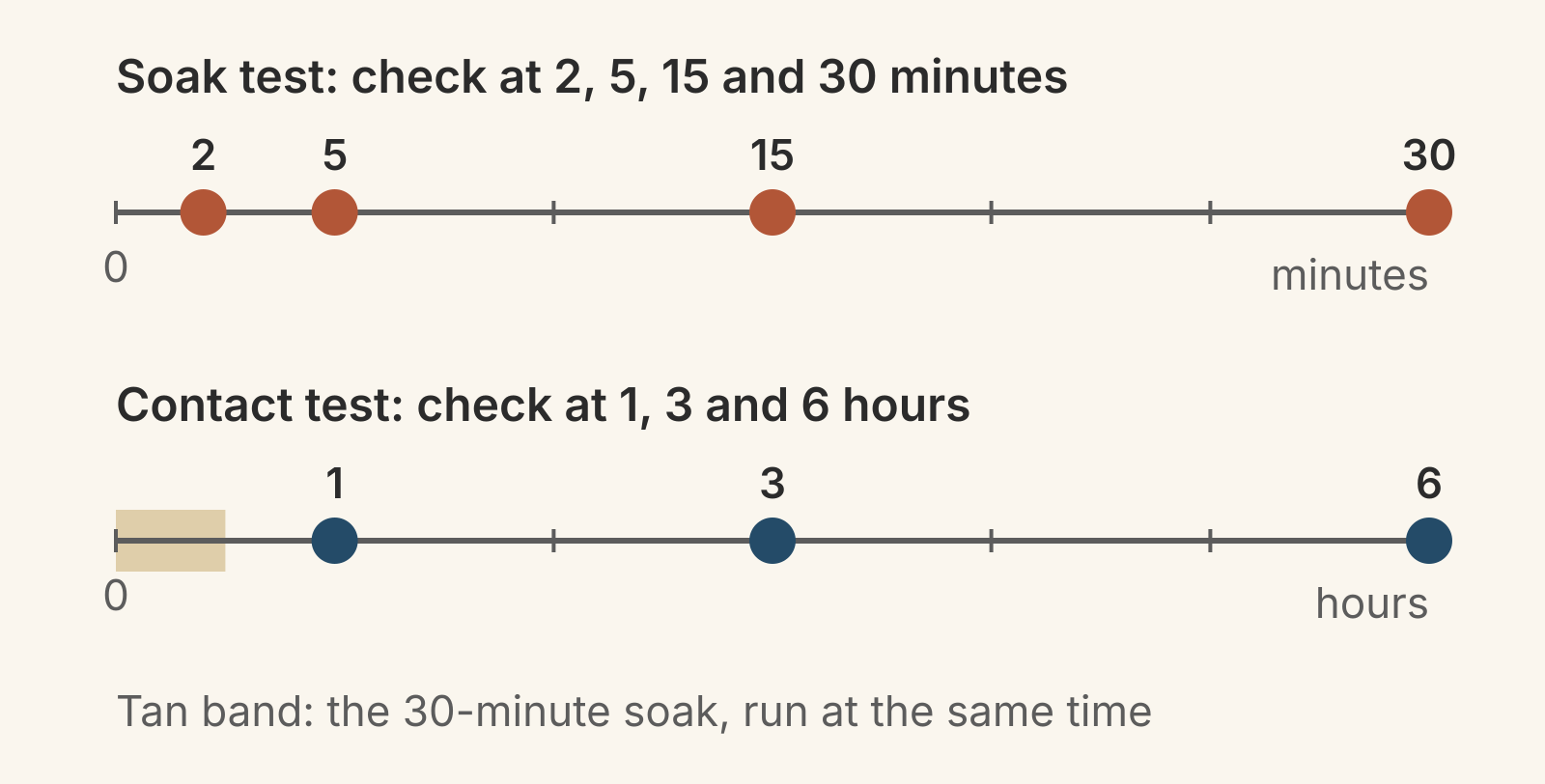
- Push the square under the water. Look at the water after a few seconds, then at 2, 5, 15 and 30 minutes. We borrowed those times from the CCI note, which uses them for a drop of water held under blotting paper. Hold the white paper behind the glass so a faint tint shows.
- At 30 minutes, squeeze the square a few times in the water. Lischko's demonstration shows why. Her first fabric darkened the water a little more with each squeeze. A tone-on-tone batik looked clear at first, then turned the water pink after a short wait, and pinker when she squeezed it.
- Lay the wet square on a white paper towel and let it dry. Look at the towel in daylight.
Lischko and Webster both use hot water, the harder test. If you'll wash the quilt cold, a pass in hot water gives you a margin. If the plain-water soak stays clear, take the CCI's second step. Repeat it with your detergent added at the strength you'd wash with, since that's what the fabric will meet in the wash.
Test 2: the contact test with your light fabric
The soak shows dye in water. It doesn't show what happens when a wet dark sits against a wet light. That's what a quilt does in the washer, after the spin and while it dries.
Webster's version is simple. She soaks a paper towel in hot water, puts it in a plastic bag, lays her fabric pieces on it and seals the bag. She usually leaves them 3 to 6 hours. In her post, the purple and blue had clearly marked the towel after 1 hour, and by 3 hours many other colors showed slight shadows.
We'd make one change: use a square of the light fabric you'll actually sew the dark to. Then you see any stain on the cloth you care about.
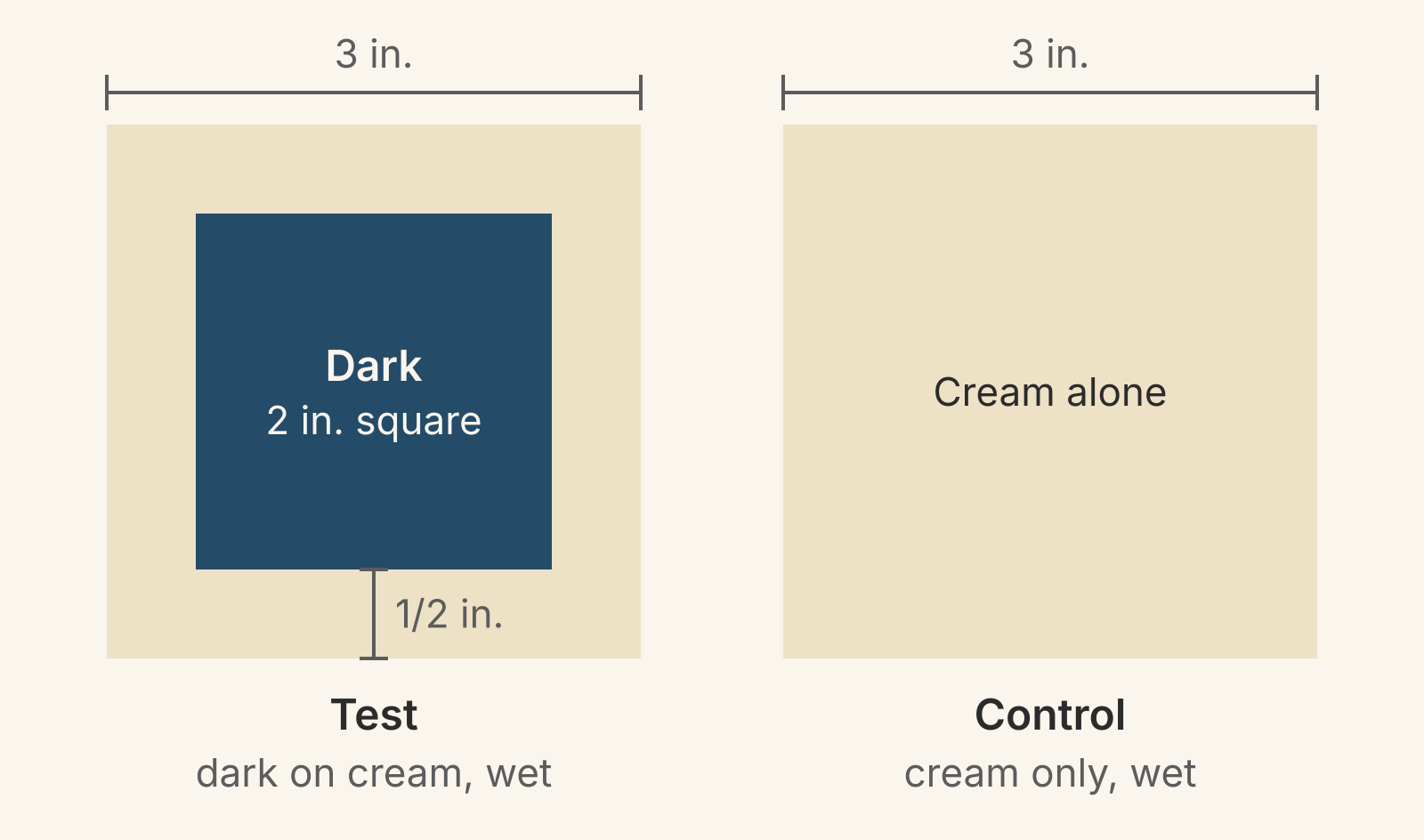
- Cut a 2 in. square of the dark and a 3 in. square of the light. That leaves a 1/2 in. margin of light fabric all around, where dye that wicks past the dark's edge will show.
- Wet both pieces in water at your test temperature and squeeze out the drips.
- Lay the dark face down in the center of the light square, slip them into their own zip-top bag, press out the air and seal it.
- Wet a second light square on its own and bag it. This control shows how the light fabric looks after the same soaking, so you compare like with like.
- Check at 1, 3 and 6 hours. Open the bag, lift the dark and compare the light square with the control. Then lay the dark back in place and reseal the bag.
Webster doesn't worry much about slight shadows unless the fabric will sit next to white. That's a sensible line for most quilts. A faint shadow between two darks is hard to see. A pink edge on a cream background isn't.
Check pressing if you use steam or starch
Webster found another test by accident. A fabric she'd soaked with spray starch left dye on her ironing board cover. If you press with steam or spray, dampen a spare piece of the dark the way you would at the ironing board. Cover it with a scrap of the light fabric and press with your usual setting, then look at the scrap. Our guide to starch and sizing compares starch, sizing and starch-free sprays.
Read the result and decide
| What you see | What it means | What to do |
|---|---|---|
| Water and light square clear at every check | No loose dye under these conditions | Use it, and keep the record |
| A faint shadow on the light square or towel | A little dye moved | Next to white or cream, wash and retest, or swap it; between darks, usually fine |
| Tinted water or a visible stain | The fabric is releasing dye | Leave it out, or treat it per the product directions and retest |
Washing and retesting can take more than one round. Webster washes problem fabrics with Synthrapol, following its directions, and tests them again before she uses them. She once washed a red batik five times before it stopped bleeding. Our prewashing decision table covers when washing just one fabric is worth the mismatch with the rest of the quilt.
What supplier advice adds
The test tells you about your sample. The shop and the maker can tell you about the cloth. Before you buy a deep color for a light quilt, or once you have a doubtful one, ask:
- Is it a batik, a hand-dye or a printed cotton?
- Does the maker or shop recommend prewashing it, or a particular detergent or fixative?
- What does the selvage say? Photograph it. The maker, collection and color number identify the cloth later.
Product directions are supplier advice too, and they're specific. Dharma Trading's Retayne directions call for 1 teaspoon per yard in a hot soak, at least 140°F, for 20 to 30 minutes, then a hot wash with detergent. The same page says Retayne doesn't work on basic dyes, and that according to some, the tradeoff can be reduced lightfastness. A fixative is a decision with its own cost, and the retest afterward still decides.
Color catchers need the same care. A sheet in the wash absorbs some loose dye, but it doesn't fix the dye in the fabric. In Consumer NZ's trial of Dylon dye-catcher sheets, Paul Smith, then its head of testing, washed a white T-shirt at 60°C (140°F) with a new burgundy towel and unwashed black jeans, and it came out lilac. A second shirt in the same kind of load, with two sheets, came out a similar lilac, while the sheets turned dark purple. Eleven of 15 staff picked the two-sheet shirt as whiter, but it was still lilac. A stained sheet shows it caught some dye. It doesn't show that the white stayed white. Smith called that load extreme, but the point carries to quilts: test the fabric, and treat a catcher as an extra.
Record the exact cloth and wash conditions
Write the record while you test, one line per fabric.
| Field | What to write | Why it matters |
|---|---|---|
| Fabric | Maker, collection, color name or number from the selvage | Identifies the cloth later |
| Light partner | The exact light fabric in the contact test | The stain shows on this cloth |
| History | Unwashed, or how it was washed before the test | A washed piece can test cleaner |
| Water | Tap, filtered or well, and where | Goldsmith's water chemistry point |
| Temperature | The measured number, in °F | "Hot" can't be repeated |
| Detergent | Product and amount, or none; any fixative or catcher | Each one can change the result |
| Pieces and times | 2 in. dark, 3 in. light; each check time | Lets you rerun the same test |
| Result | Clear, faint or visible at each check; photo file name | What you actually saw |
| Decision | Use, wash and retest, or replace | Ties the result to the quilt |
Photograph the light square beside its control on white paper in daylight, with a slip naming the fabric and the check time. Our materials record guide shows how to keep notes like these with the rest of a quilt's materials.
Worked example: five fabrics against a cream background
Say you're making a throw with a cream background, and five fabrics touch the cream: a navy solid, a red batik, a blue print, a black print and a mustard print. Between Lischko's and Webster's lists, all five qualify, the mustard included. We drew this plan for the article and haven't run these tests ourselves.
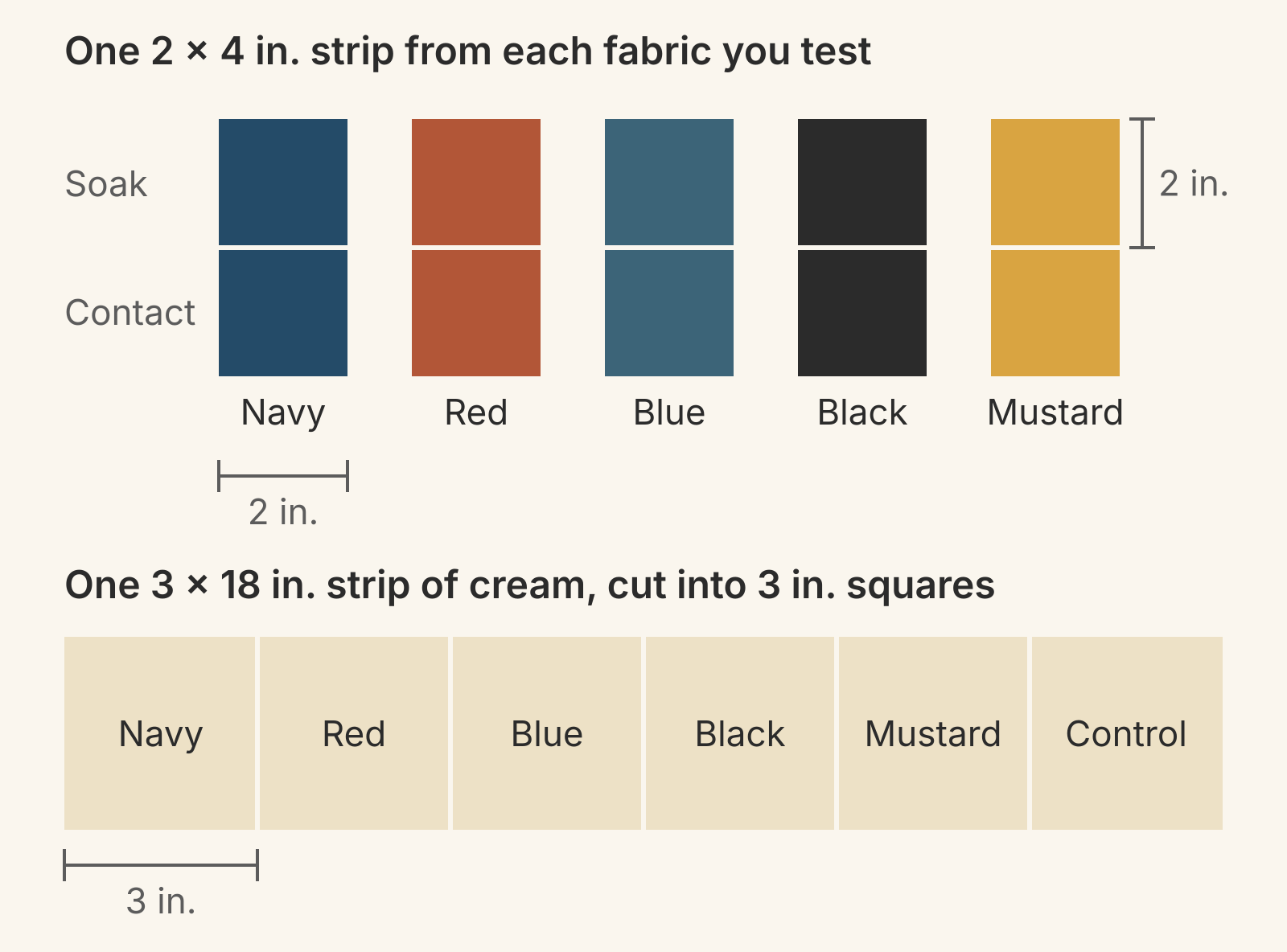
- From each of the five, cut one 2 x 4 in. strip and cut it in half. One 2 in. square goes in the soak, the other in the contact test. That's 10 squares, and 8 square inches from each fabric.
- From the cream, cut one 3 x 18 in. strip into six 3 in. squares: five partners and one control.
- Fill five glasses and check them at 2, 5, 15 and 30 minutes. Then squeeze each square and dry it on a paper towel.
- Bag each of the five sandwiches and the control on its own, six bags in all, and check them at 1, 3 and 6 hours.
Start both tests at the same time and the whole run takes 6 hours. The soak is done after 30 minutes, and the contact test ends with the 6-hour check.
Write one record line per fabric before you start, with a blank for each check. Suppose the red batik leaves a faint pink edge in the cream margin at 3 hours. It touches cream, so the table says wash and retest, or swap it. If you wash it, rerun both tests with the same water, temperature and cream, and add the new result as a dated line under the first.
Your next step
Before you cut, list each dark that touches a light in your layout. Cut the test pieces, start the soak and the contact test on the same afternoon, and fill in the record at each check.
QuiltLab can help you build that list. Upload a photo of each fabric in the Swatch Editor and save it as a swatch. Choose the swatches for pieces in the Block Editor, then lay the blocks out in the Quilt Editor and note every dark that meets the background. The layout can't show how a dye behaves; that's the water's job. When the tests are done, put the test photos and your notes on a canvas beside the same swatches.
Canvas Editor: arrange your ideas →Combine images, text and library assets on a personal or project canvasRelated posts
Pin Basting vs Spray Basting: Which Fits Your Quilt and Room?
Pins 3 to 4 inches apart hold until you remove them; spray is faster but lasts only as long as its label says. Choose by quilt size, surface and can.
How to Prepare a Quilt for Longarm Quilting
The checklist longarm quilters ask for, with the reason behind each step, then one 64 x 80 inch top checked against two real service sheets.
Should You Prewash Quilt Fabric? Decide by Precuts, Yardage and Color
Most quilters can skip prewashing good quilting cotton as long as every fabric in the quilt gets the same treatment. Here's when precuts, flannel, a wide backing or a deep red change the answer.