


Rainbow Quilt Color Order: Keep It Straight When Blocks Turn
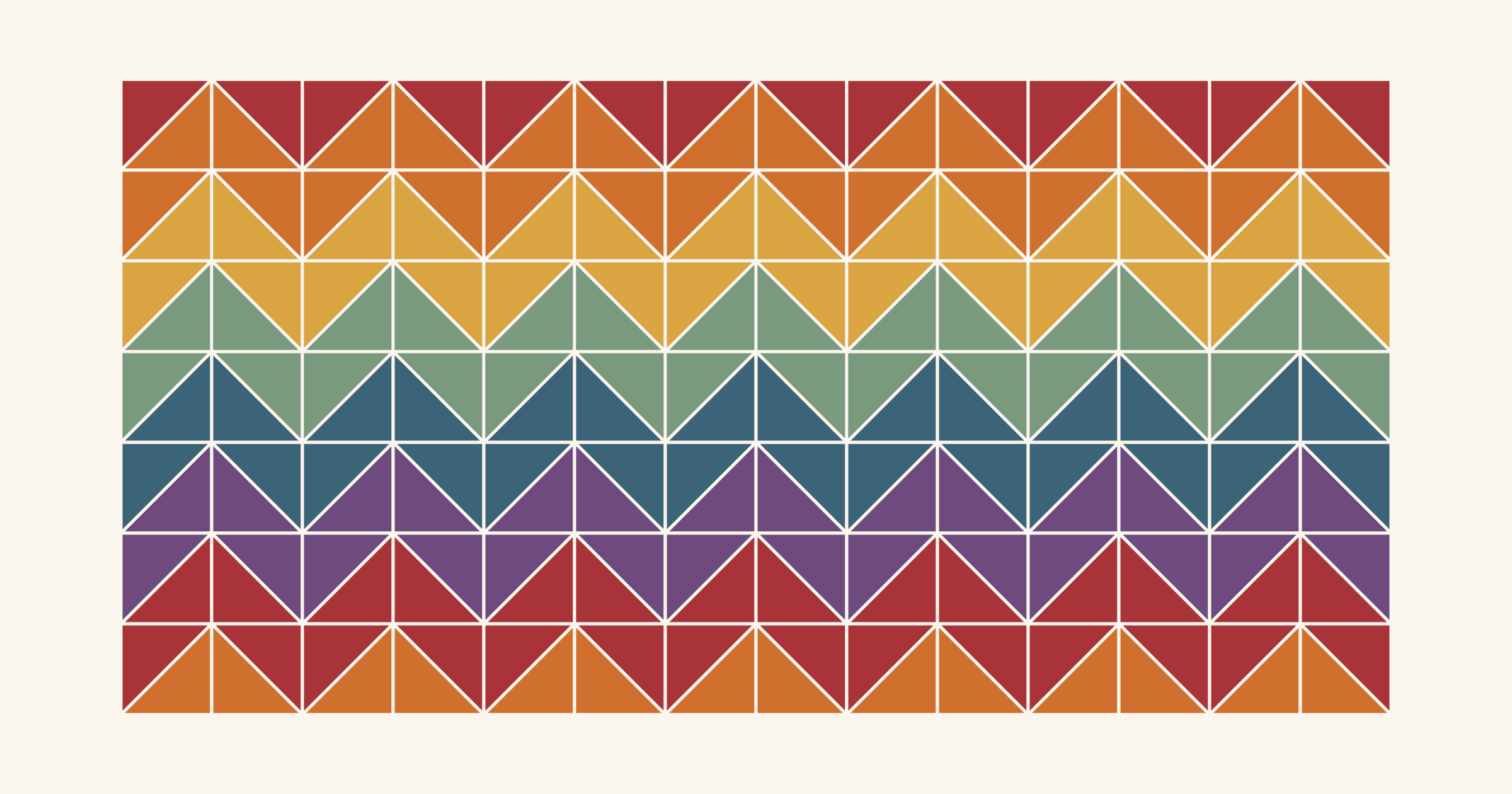
Rainbow quilts usually run red, orange, yellow, green, blue and purple. That's the spectrum order the Met Office lists as ROYGBIV; in fabric, fold indigo into blue or purple. Rachel LaBour of Stitched in Color adds the practical rule: start with any color, then keep cycling around the color wheel.
The order is the easy part. Keeping it when blocks turn is where rainbow quilts go wrong. Give each hue a place on the quilt: a row, column, diagonal or zigzag band. Then color every patch by the band it lands in after its block is turned. For a first rainbow quilt, put one hue in each block, so turning can't scramble the order. When a block carries two hues, as in a zigzag of half-square triangles, use a turning key like the one below.
What order do rainbow quilt colors go in?
Start with six families: red, orange, yellow, green, blue and purple. Then place the in-between fabrics. LaBour's scrap rainbow tips cover the usual problems:
- Pinks: rosy, cool pinks go between purple and red. Peachy, warm pinks go between red and orange, or stand in for orange.
- Greens: yellow-green (lime) sits next to yellow, and blue-green (teal) next to blue.
- Neutrals: she says they can go anywhere in the progression. She puts white beside yellow and grays or browns between blue and purple.
- Prints: sort each one by the color that stands out most.
Six steps read as stripes. For a smoother blend, use more. The rainbow-blend chapter of LaBour's book asks you to choose twelve colors. Melissa Corry of Happy Quilting used 36 Riley Blake Shades Basics for one diagonal rainbow.
Decide early whether the rainbow runs once or repeats. A repeating rainbow wraps from purple back to red, and that turn is where a rosy pink fits.
Give each hue a line across the quilt
LaBour shows vertical, diagonal and circular blends. Corry chose a diagonal and suggests vertical, horizontal or "exploding from the center" as other directions. On a grid quilt, count the lines the rainbow steps across:
- Rows: one line per row.
- Columns: one line per column.
- Diagonals: rows plus columns, minus 1. Blocks whose row and column numbers add up to the same total share a diagonal.
Each line takes the next hue. Count blocks per hue before you buy fabric, because the direction changes the count. Take a 60 × 72 inch throw of 6-inch finished blocks: 10 columns, 12 rows, 120 blocks.
| Plan | Lines | Blocks per hue |
|---|---|---|
| Rows, six hues repeating | 12 rows | 20 of each |
| Columns, six hues repeating | 10 columns | 24 each of red, orange, yellow and green; 12 each of blue and purple |
| Diagonals, six hues repeating | 21 diagonals | 20 of each |
| Diagonals, one pass, seven hues | 21 diagonals, 3 per hue | 6, 15, 24, 30, 24, 15, 6 |
The repeating diagonal comes out even because 12 rows is a multiple of six hues, so every column holds each hue twice. The one-pass plan adds rosy pink as a seventh hue so 21 diagonals split into seven bands of three. It gives the middle hue, green, five times as many blocks as the red and pink corners. That suits a quilt with a wide center band. If you want the hues to look equal, repeat the sequence.
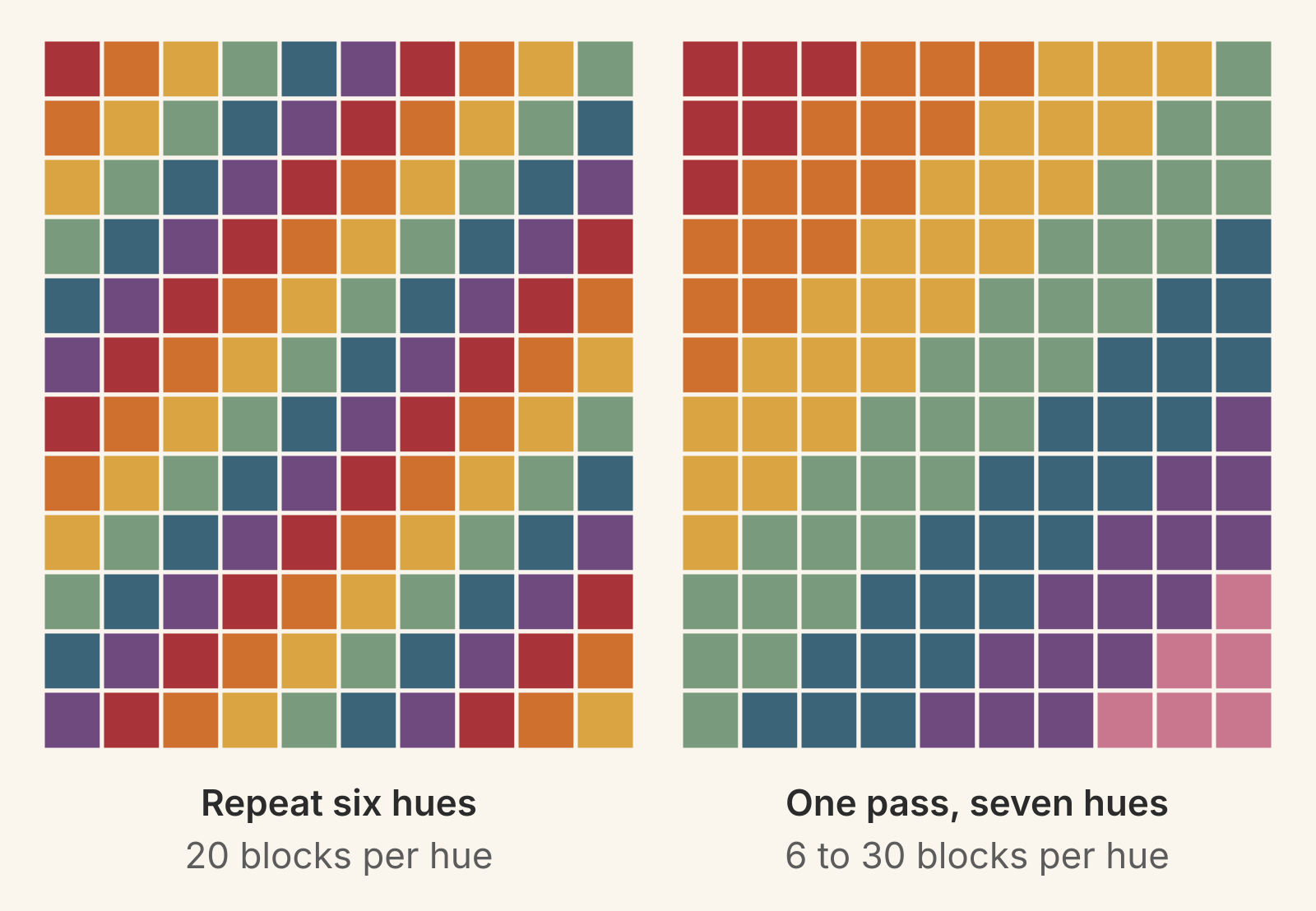
With one hue per block, or one hue plus background, a turn can't break these plans. The hue belongs to the block's place in the grid, so turning the block changes the shape at the band's edge, never which hue comes next.
Why do turned blocks scramble a zigzag rainbow?
Some rainbow layouts cut through the blocks. In a zigzag (chevron) of half-square triangles (HSTs), each band is the bottom triangles of one row plus the top triangles of the next. So every HST holds two hues: the band above on top, the band below underneath. The free Chevron Block by Jina Barney for Riley Blake Designs is built this way. Its rows pair pink with white, red with pink, and red with white, then repeat.
A two-hue block has a direction of its own. Turn a red and orange HST clockwise through its four positions, and only two keep red on top:
- 0°: the seam runs from lower left to upper right, with red in the upper-left half. Use it in odd columns.
- 90°: the seam runs from upper left to lower right, with red in the upper-right half. Use it in even columns.
- 180° and 270°: orange ends up on top. Each wrong turn still has a seam that looks right in one kind of column: 180° slants like an odd column, 270° like an even one. So check the colors, not just the seam.
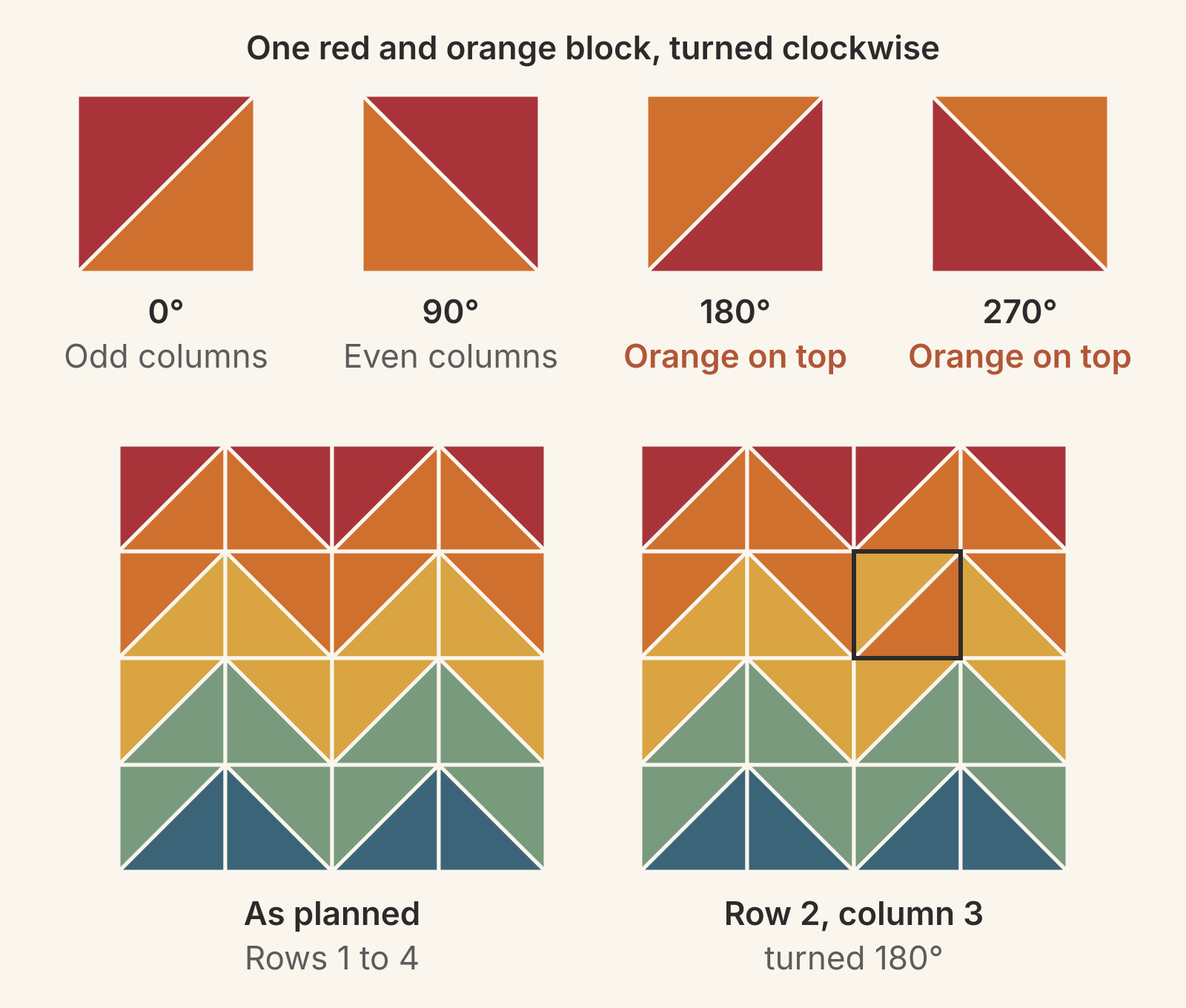
One wrong block mismatches all four of its edges: the later hue pokes up into the band above, and the earlier hue drops into the band below. The key still applies when one half is background, as in a rainbow zigzag with cream bands between the colors. There, a wrong turn drops cream into a colored band.
For the orientation names of other HST settings, see our half-square triangle layouts. The color rule is the same in all of them: decide the turn first, then give each triangle the hue of the band it lands in.
Worked example: map a 60 × 72 inch zigzag rainbow
Use the same throw: 10 columns and 12 rows of 6-inch finished HSTs (6 1/2 inches unfinished), with six hues repeating.
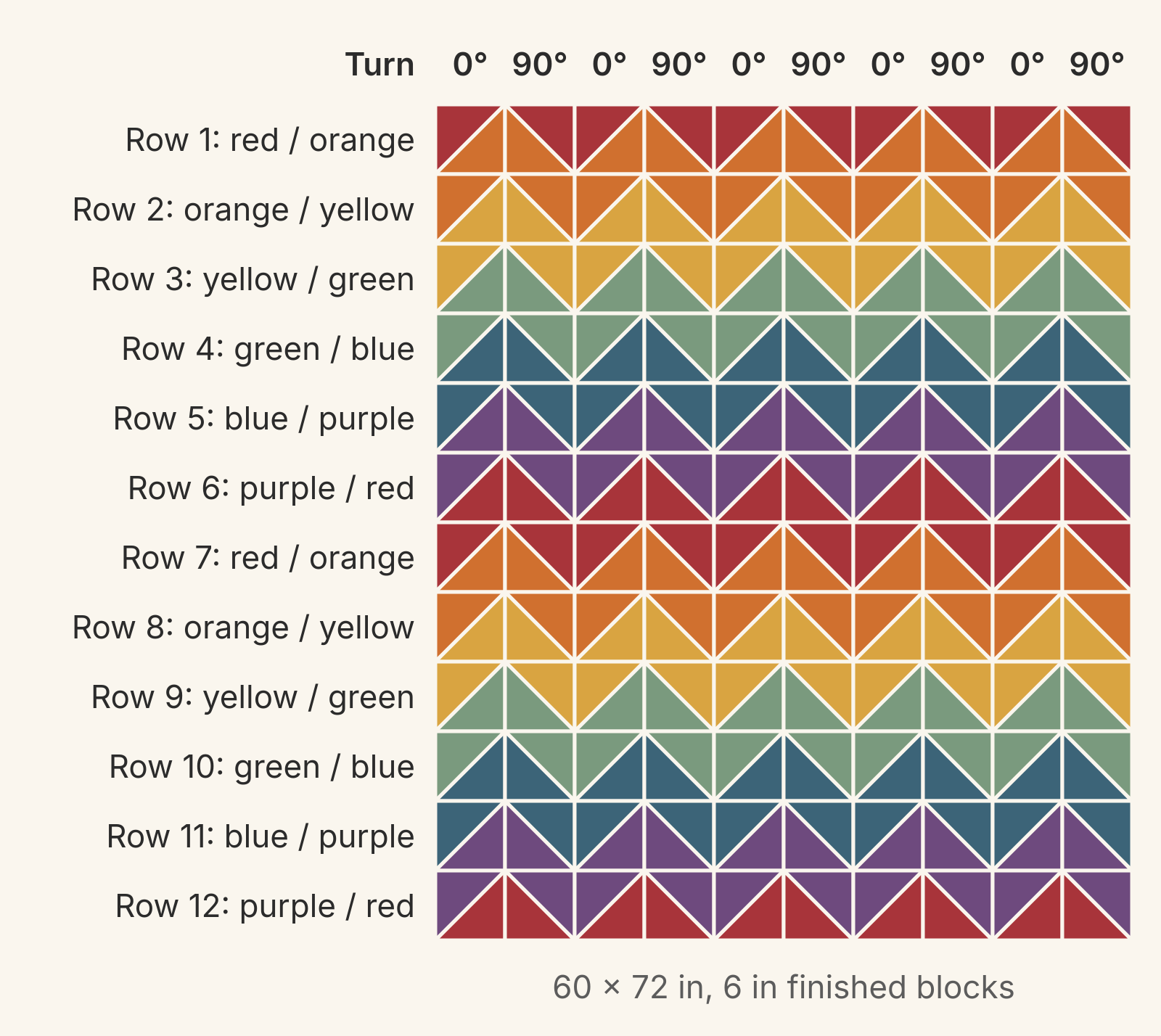
- Number the bands. Twelve rows make 13 bands. A half band runs along the top edge (the top triangles of row 1), then 11 full zigzags, then a half band along the bottom (the bottom triangles of row 12). Band 0 is red, band 1 orange, and so on around the six hues, so bands 0, 6 and 12 are red.
- Read each row's pair. Row 1 is red over orange, row 2 orange over yellow, through row 6, purple over red. Rows 7 to 12 repeat rows 1 to 6.
- Set the turns. Odd columns stay at 0° and even columns turn 90° clockwise, 60 blocks each.
- Count. Each of the six pairs fills two rows, so you need 20 HSTs of each pair. Every hue covers 40 triangles: two full bands of 20, or for red, one full band plus the two half bands of 10.
With two-at-a-time HSTs, one square of each hue makes two identical blocks. That's 10 pairs of squares for each hue pair, or 20 squares of each hue and 120 squares in all. Using the rules in our two-at-a-time guide, start with 6 7/8-inch squares, or 7-inch squares trimmed to 6 1/2 inches. If you trim, our guide to trimming half-square triangles so the points meet shows where the ruler goes. Quilting cotton fits at least five squares across, so 20 squares take four width-of-fabric strips: 27 1/2 inches for 6 7/8-inch squares, or 28 inches for 7-inch squares. Buy 7/8 yard (31 1/2 inches) of each hue.
Before sewing all 120, sew rows 1 and 2 and lay them out. Their shared orange band is the first full zigzag, so it tests the turning key.
Check the neighbors as well as the order. Two hues close in value, such as a medium blue beside a medium purple, can blur at the zigzag edge. Our color theory guide shows the black-and-white photo check. Our grayscale value check walks through testing each pair of fabrics that share a seam.
Check the map in QuiltLab before you cut
In the Quilt Editor, a Standard grid with 6-inch blocks, 10 columns and 12 rows shows 60 × 72 inches beside the Layout heading. Place the Half Square Triangle template in every cell, as in our HST layouts walkthrough. It lands like the 0° block above, dark half in the upper left. Then select each block in an even column and press R, or use Rotate clockwise in the Transform section of Properties. Turn them one at a time: with several blocks selected, rotation turns the group around its center and moves the blocks.
To give one placement its own hue pair, select it and open Cell Overrides in Properties. You pick a fabric for each of the block's fabric groups, for that placement only. If the block has no fabric groups, add them in the Block Editor. Recolor rows 1 and 2 first; like the first two rows you sew, they test the turning key. QuiltLab won't count triangles per hue or work out yardage for a grid quilt, so keep the counts from this article.
Quilt Editor guide →Grid size, block layout, borders and savingYour next step
Write the hue list first, with pinks and neutrals placed. Choose rows, columns, diagonals or zigzags, number the lines, and count blocks per hue. If your blocks carry two hues, write each row's pair and each column's turn on a map like the one above. Then sew one pair of rows and lay it out before you cut the rest. In the Quilt Editor you can set every turn on screen first, so a wrong turn costs a click instead of a seam ripper.
Related posts
Grayscale Value Check: Which Quilt Fabrics Will Blend?
Photograph your fabrics in black and white and look for any two that turn the same gray. A worked Friendship Star shows why opposite colors can blend.
Irish Chain Quilt Colors: Which Fabric Goes Where?
Most Irish Chains put darker chain fabrics on a light background. Compare single and double chain value maps and see which fabric shapes the diamonds.
Low Volume Quilt Fabric: When Do Quiet Prints Need Contrast?
Light prints can blend in the background but need a value step wherever they form the design. Sort them into two groups and follow a 45 x 60 inch plan.