


Half-Square Triangle Quilt Layouts: One Block, Many Quilts
Most half square triangle quilt layouts are the same 64 units, turned. The block does not change. The dark triangle's corner does. This post names seven traditional settings, says how each half-square triangle (HST) is oriented, and works a 48-inch square on an 8 × 8 grid you can sew or try first in the Quilt Editor.
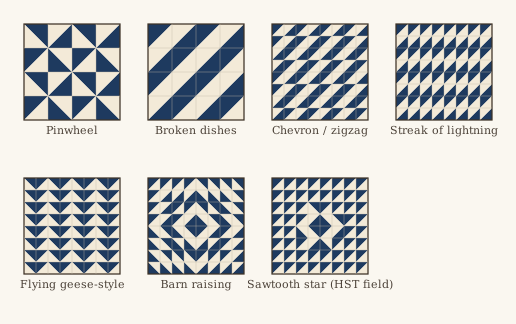
The live search results for this query are idea galleries: Cara Stromness at MadamSew lists 13 block-scale arrangements, and other posts sell a printable. They rarely name the traditional settings or say which corner the dark half occupies. The notes below do both.
The unit, and how we talk about orientation
An HST is a square split on one diagonal into a dark triangle and a light triangle. QuiltLab's Half Square Triangle page calls it a triangle square: two pieces, one seam.
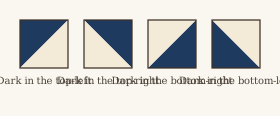
Every layout in this post is a grid of those squares. To place one, you only need to know which corner holds the dark triangle:
Value does the drawing. If the two fabrics sit too close in value, pinwheels flatten into noise. Color theory for quilters is the longer treatment; here, photograph the pull in black and white before you cut.
QuiltLab does not calculate cut sizes or yardage. The numbers below are reader math, using the oversized "add 1 inch, then trim" formula Carole Fure published for National Quilters Circle. Sarah Stearns's charts give the exact-cut alternative (finished size plus 7/8 inch, two at a time) if you would rather not trim.
A 48-inch square: 64 HSTs on an 8 × 8
| Grid | 8 columns × 8 rows |
| Finished HST | 6 inches |
| Unfinished HST | 6 1/2 inches |
| Quilt-top size | 48 × 48 inches, no border |
That is 64 units. Two at a time: pair 7-inch squares, sew a scant quarter inch on both sides of one drawn diagonal, cut on the line, press toward the dark, trim to 6 1/2 inches. You need 32 pairs (64 squares to start). Eight at a time: pair 14-inch squares (6 + 1 = 7, times 2), draw both diagonals, sew on both sides of each, cut on the X and through the midlines. Eight batches make 64 with no spare. Jenny Doan at Missouri Star walks through two, four and eight at a time on precuts; four-at-a-time puts the outer edges on the bias, so press, don't slide.
A 2-inch finished HST on the same 8 × 8 is a 16-inch mini. A 4-inch finished HST is 32 inches. The orientations do not change with size.
Seven named layouts, and how each HST faces
Start every unit the same way: dark in the top-left. Then turn only the units the setting asks for. Coordinates below are (column, row), 1-based, from the top-left of the quilt.
Pinwheel
A 2 × 2 whose seams make an X through the centre, with the dark halves spinning one way. QuiltLab's Pinwheel block is this unit sewn as one four-patch.
In each 2 × 2:
| Cell | Dark corner |
|---|---|
| Top-left | Top-right |
| Top-right | Bottom-right |
| Bottom-left | Top-left |
| Bottom-right | Bottom-left |
That is a clockwise spin. Swap every dark to the opposite corner for counter-clockwise. Tile the 2 × 2 across the 8 × 8 (16 pinwheels). Keep the spin direction the same in every repeat or the field fights itself.
Broken dishes
A 2 × 2 hourglass: opposite units match, adjacent units are rotated 180 degrees. Seams still make an X, but the darks form two large triangles instead of a swirl.
| Cell | Dark corner |
|---|---|
| Top-left | Top-left |
| Top-right | Bottom-right |
| Bottom-left | Bottom-right |
| Bottom-right | Top-left |
Tile it. Secondary hourglasses appear where four 2 × 2s meet. QuiltLab's Half Square Triangle template lists Broken Dishes as an alternate name and notes it as an all-HST quilt. It is not the same as pinwheel.
Chevron / zigzag
Two HSTs side by side, one turned 180 degrees, make a dark parallelogram. Stack two identical rows, then flip the pair for the next two rows, and the parallelograms form a zigzag.
- Rows 1–2: dark top-left, dark bottom-right, repeating across the row.
- Rows 3–4: dark bottom-right, dark top-left, repeating.
- Repeat that four-row unit once more to fill eight rows.
Points run across the quilt. Reverse the two-row groups to send the chevron the other way.
Streak of lightning
Same zigzag idea, but each whole row faces one way. Row 1: every HST dark in the top-left. Row 2: every HST dark in the bottom-right. Alternate to the bottom. The result is horizontal lightning bolts, not the paired parallelograms of chevron. It is the faster layout to sew: you chain whole rows of identical units, then join the rows.
Flying geese-style
Two HSTs make one goose: darks meet at the top centre so the large dark triangle points up.
- Odd columns: dark in the top-right.
- Even columns: dark in the top-left.
Repeat in every row. You get four geese across and eight down, 32 geese from 64 HSTs. Turn the pair 180 degrees (darks in the bottom-right and bottom-left) to point the flock down. This is a setting of HSTs, not a pieced flying-geese unit with a single large triangle; the seam down the middle of each goose is the join between two HSTs.
Barn raising
Concentric diamonds, the HST cousin of a log-cabin barn raising. On an 8 × 8 the centre sits between cells (4, 4), (5, 4), (4, 5) and (5, 5).
Even rings (the centre 2 × 2, then the 6 × 6): point the dark triangle toward the centre. Odd rings (the 4 × 4, then the outer 8 × 8): point the dark triangle away from the centre.
| Quadrant | Toward centre | Away from centre |
|---|---|---|
| Upper-left | Bottom-right | Top-left |
| Upper-right | Bottom-left | Top-right |
| Lower-left | Top-right | Bottom-left |
| Lower-right | Top-left | Bottom-right |
The centre becomes a dark diamond; the next ring a light diamond; then dark, then light.
Sawtooth star
A traditional Sawtooth Star is not an all-HST quilt. QuiltLab's block is a centre square, four corner squares, and four flying-geese units (eight small triangles) for the points. You can build each goose from two HSTs, which is why it belongs on this list, but you still need the five squares.
Friendship Star is the smaller cousin: a nine-patch with four HST points and five squares. Same rule: the HSTs all turn the same way around the centre.
If you want a star suggestion on an all-HST 8 × 8, put a dark diamond in the centre 2 × 2 and a goose (two HSTs) on each side of it, pointing out. The rest of the field can stay on one orientation as a background. It reads as a star. It is not the 17-piece Sawtooth Star.
Try every layout on one grid in QuiltLab
The Quilt Editor's rotate and flip controls are built for this. Place one HST in every cell, then turn units. You are not redrawing the block.
- Open the Quilt Editor. Choose File > New Quilt..., then Grid, then Create grid quilt.
- Open Properties. Keep orientation Standard. Set block Width and Height to 6 inches, Columns to 8 and Rows to 8. Leave Borders at 0. The finished area should read 48 × 48 inches.
- Open the Blocks tab. Expand Templates, search for Half Square Triangle, and choose Use template. Click every cell, then press Escape to leave placement mode.
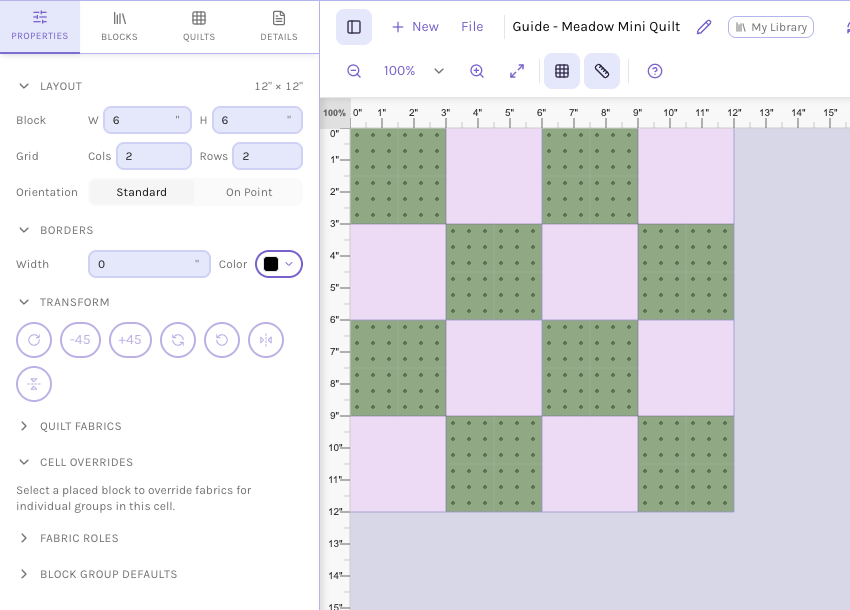
Properties on a smaller 2 × 2 of 6-inch blocks. For this project, enter 8 columns and 8 rows.
Select one placed HST. Press R to rotate it 90 degrees clockwise, Shift+R counter-clockwise, H to flip it horizontally, or V to flip it vertically. The toolbar has the same four actions, plus 45-degree steps and a reset-to-grid control. These layouts stay on a Standard grid, so 90-degree turns and flips are the ones you need.
Quilt Editor guide →Grid size, Standard vs On Point, borders and the Blocks libraryTo draw your own HST instead of using the template, open the Block Editor, set the block to 6 × 6 inches, and split a square on the diagonal (the Triangle draw tool makes an isosceles triangle from a bounding box, not a corner-to-corner HST). Save it, then place it from Blocks the same way.
On Point orientation rotates the whole grid 45 degrees. It does not create these settings by itself, and it does not stagger rows.
What to sew after you pick a setting
The 8 × 8 of 6-inch HSTs is a 48-inch top. A 3-inch border on all sides makes 54 inches; a 6-inch border makes 60. Work those additions on paper. QuiltLab will show the finished size in Layout once you type a border width, but it will not give you a cutting list, binding length or backing yardage.
Press HSTs toward the dark so the seams nest when darks meet. For pinwheel centres, unpick the few stitches inside the seam allowance and spin the seam; the centre opens into a tiny pinwheel and the bulk drops.
If you want one more layout after you settle this one, keep the same 64 units on the design wall and turn them again. That is the whole point of the block.
Try every layout on one 8 × 8 grid before you cut. See pricing.
Related posts
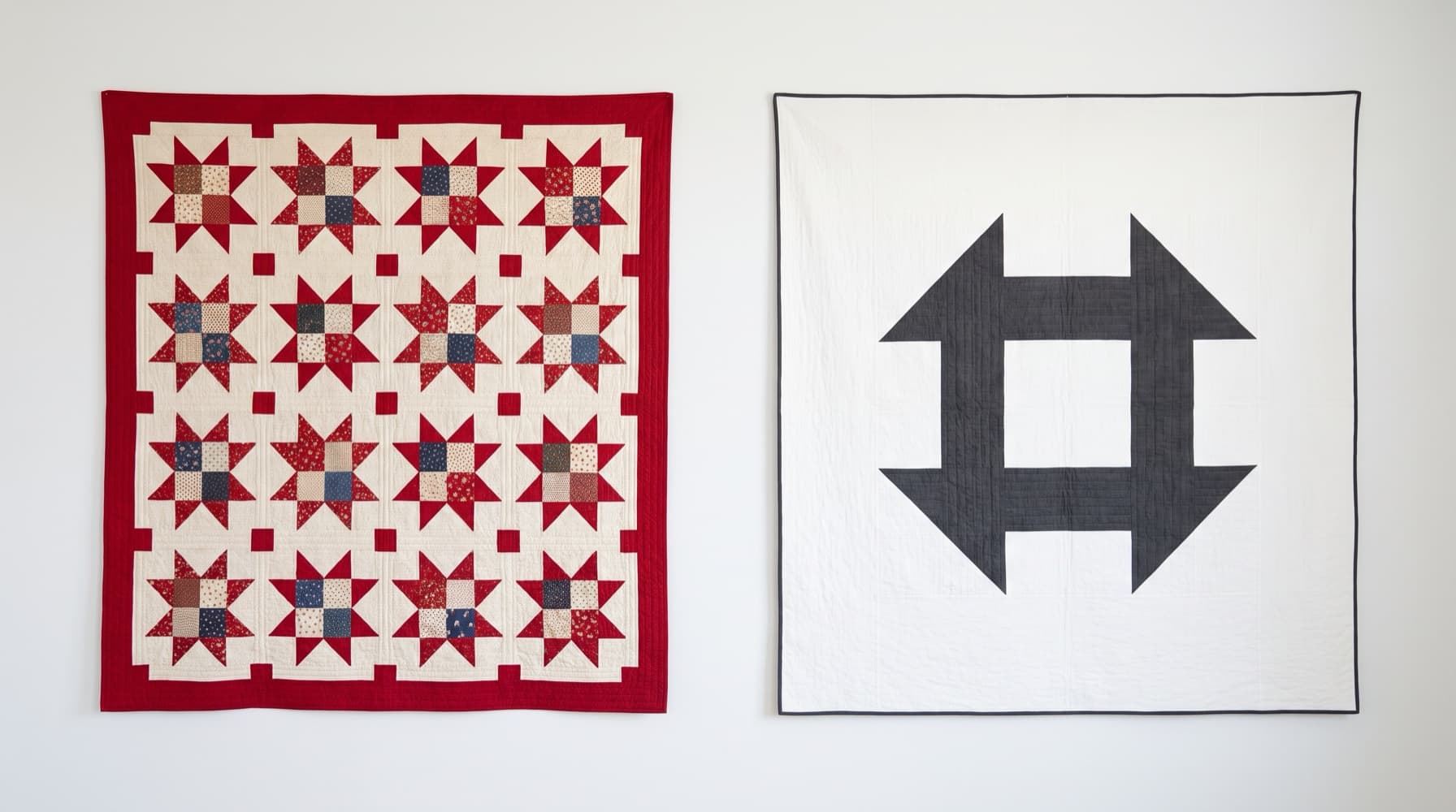
Modern vs. Traditional Quilts: What Actually Separates Them
Fabric choice isn't what makes a quilt modern. Layout, scale, negative space and quilting do. Here's how to tell the two styles apart, and how to borrow from both on purpose.
Color Theory for Quilters: Value, Hue and Choosing Fabrics That Work
Most quilt color problems are value problems. This guide covers the four properties of fabric color, the classic schemes, and a fabric-pull process you can use on your next project.
Photo Quilt Ideas: Seven Projects, From Printed Panels to Pieced Mosaics
There are three ways to put a photo in a quilt, and each suits different pictures. Here are seven project ideas matched to the right technique, with layout sizes you can use.