


Irish Chain Quilt Colors: Which Fabric Goes Where?
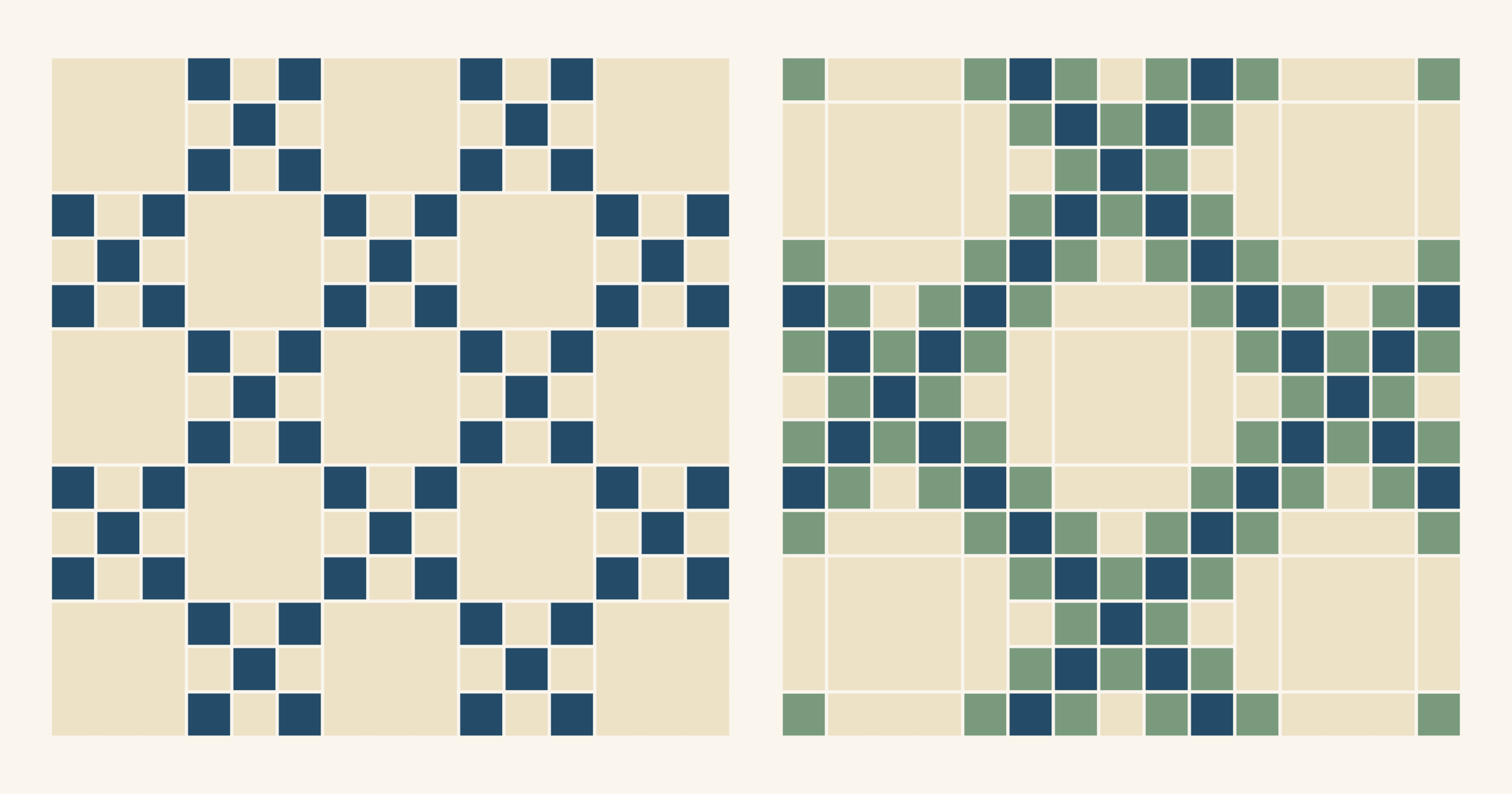
Most Irish Chain quilts put one or two darker chain fabrics on a light background. Julie Baird of Generations Quilt Patterns makes the Single Irish Chain from two fabrics, a background and a contrasting chain. Her Double Irish Chain uses three: a background and two chain fabrics. For a double, put your darkest fabric on the X that runs through the chain block and a medium in the squares beside it. Start there for a first chain quilt.
Then look at the light shapes between the chains. They form stepped diamonds, the quilt's secondary design, and your fabric roles decide whether the chain or the diamonds lead. Below, both chains use 2-inch finished squares, and only the fabric roles change. We drew these diagrams for this article and haven't sewn them.
Name the roles before you pull fabric
A classic Irish Chain alternates a pieced chain block with an alternate block. Give each patch a job before you choose fabric:
- X squares (X). The squares that run corner to corner through the chain block. In a single chain, they're the four corners and center of a nine patch.
- Side squares (S). Double chain only. These are the 12 squares that fill in beside the X, plus the 4 corner squares of each alternate block.
- Background (B). The middle square on each edge of the chain block, plus the rest of the alternate block.
With 2-inch finished squares, cut at 2 1/2 inches, a single chain block finishes at 6 inches and a double chain block at 10 inches.
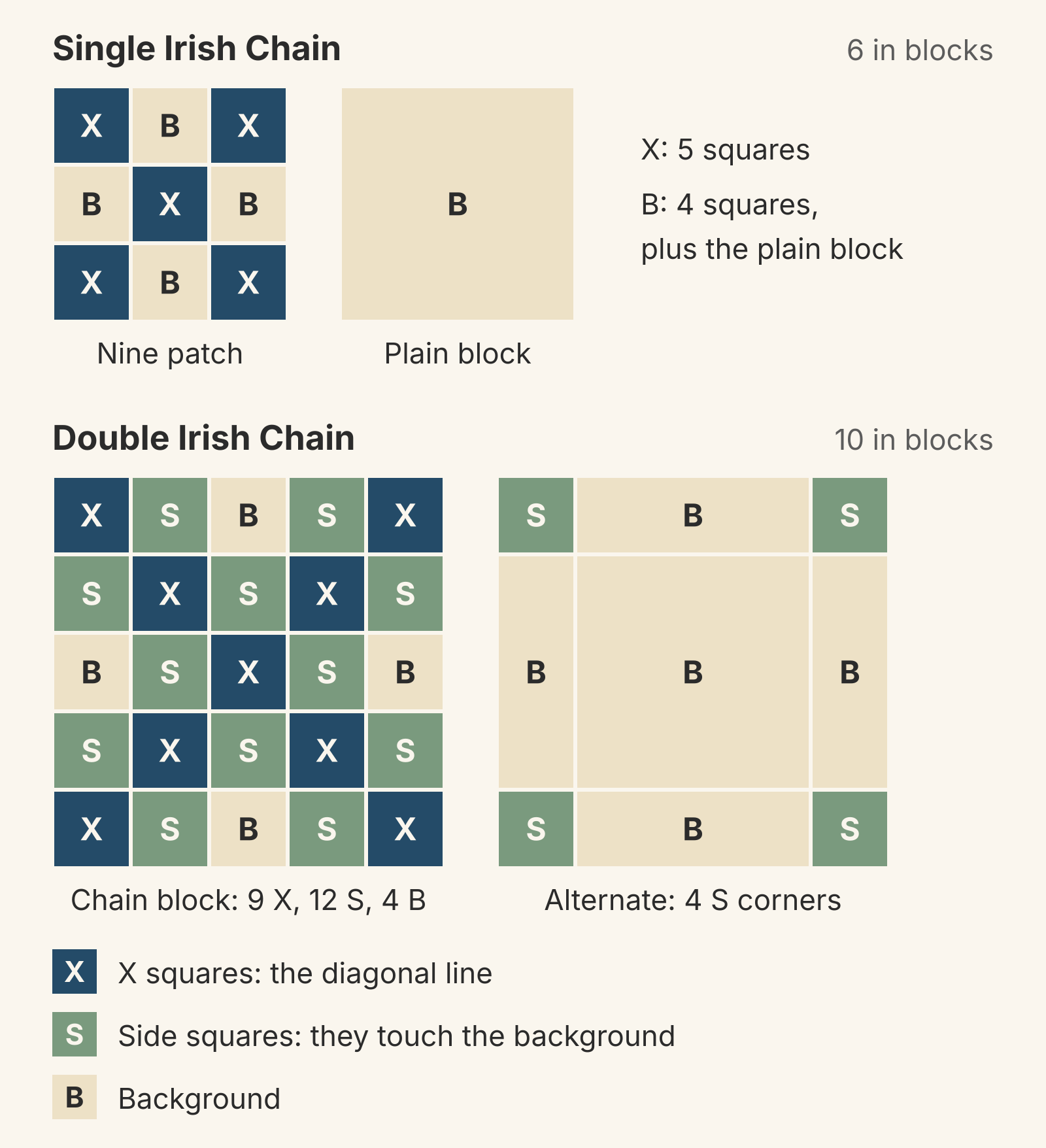
The classic double puts dark on the X and medium on the side squares. The American Quilter's Society's chain block lesson cuts its pair of 15-inch Double Irish Chain blocks from 9 dark squares, 16 medium squares and light background pieces. Its block drawing puts the dark squares on the X. The 16 medium squares are the 12 side squares in the chain block plus the 4 corners of the alternate block.
Baird's Double Irish Chain page says the pattern is traditionally made with a light background and two medium to dark fabrics. She also reminds you that color value is relative: the chains need enough contrast to stand out from the background.
Where the secondary design comes from
The background doesn't form one big field. Each alternate block joins the four background squares around it, one from each neighboring chain block, and together they make a stepped diamond. In a single chain, Baird describes the dark fabric forming diamond-shaped frames around the plain squares.
The size of that diamond is the first difference between the two chains. Here they are with the same 2-inch squares, in a layout of 5 x 5 blocks:
| Single chain | Double chain | |
|---|---|---|
| Diamond area | 52 square inches | 100 square inches |
| Diamond, point to point | 10 inches | 14 inches |
| Background share of the top | 71% | 49% |
The double chain's diamond has almost twice the area. Yet the background covers less of the quilt, because the chain itself is wider.
The second difference is how the chain squares meet. In a single chain, each X square has background on all four sides, and the X squares touch each other only at their corners. The chain is a dotted line. Baird notes that because a single chain is one fabric wide, the pattern is less distinct; you may need to squint to see it.
In a double chain, the X squares never share a seam with the background. Side squares surround every X square, so the chain becomes a solid band. That's the fact behind every choice below: the side-square fabric is the only chain fabric the background touches.
Single chain: give the X your strongest contrast
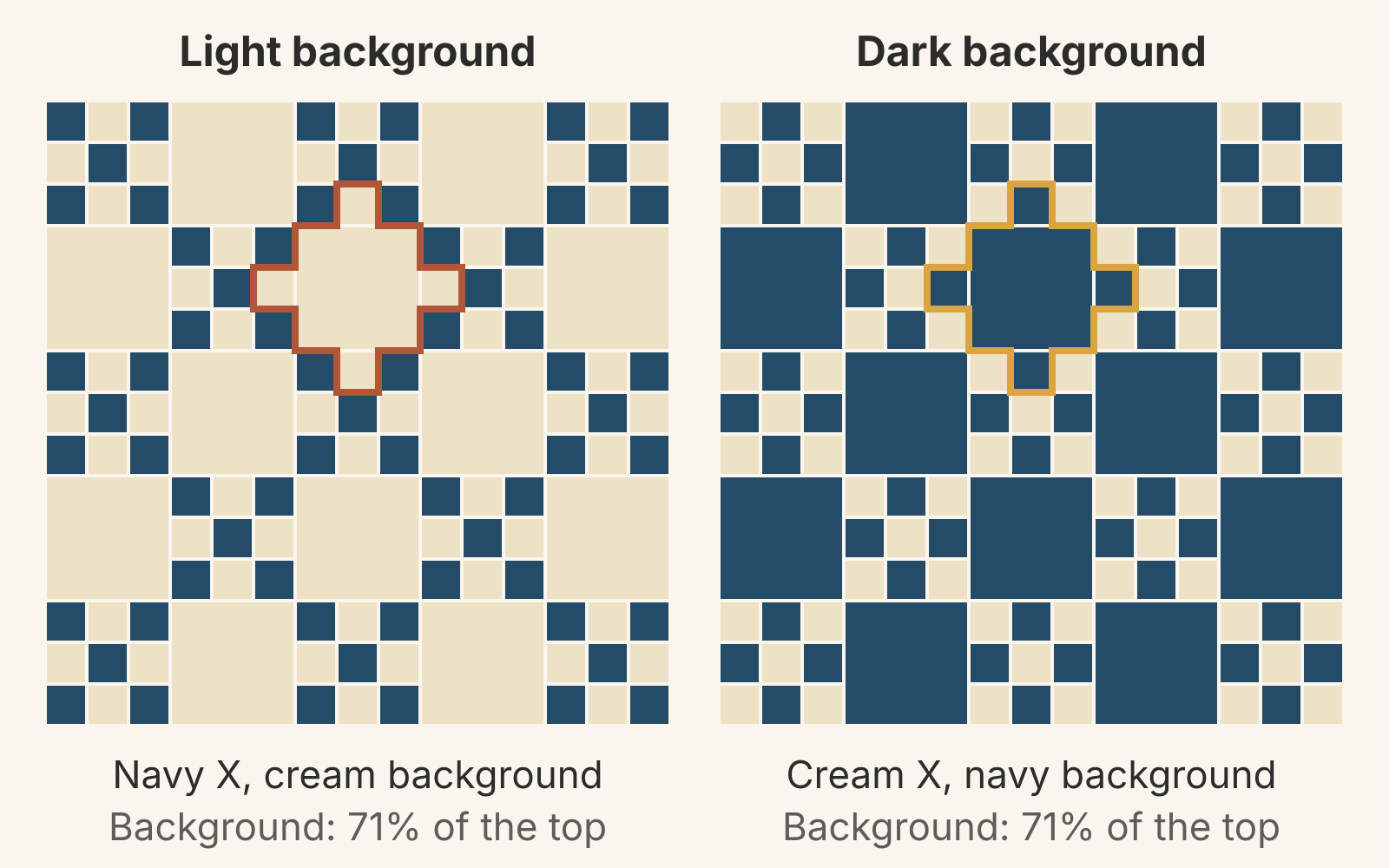
A single chain has two roles, so you make one decision: which role is dark. The maps below show the same 30-inch layout both ways. It has 13 nine patches and 12 plain blocks in 5 rows of 5, with nine patches in the corners.
- Light background. Navy X squares on cream. The navy covers 29% of the top and reads as a thin diagonal lattice. The cream diamonds are open windows, ready for quilting or applique. This is the traditional look.
- Dark background. Cream X squares on navy. The background is still 71% of the top, but now it's dark. The navy diamonds become the bold shape, and the cream chain turns into a light lattice laid over them.
Baird writes that a light background gives a more traditional feel, while a dark one can add drama and a more contemporary look. The International Quilt Museum notes that Irish Chains often use a limited number of colors, one of them usually white. It calls the orangey-brown background of one Triple Irish Chain, probably made in Pennsylvania, a radical departure from white.
Because single-chain squares touch only at their corners, they need the strongest value contrast you have. A medium chain on a light background fades faster here than in a double, because its squares never join into a band. Our guide to spacing the values in a two-color quilt gives a gap to aim for. If you go scrappy, vary the X squares and keep the background the same. Ellen March's Irish Chain tutorial for Sulky uses a different print in each nine patch and keeps the blender squares in the same place. She also notes that two fabrics give more of the chain effect.
Double chain: choose which fabric touches the background
With three roles, the order of your two chain fabrics matters as much as their contrast with the background. The maps below use one 50-inch layout twice: 5 x 5 blocks of 10 inches, 13 chain blocks and 12 alternate blocks. Only the X and side fabrics trade places.
- Medium beside the cream. Navy X, sage side squares, cream background. Sage sits about halfway between cream and navy in value, so each change of fabric is a medium step. In the drawing, the navy X lines read clearly as the chain, and the diamonds have a softer edge.
- Dark beside the cream. Sage X, navy side squares. Now every seam between the chain and a diamond is navy against cream, the strongest contrast in the quilt. In the drawing, each diamond gets a dark stepped outline, and the sage X lines sink into the band.
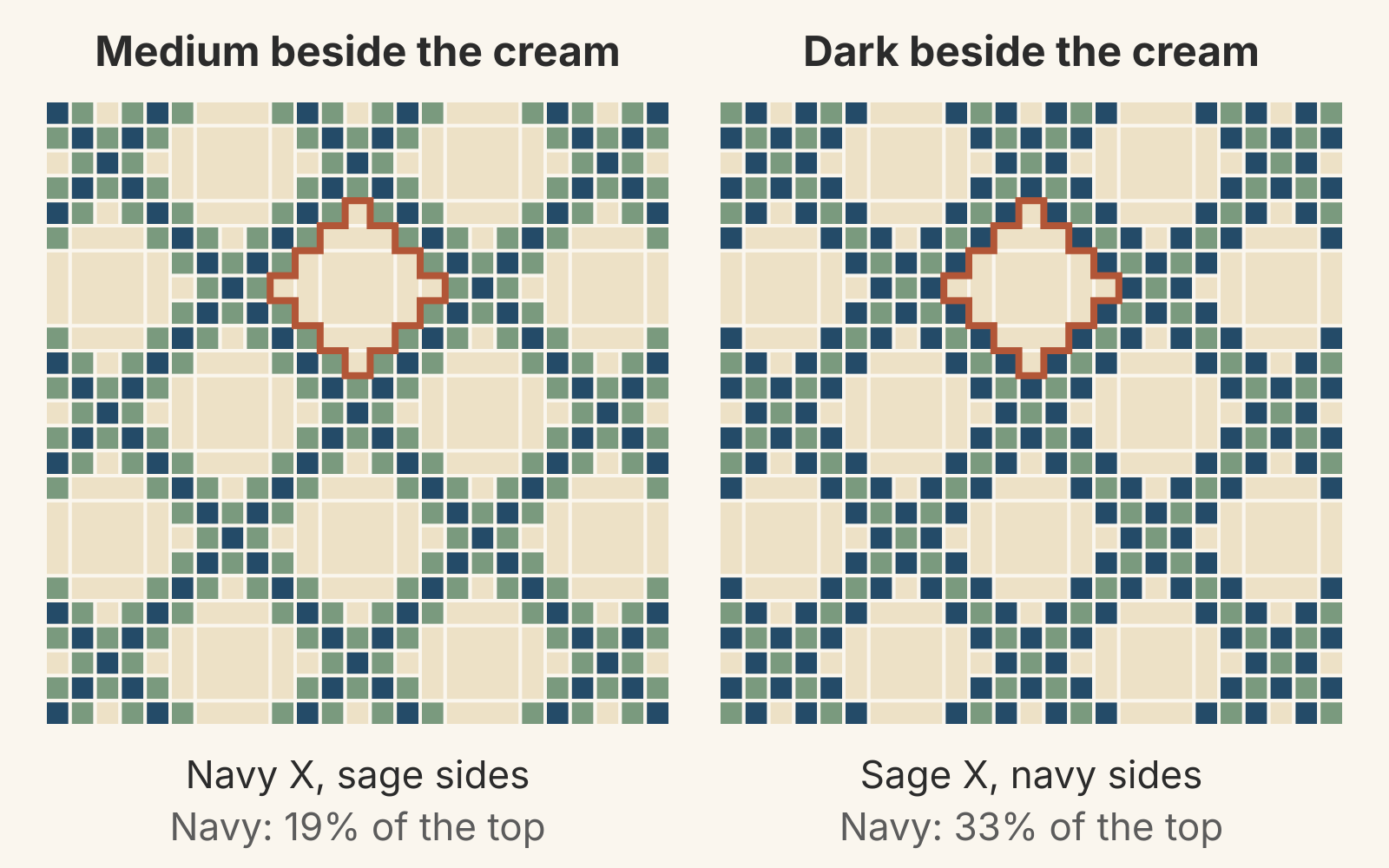
The swap also changes how much dark fabric you see. Here's what each role covers in this 50 x 50-inch top:
| Role | Pieces | Finished area |
|---|---|---|
| X squares | 117 squares | 468 square inches |
| Side squares | 204 squares | 816 square inches |
| Background | 52 squares plus 12 alternate-block backgrounds | 1,216 square inches |
The total is 2,500 square inches, the full top. Moving navy from the X to the side squares takes it from 468 to 816 square inches, about 1 3/4 times as much. When you audition fabric for either order, keep those proportions: more side fabric than X fabric, and more background than either.
For most double chains, start with the classic order: dark on the X, medium on the side squares. You get a clear chain with even value steps. Swap them when you want each diamond outlined more strongly than the chain line. If you'd rather push attention into the open spaces for quilting or applique, Baird suggests a different move: reduce the contrast between the chains and the background.
Check value before you cut
Prints and real colors can shift the balance you drew. Before you cut all the squares:
- Photograph the fabrics in grayscale. For the classic double, you want three distinct grays, with the side fabric between the other two. For a single, you want the biggest gap you can get between X and background. Our color theory guide covers value checks in more detail.
- Audition one full diamond. A diamond needs an alternate block with a chain block on each of its four sides. That plus shape is 18 inches across for a 6-inch single and 30 inches for a 10-inch double. Lay it out on a design wall or draw it.
- Watch the background print. A busy light print in 2-inch squares can break up the diamond edges. Our guide to choosing background fabric walks through that choice.
- Decide on blending on purpose. Baird notes that chain fabrics that blend into each other, as in a colorwash, make the links of the chain blur together. That's a fine effect when you choose it.
For more on how motifs form across block seams, see our article on secondary patterns in quilts.
Try both orders in QuiltLab
You can compare value orders on screen before cutting. In the Block Editor, set the block to 10 inches. In the View menu, turn on Snap to grid and set Grid spacing to 2 inches, then draw the 25 squares of the chain block. Select the nine X squares together and choose their fabric in one step, then do the same for the side squares and the background. For a block in your own library, save it, then choose File > Save A Copy. You keep working in the copy, so swap the X and side fabrics there. Draw the alternate block too: four 2-inch corners, four 2 x 6-inch sides and a 6-inch center.
In the Quilt Editor, start a Grid quilt with 10-inch blocks, 5 columns and 5 rows. Put chain blocks in the corners and alternate them with the alternate block, then build a second quilt with the swapped chain block. QuiltLab doesn't calculate yardage or cutting lists, so keep the counts above with your plan. For a full walkthrough of a nine patch chain, see Design Your First Quilt in QuiltLab.
Block Editor guide →Draw pieces, assign fabrics and save blocks for your quilt layoutsOnce you've picked an order, cut 2 1/2-inch squares of your three fabrics and lay out one chain block next to a piece of background at least 10 1/2 inches square. Take a grayscale photo. If the three grays fall in the order you planned, cut the rest.
Related posts
Ohio Star Quilt Block Variations: Will the Star or Center Stand Out?
Many Ohio Star variations keep the same nine-patch and move the fabrics. Compare four color maps on one 12-inch star and see why value decides what you notice first.
Rail Fence Quilt Color Placement: Which Strip Makes the Zigzag?
Put your lightest and darkest fabrics on the outside strips and a medium in the center. Three 24-inch studies show why the outside strips draw the zigzag.
Courthouse Steps Color Placement: Where Do Lights and Darks Go?
Put light fabric on one pair of opposite sides and dark on the other, or color by rounds for framed squares. Two 10-inch maps show how each one repeats.