


Precuts vs Yardage: One Quilt Counted Both Ways
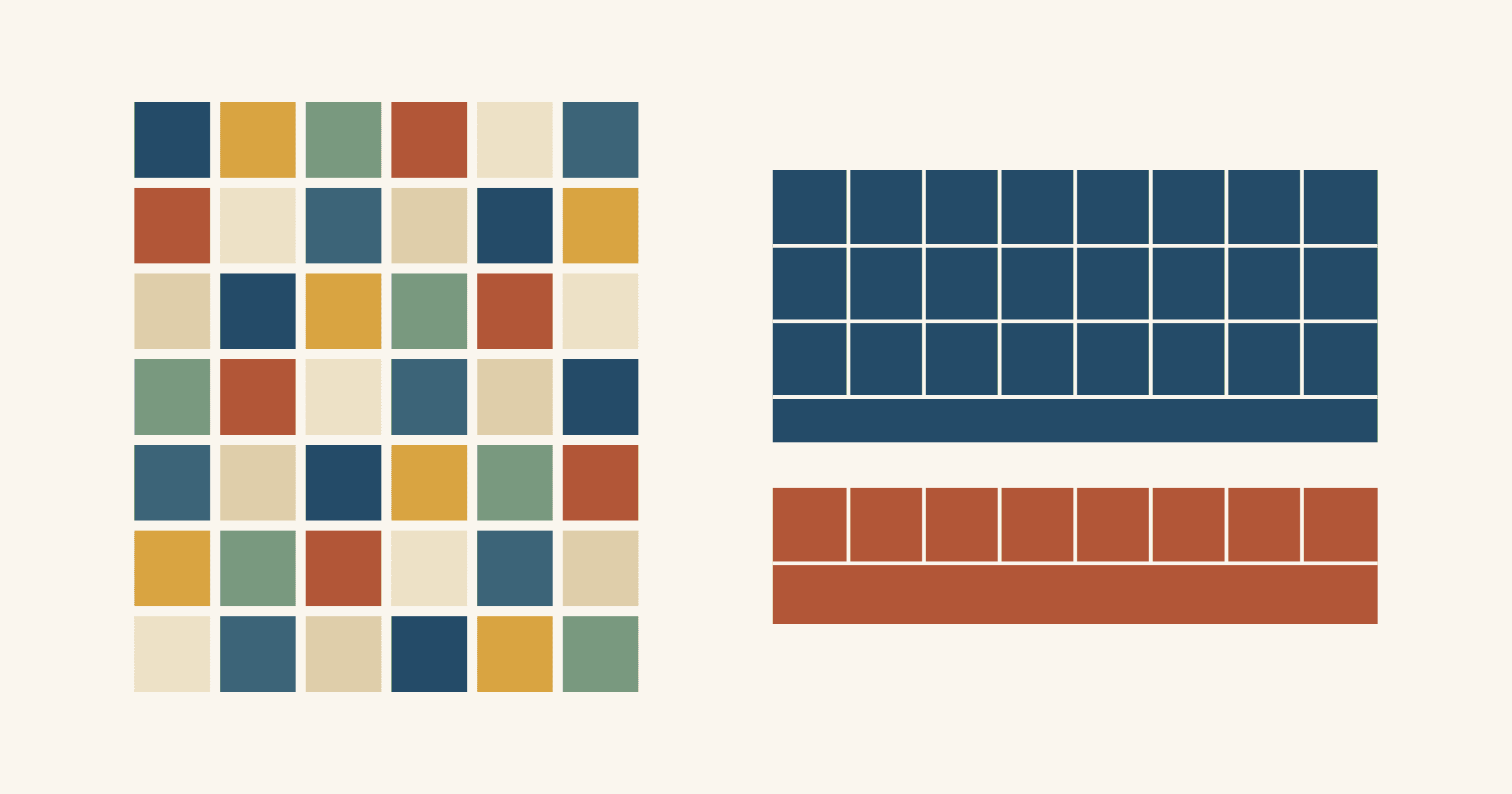
Most quilters buy both. Precuts supply the many prints in a quilt top, and yardage covers the background, borders, binding and backing. That's the bottom line of Missouri Star Quilt Co.'s comparison of precut fabric and yardage. Choose precuts when your design needs lots of prints in pieces the size of the precut. Choose yardage when it uses a few fabrics, pieces bigger than the precut, or prints you want to pick yourself.
To see how far apart the two routes are, we counted one quilt both ways: 120 five-inch squares sewn into a 45 x 54-inch top. Three charm packs give it 40 prints, nothing to cut and 150 square inches left over. Five half yards give it 5 prints, 15 strips and 120 squares to cut, and 600 square inches left over. Matching the charm packs' 40 prints takes 10 yards of quarter-yard cuts, or 5 yards of fat eighths, for a top that uses about 2 yards.
Precuts vs yardage: the basics →What each format is, its standard sizes and the jobs each one suitsThe quilt and the assumptions
The design is plain patchwork, 10 squares across and 12 down. Each square is cut at 5 inches and finishes at 4 1/2 inches with quarter-inch seams. The top measures 10 x 4 1/2 = 45 inches wide and 12 x 4 1/2 = 54 inches long.
Every number below rests on these assumptions:
- A charm pack holds 42 squares, 5 x 5 inches, one per print. Amy Smart's guide to working with precuts says 5-inch packs typically come with 42 squares. Missouri Star says a charm pack has one square from each fabric in the collection. Count yours before you plan; not every pack has 42 different prints. Our charm pack guide covers sizes and names.
- Yardage has 40 usable inches across. A quarter yard is 9 inches by the width of the fabric, which Amy Smart puts at around 42 to 43 inches in her beginner fabric shopping tips. Trimming selvages and squaring the edge takes some of that. At 40 or 42 inches, a 5-inch strip gives eight squares. We count yardage at 40 inches, so the totals leave out the selvages you also pay for.
- The smallest straight cut that works is a quarter yard. An eighth of a yard is only 4 1/2 inches deep, too narrow for a 5-inch square.
- Only the top is counted. Binding, backing and any border come from yardage on either route. Our backing and binding guide works those out.
Route 1: three charm packs
Buy three packs of the same collection. They hold 3 x 42 = 126 squares, six more than the quilt needs. Pull the two prints you like least, three squares each, and you have exactly 120: 40 prints, three of each. Keep the six spares in case a square gets damaged, because a precut has no extra fabric to recut from. Have only one pack? Our one charm pack quilt plan shows how far background fabric stretches it.
There's nothing to cut. Missouri Star does suggest checking each square with a ruler before you sew, since some may not be perfectly square. If you have to trim, trim every square to the same size so the rows still line up.
The squares come to 126 x 25 = 3,150 square inches of fabric. The quilt uses 120 x 25 = 3,000 of them, or 95%.
Route 2: yardage in a few prints
From yardage, every square starts as a strip cut across the width. A half yard is 18 inches deep, so it gives three 5-inch strips and a 3-inch strip left over. A quarter yard is 9 inches, so it gives one strip and a 4-inch strip left over. Squaring up the cut edge takes its trim from that spare strip, so a slightly crooked cut from the shop still leaves room for every strip.
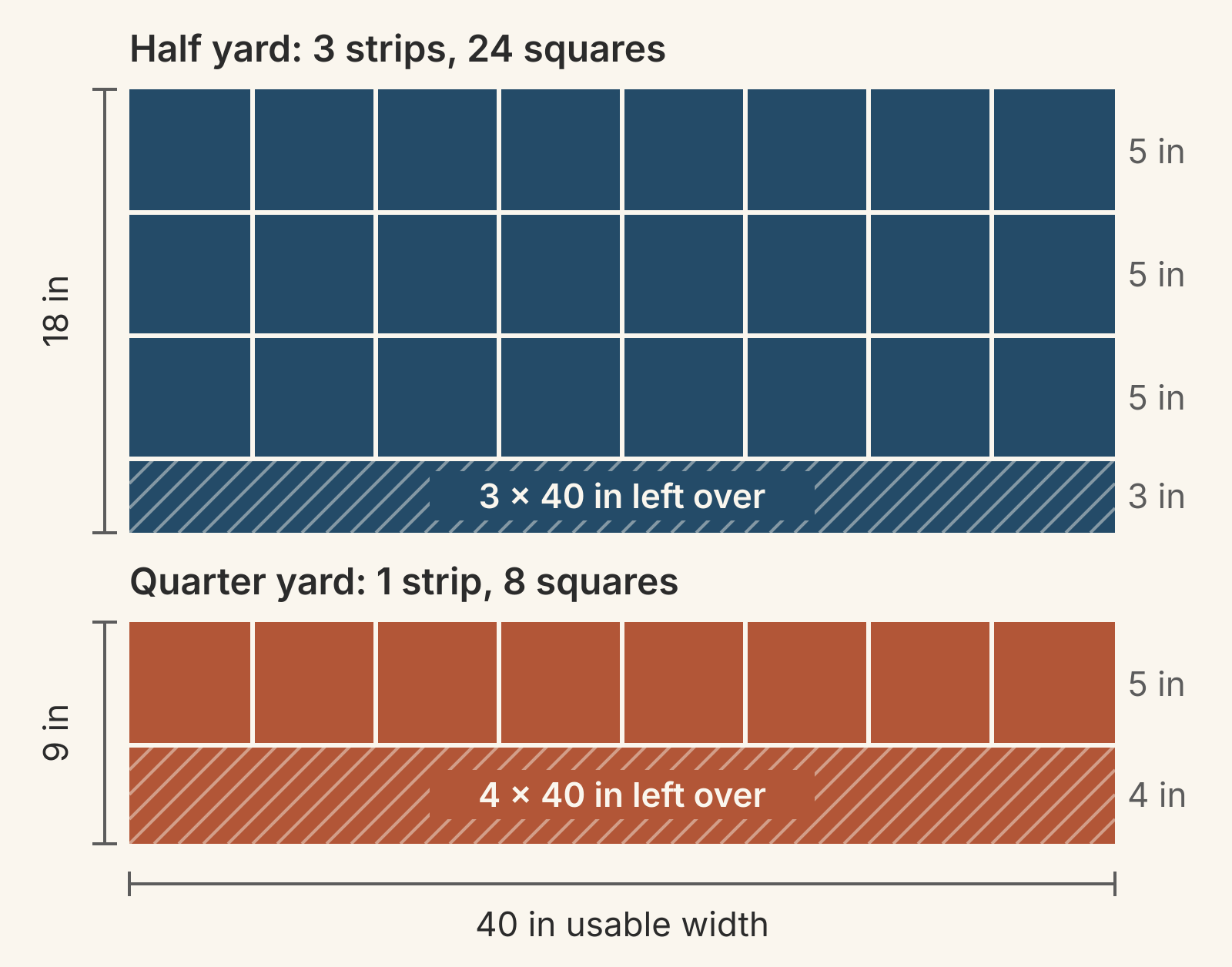
That gives three yardage routes to the same 120 squares:
- Five half yards, 2 1/2 yards in all. Each gives 3 strips x 8 = 24 squares, and 5 x 24 = 120. You get 5 prints, each used 24 times.
- Fifteen quarter yards, 3 3/4 yards. Each gives 8 squares, and 15 x 8 = 120. You get 15 prints, eight of each.
- Forty quarter yards, 10 yards. This matches the charm packs' variety: 40 prints, three squares each. You use 15 inches of each strip and keep the rest.
Fat quarters and fat eighths fall in between. They're sold as precuts, but you cut them like yardage. At 40 usable inches, a fat quarter is 18 x 20 inches. It gives three 5 x 20-inch strips of four squares, 12 in all, with a 3 x 20-inch strip left over. Ten fat quarters make the quilt from the same 2 1/2 yards as five half yards, with twice as many prints. The 20-inch side has no inch to spare, so measure yours first; our fat quarter cutting layout shows how.
A fat eighth is half a fat quarter, 9 x 20 usable inches. It gives one strip of four squares, one more than the 40-print version needs of each print. Forty fat eighths make that version from 5 yards instead of 10.
How much fabric is left over?
| Route | Prints | Fabric bought | Used in the squares |
|---|---|---|---|
| Three charm packs | 40 | 3,150 sq in | 95% |
| Ten fat quarters | 10 | 3,600 sq in (2 1/2 yd) | 83% |
| Five half yards | 5 | 3,600 sq in (2 1/2 yd) | 83% |
| Fifteen quarter yards | 15 | 5,400 sq in (3 3/4 yd) | 56% |
| Forty fat eighths | 40 | 7,200 sq in (5 yd) | 42% |
| Forty quarter yards | 40 | 14,400 sq in (10 yd) | 21% |
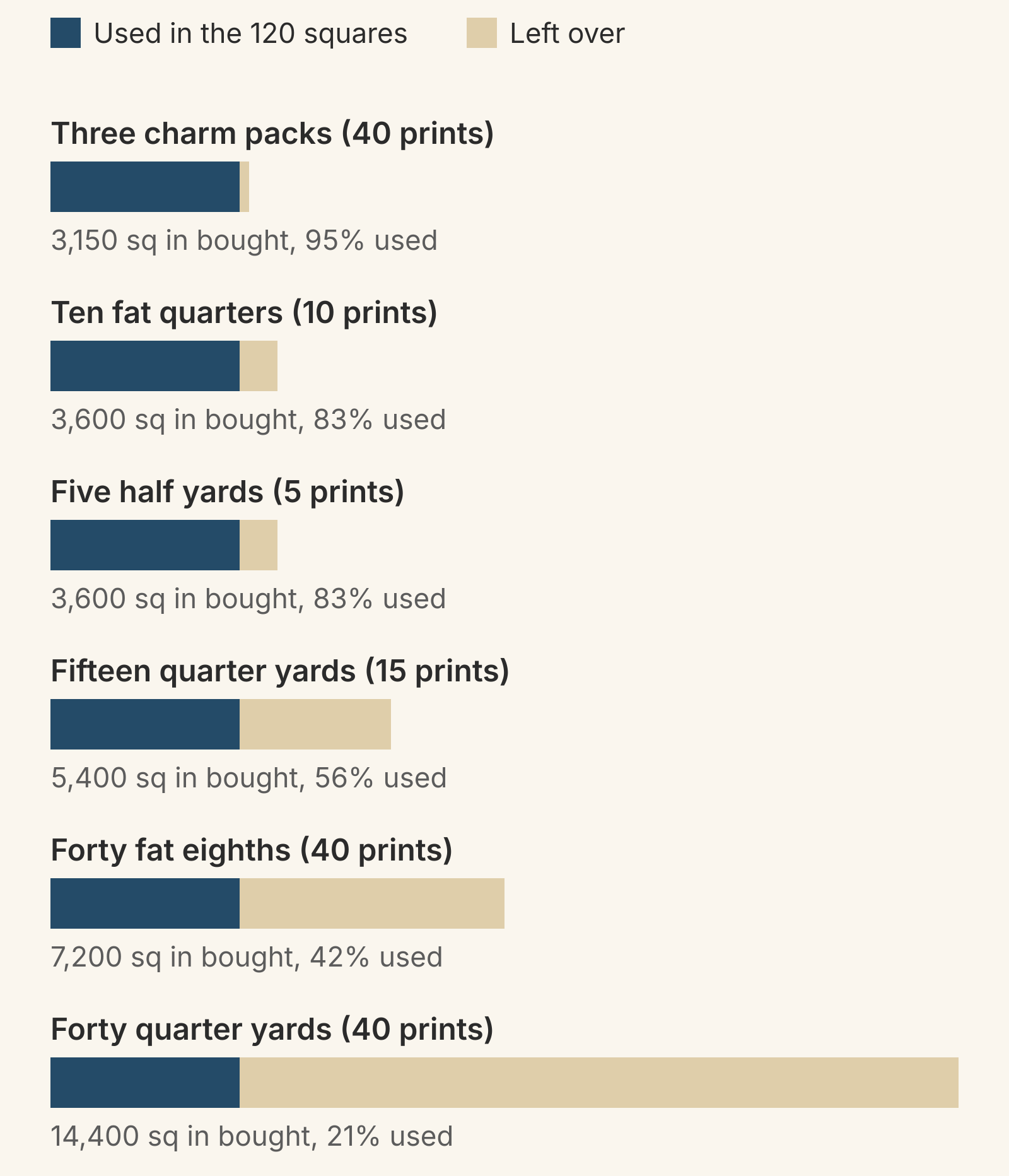
The charm packs buy the least fabric because the pieces arrive at the size the quilt needs. Yardage stays close only when you use a few prints. Each print you add costs at least a fat eighth or a quarter yard, so the leftovers grow fast.
Leftover fabric isn't always waste. Once squared up, the spare strips from half yards and quarter yards usually still trim to 2 1/2 inches. That's enough for a scrappy binding or a strip quilt later. If you'll sew them, the yardage routes waste less than the chart suggests. If they'll sit in a bin, they're waste.
How much cutting does each route take?
| Route | Fabrics to square up | Strips to cut | Squares to cut |
|---|---|---|---|
| Three charm packs | 0 | 0 | 0 |
| Ten fat quarters | 10 | 30 | 120 |
| Five half yards | 5 | 15 | 120 |
| Fifteen quarter yards | 15 | 15 | 120 |
| Forty fat eighths | 40 | 40 | 120 |
| Forty quarter yards | 40 | 40 | 120 |
Squaring up is a real step. In her lesson on cutting fabric, Amy Smart matches the selvages, presses, and trims the edge straight before cutting the first strip. Skip it and the strips come out in a V shape. More prints mean more fabrics to prepare, even though the square count stays at 120. Stacking a few fabrics saves cuts, but each one still has to be pressed and lined up first.
Which prints do you get?
A charm pack gives you a whole collection, chosen by its designer to go together. Amy Smart counts that as budget-friendly variety: you sample a collection without buying yardage of every print. The catch is that you get every print, including the ones you'd skip. Nikki at Sew Nikki found there were always prints in a bundle she didn't care for, and that precuts rarely include enough background fabric.
Yardage lets you choose each print and how often it repeats. You can add a dark print to a collection that's all mid-tones, or repeat a favorite. You pay for that control in minimum cuts. In this quilt, going from 5 prints to 15 adds 1 1/4 yards. Going to 40 adds 7 1/2 yards in quarter yards, or 2 1/2 yards in fat eighths.
Are precuts cheaper than yardage?
Our sources disagree. Nikki's answer is no: precuts save time, not money, and per yard they almost always cost more than fabric off the bolt. Missouri Star, which sells both, argues that the per-yard price looks higher but you buy only what you need.
The counts above show what each side means. Nikki is comparing price per yard. Missouri Star is comparing what you have to buy for one quilt. For these squares, the charm packs buy the least fabric, 3,150 square inches against 3,600 for the leanest yardage route.
Run the break-even with your shop's prices. Three packs cost less than five half yards only if one pack costs less than 5/6 of a yard. Against forty quarter yards, they cost less as long as one pack costs less than 3 1/3 yards. For your own quilt, multiply packs by the pack price and yards by the price per yard, then compare.
When does yardage win?
The counts flip when the design changes:
- Few prints. A five-print quilt can't come from a charm pack, which holds one square of each print. Five half yards are the simple buy.
- Pieces bigger than the precut. Say the squares are cut at 6 1/2 inches. A charm square is too small. A 10-inch layer cake square holds one, using 42% of it. A 6 1/2-inch strip of yardage holds six, using 39 of its 40 inches.
- Background, borders and sashing. Long strips and an even background need yardage, Missouri Star notes, and precuts are too small for backing. Our guide to choosing background fabric helps you pick one.
- Leftovers you'll use. If your stash absorbs the strips, the extra fabric isn't lost.
For this quilt, buy three charm packs for the squares and yardage for the binding and backing. If you want only a handful of prints, buy five half yards or ten fat quarters instead. Whichever you buy, our guide to prewashing precuts and yardage explains why every fabric in the quilt should get the same treatment.
Count your own quilt before you buy
- List each piece size and how many prints you want.
- Check whether a piece size matches a precut. If it does, the precut buys the least fabric for those pieces.
- For yardage, work out squares per strip at your usable width, then strips per cut.
- Total the fabric bought on each route and compare it with what the quilt uses.
QuiltLab's editors don't calculate yardage or cutting lists, so keep these counts on paper. Then audition the prints. In QuiltLab, Search fabrics looks up catalog fabrics by name, collection or manufacturer (Swatch Editor guide). If a collection is in our catalog, you can look through its prints before you buy a pack. Then draw a block in the Block Editor, select its pieces and change their fabric to try the prints you'd pull (Block Editor guide).
Related posts
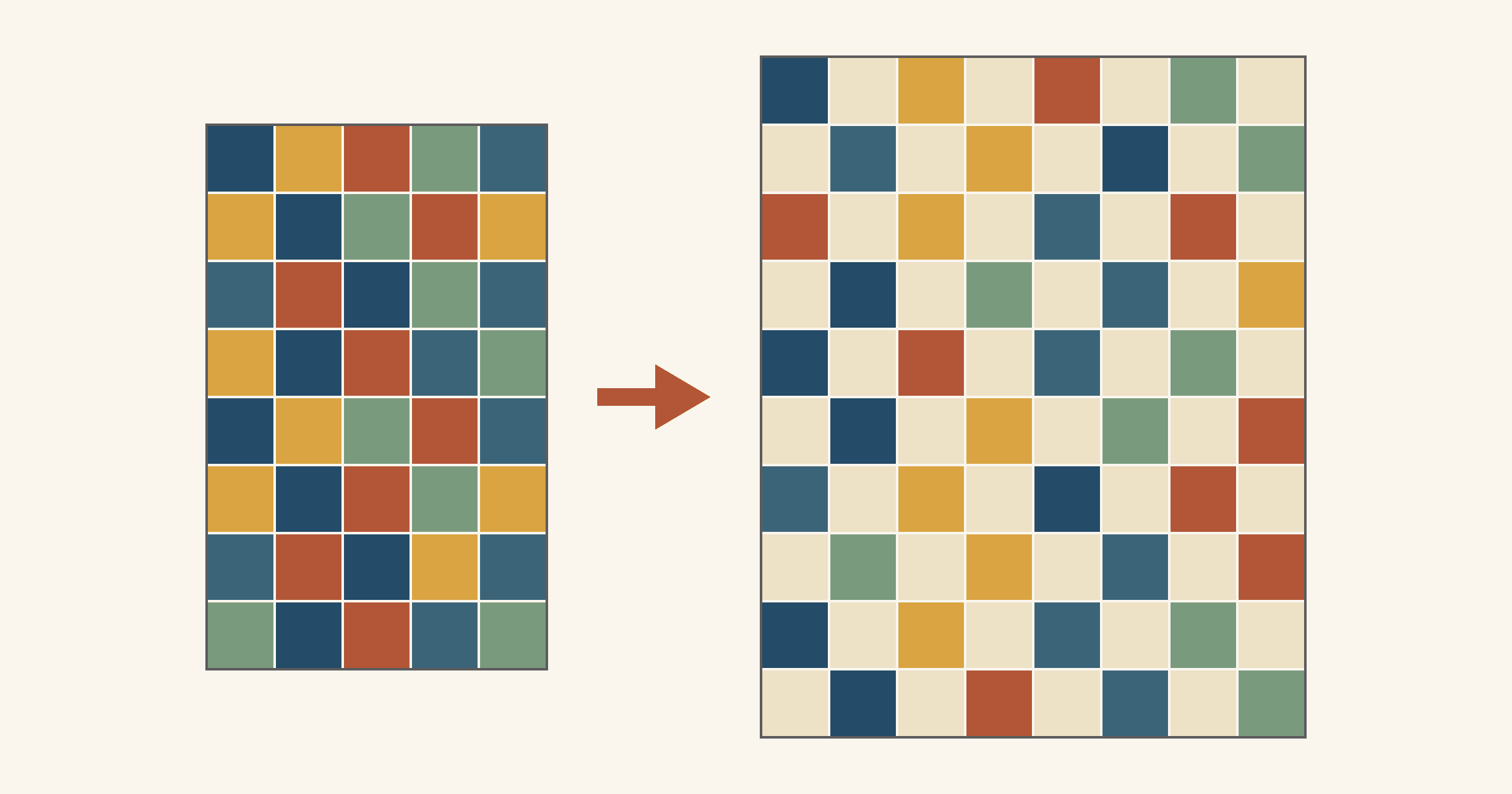
One Charm Pack Quilt: What Size Can You Make?
Sewn edge to edge, one charm pack makes a quilt about 27 x 31 1/2 inches. Count your usable squares, then compare four layouts that stretch it with background.
How to Read a Foundation Paper Piecing Pattern: Which Line Is Which?
Numbers set the sewing order, the lines inside a section are where you stitch, and the outer pair of lines marks the finished edge and the trim line.
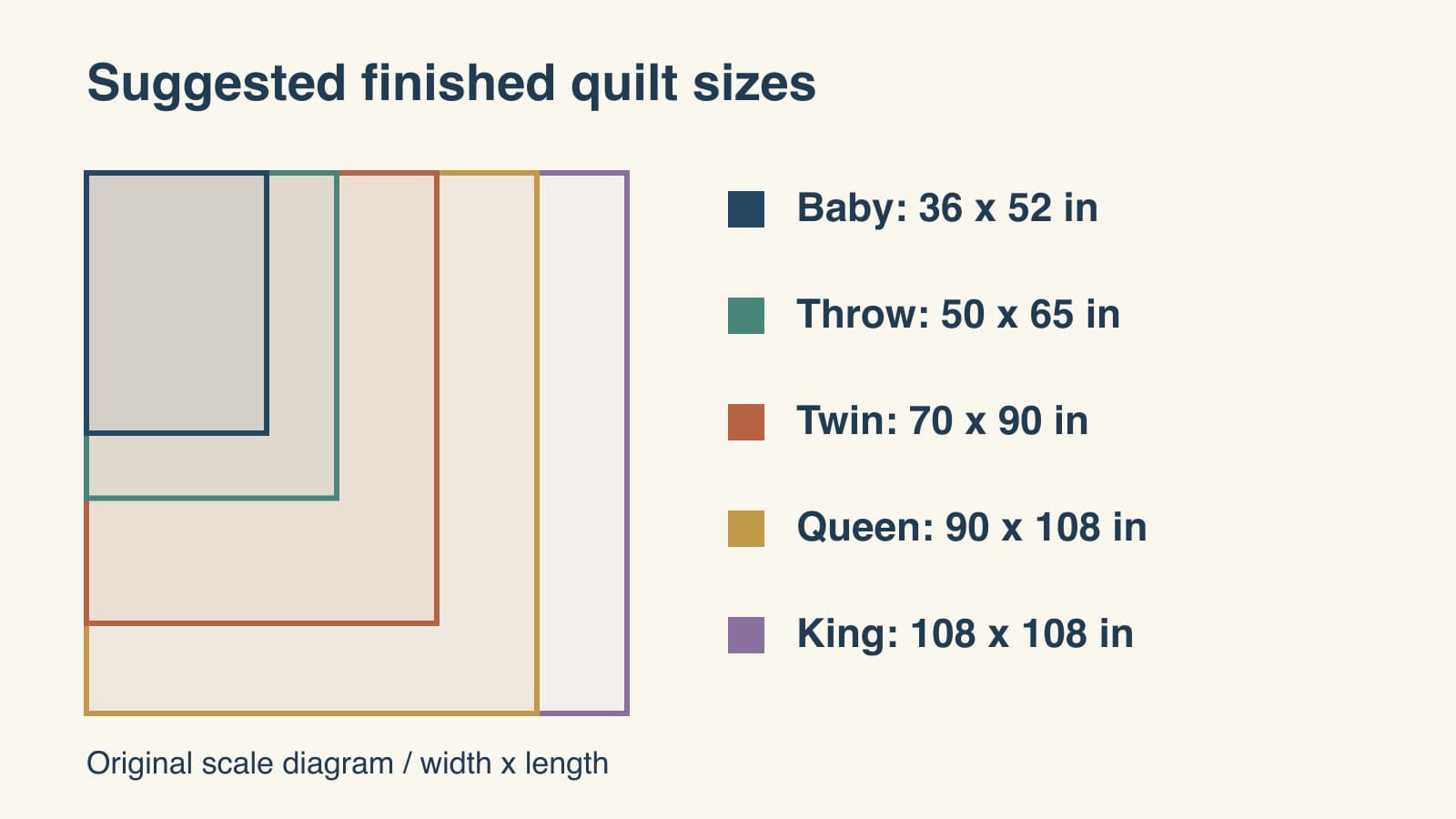
Quilt Size Chart: Baby, Throw, Twin, Queen and King
Compare suggested finished quilt sizes, measure the drop on a real bed, and check how many blocks fit your target before choosing a pattern.