


How Much Fabric for Quilt Backing and Binding?
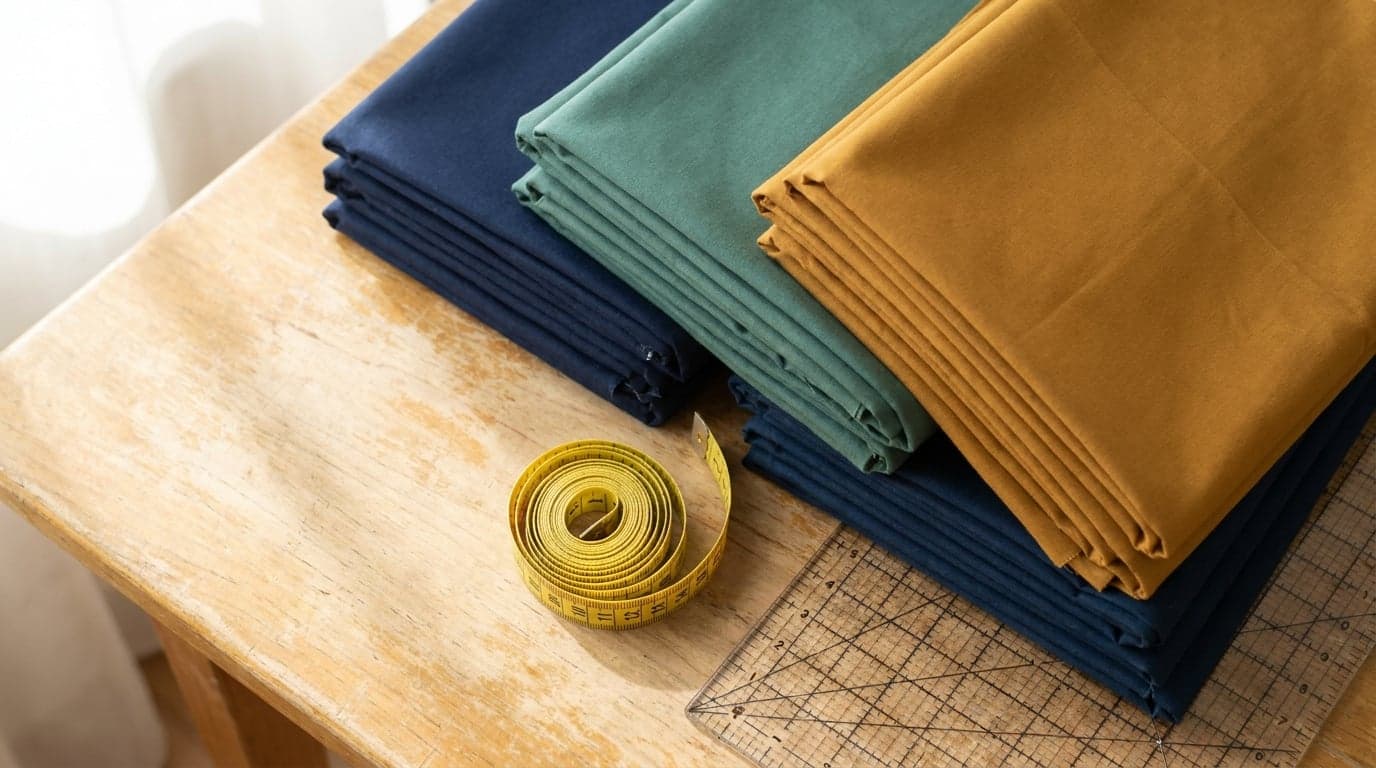
How much fabric for quilt backing comes down to three numbers: the finished size of the quilt top, the extra your quilter needs around it, and the usable width of the fabric you are buying. This guide shows the arithmetic, then works it for five example sizes on ordinary 42-inch quilting cotton and on 108-inch wideback. Binding gets the same treatment at the end.
The short version for a 60 x 72 inch throw: cut a 68 x 80 inch backing, which takes 4 yards of standard-width fabric or 2 yards of wideback, plus 1/2 yard for binding.
Start from the finished size, in inches
Names like "twin" and "queen" are a poor basis for buying fabric. APQS, which makes longarm quilting machines, points out in its reference chart for quilt sizes that mattress depth, risers and bed frames vary enough that it is better to think in inches than in a standard quilt size. Measure the finished top across the middle in both directions and write both numbers down.
If you laid the quilt out in QuiltLab, you already have them. In the Quilt Editor, the Layout heading in Properties shows the finished dimensions, and the status bar shows the quilt dimensions. QuiltLab gives you the size; the backing and binding arithmetic below is yours to do.
Quilt Editor: arrange blocks and fabric →Where a layout's finished dimensions appearAdd the extra your quilting method needs
A backing is always cut larger than the top. How much larger depends on who quilts it and on what machine, so ask before you buy:
- APQS's size chart suggests 3 to 6 inches beyond the quilt top on every side for longarm quilting. The extra gives room to test tension, attach the clamps and quilt off the edge of the top.
- APQS's guide to preparing a quilt for a longarm quilter asks for more: 6 to 8 inches on every side.
- The Crafty Quilter's batting and backing guide gives 3 to 4 inches on all four sides as the general suggestion.
This article uses 4 inches per side, which adds 8 inches to each dimension. Substitute your quilter's number.
- Backing width = top width + 8
- Backing length = top length + 8
Work out yardage for standard-width fabric
Standard quilting cotton is narrower than most backings, so the backing is seamed from panels. With the assumptions above, one panel covers 42 inches, two cover 83 and three cover 124.
- Try the panels running lengthwise. Count the panels needed to cover the backing width, then multiply by the backing length.
- Try them running crosswise. Count the panels needed to cover the backing length, then multiply by the backing width.
- Divide each total by 36 and round up to the quarter yard. Buy the smaller amount, unless a directional print decides the direction for you.
Here is the throw from the top of the page. A 60 x 72 inch top needs a 68 x 80 inch backing.
- Lengthwise: 68 inches of width needs 2 panels. 2 x 80 = 160 inches, which is 4.44 yards. Buy 4 1/2 yards.
- Crosswise: 80 inches of length needs 2 panels, because two panels cover 83. 2 x 68 = 136 inches, which is 3.78 yards. Buy 4 yards.
Crosswise saves half a yard here, but look at the margin: 83 inches of seamed panels against 80 inches needed. If your fabric gives 40 usable inches instead of 42, two panels cover only 79 and the saving disappears. Measure before you trust it.
Backing yardage for five example sizes
These tops are examples, not standards. Find the row nearest your quilt, then redo the arithmetic with your own measurements.
| Example quilt top | Backing, 4 inches per side | 42-inch fabric | 108-inch wideback |
|---|---|---|---|
| 40 x 50 inches | 48 x 58 inches | 2 3/4 yards, 2 panels across | 1 1/2 yards |
| 60 x 72 inches | 68 x 80 inches | 4 yards, 2 panels across | 2 yards |
| 70 x 90 inches | 78 x 98 inches | 5 1/2 yards, 2 panels long | 2 1/4 yards |
| 90 x 100 inches | 98 x 108 inches | 8 1/4 yards, 3 panels across | 3 yards |
| 108 x 108 inches | 116 x 116 inches | 9 3/4 yards, 3 panels | Too narrow for one piece |
When wideback saves fabric
Wideback is quilt backing woven wide enough to skip the seam. Robert Kaufman's Kona Wide, for example, is listed at 108 inches wide. This article plans on 106 usable inches from a 108-inch bolt; check yours.
The rule is short: if either backing dimension is 106 inches or less, that dimension goes across the fabric and you buy the other one as length.
- 90 x 100 inch top: the 98-inch backing width fits across, so buy the 108-inch length. That is 3 yards, against 8 1/4 yards of standard-width fabric.
- 108 x 108 inch top: the backing is 116 inches both ways, so one piece of wideback is not enough. Piece it from standard fabric (9 3/4 yards), or seam two 116-inch lengths of wideback, which takes 6 1/2 yards.
Compare the total cost of the yardage you need, not the per-yard price: a yard of wideback is more than twice as wide as a yard of standard fabric.
How much fabric for binding
Binding is cut as strips across the width of the fabric and joined end to end. National Quilters Circle's binding method divides the quilt's perimeter by 40 inches, the usable strip length once the joins are allowed for, to get the number of strips. Multiply the strips by the strip width to get the inches of fabric to buy. The same article gives 2 1/4 inches as the traditional strip width and 2 1/2 inches as the other choice.
This article adds 12 inches to the perimeter for the corners and the final join, uses 2 1/2-inch strips and rounds up to the next eighth of a yard.
For the 60 x 72 inch throw: 2 x (60 + 72) = 264 inches of perimeter. Add 12 to get 276. Divide by 40 to get 6.9, so cut 7 strips. 7 x 2 1/2 = 17 1/2 inches of fabric. Buy 1/2 yard.
| Example quilt top | Perimeter + 12 inches | Strips at 2 1/2 inches | Binding fabric |
|---|---|---|---|
| 40 x 50 inches | 192 inches | 5 | 3/8 yard |
| 60 x 72 inches | 276 inches | 7 | 1/2 yard |
| 70 x 90 inches | 332 inches | 9 | 5/8 yard |
| 90 x 100 inches | 392 inches | 10 | 3/4 yard |
| 108 x 108 inches | 444 inches | 12 | 7/8 yard |
These figures are for straight-grain strips cut across the width. Bias binding is calculated differently and is not covered here.
Batting follows the backing
Batting has to extend past the quilt top as well. The Crafty Quilter's guide above treats batting and backing together, at 3 to 4 inches beyond the top on all four sides, so the backing size you just worked out is a sound starting point for the batting too. Confirm it with your quilter.
QuiltLab's batting guide compares batting materials by loft, warmth, shrinkage and price, and the batting selector starts from your project type and quilting method.
Before you buy
- Measure the finished top in inches, or read the finished dimensions from your layout.
- Ask your quilter how much extra backing they need on each side.
- Measure the usable width of the fabric, selvages excluded.
- Work the yardage both ways, lengthwise and crosswise.
- Check whether a directional print fixes the direction of the panels.
- Count binding strips from the perimeter, then convert to yardage.
If you have not settled the size yet, lay the quilt out first. The first design walkthrough lays out a 60 x 72 inch throw and works out its cutting and yardage by hand, and pricing lists what each plan includes.
Related posts
The Best Sewing Machines for Quilting in 2026: Five Picks for Every Budget
What actually matters in a quilting machine, and five machines worth considering in 2026, from a $280 starter to a stitch-regulated flagship. Specs and prices were checked in September 2026.
Looking for an EQ8 Alternative? Compare Before You Switch
Compare desktop and browser workflows, cutting output and project migration before choosing an alternative to Electric Quilt 8.
How to Design a Quilt: Size, Layout, Blocks and Fabric
Plan a quilt you can actually make: choose its finished size, compare block counts, assign fabric roles and check the design before cutting.