Work Backward from Your Quilt Gift Deadline
Start with the date the quilt must reach its recipient, then work backward through delivery, packing, binding, quilting and any studio handoffs. Put waiting and transit on the calendar separately from sewing time. A finished top can still be weeks away from a delivered gift.
For a first plan, ask the longarmer or other provider about actual availability before promising the gift date. Keep a separate buffer for delays rather than hiding it inside an unexplained estimate.
Name the deadline the recipient cares about
Write what must happen on that date: the recipient opens the gift, a package arrives, or you hand over a finished quilt in person. Those are different endpoints.
Brittany Lloyd's quilt-gifting checklist includes a label, care information and packaging. Put those tasks before the handoff, along with any care steps the actual materials require.
If you will present the quilt in person, travel and packing still belong in the plan. If you will mail it, choose a delivery target that leaves room before the occasion rather than treating the occasion as the mailing date.
Write the endpoint at the top of the page. Every earlier date should explain how the quilt gets there.
Separate hands-on work from outside intervals
Our quilt-making time guide shows how to time your own small batch and estimate the work ahead. Use your measured pace when deciding how much making fits your available sessions.
The backward calendar adds a different layer. Fabric delivery, the longarmer's queue and return transit use calendar time even when you are not sewing. Some tasks can overlap; others cannot begin until a handoff is complete.
Timna Tarr's time-log account illustrates the difference between logged work and the months over which a project develops. Her numbers belong to her quilt. Your calendar needs your own work estimate and the actual outside commitments.
List each interval before choosing its duration. That keeps a vague "quilting month" from accidentally swallowing outbound shipping, studio work and the return trip without enough room for all three.
Get the provider's handoff requirements
Get these answers before assigning a studio interval:
| Ask the provider | Put in your calendar |
|---|---|
| What must arrive, and by when? | Top, backing, instructions and the arrival deadline |
| When does turnaround begin? | The actual start event, such as receipt of a complete order |
| What must happen before return? | Payment, pickup booking or return-shipping arrangements |
| Are there closures or unavailable dates? | Time when work or handoffs cannot happen |
A named provider's policy can show how separate these milestones are. Trace Creek Quilting's 2026 holiday schedule gives different arrival, payment, shipping and closure dates. Those dates apply to that published policy; get a current agreement for your actual project.
Keep the quote or message with your calendar and note which assumptions it replaces. "Four weeks after arrival" starts at a different point from "four weeks after booking." Record who confirmed the arrangement and when, so you can check a later change against the same agreement.
Our longarm-preparation guide helps identify the top, backing and instructions that must be ready for a real handoff.
Work a dated example backward
For a hypothetical gift, choose a delivery deadline of May 30, 2027. The eight durations below are invented calendar allowances for the calculation, not a studio quote or shipping promise.
| Stage | Assumed days | Planned start |
|---|---|---|
| Prepare top and backing | 14 | March 19 |
| Outbound transit | 5 | April 2 |
| Studio interval | 28 | April 7 |
| Return transit | 5 | May 5 |
| Binding and permitted care | 7 | May 10 |
| Label and packing | 3 | May 17 |
| Delivery transit | 7 | May 20 |
| Delivery contingency | 3 | May 27 |
Each date is the start boundary of its interval; the next date is its handoff. For example, April 2 to April 7 is five elapsed calendar days, not a count that includes both dates as full extra days.
The total is 14 + 5 + 28 + 5 + 7 + 3 + 7 + 3 = 72 days. Working back 72 days from May 30 gives March 19 as the latest planning start that leaves every assumed allowance intact.
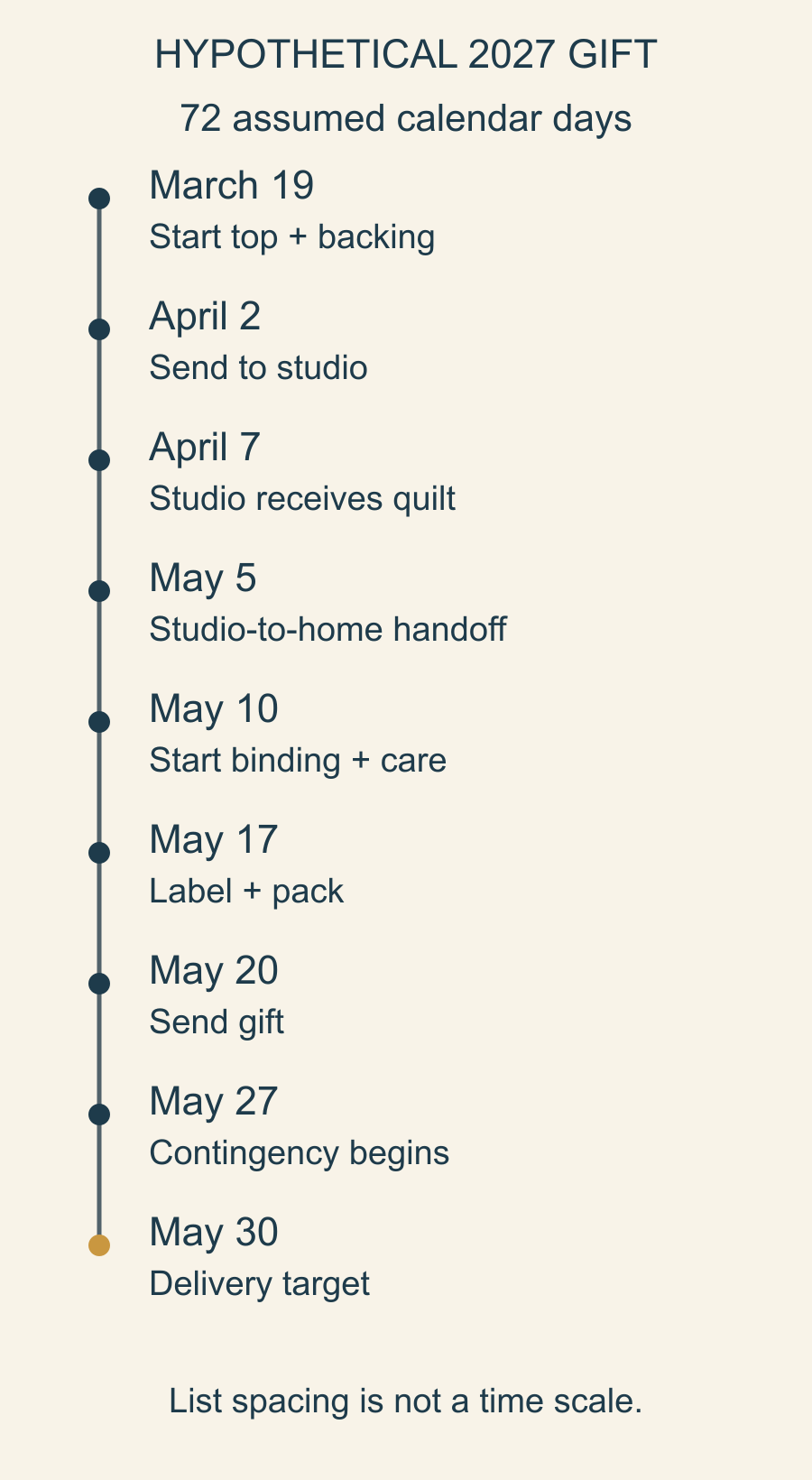
You can start earlier. The calculation doesn't reserve studio space or prove that fourteen calendar days contain enough of your sewing sessions.
The first row includes making the top as well as preparing the backing. List the sewing sessions actually available between March 19 and April 2, then compare them with your own work estimate. Fabric that still needs ordering or a technique that needs practice may require an earlier start. Two free weeks on the calendar don't automatically give you two weeks at the machine.
Change one interval and see what moves
Suppose the studio confirms 40 calendar days rather than 28 for your project. That adds 12 days to the critical path.
If the May 30 delivery target stays fixed and no other interval changes, the top-and-backing preparation start moves from March 19 to March 7. The delivery and home-finishing milestones can stay where they were while the earlier handoffs move back.
| Milestone | Original 28-day studio plan | Revised 40-day studio plan |
|---|---|---|
| Start top and backing | March 19 | March 7 |
| Send to studio | April 2 | March 21 |
| Studio receives the work | April 7 | March 26 |
| Studio-to-home handoff | May 5 | May 5 |
March 26 to May 5 gives the studio its full 40 days. The whole plan now needs 84 elapsed calendar days, while the later five intervals keep their original dates.
If March 7 is impossible, the calendar has exposed a decision. You might choose another confirmed finishing approach, simplify the making plan or discuss a later gift date.
Don't shorten the provider's interval on paper to make the table look comfortable. Change a real constraint, then recalculate.
Check whether tasks can actually overlap
Making the label while the quilt is at the studio may be possible. Attaching it or checking the final dimensions may need to wait until the quilt returns. Keep those tasks separate if it helps the plan.
Similarly, you can prepare packaging early, but the actual quilt's thickness and the chosen packing method still need a real fit check. A drawing's dimensions don't establish the packed volume.
Mark outside commitments as confirmed, estimated or unanswered. An unresolved handoff should remain visible rather than appearing as a firm date simply because the calendar has a neat row for it.
Review holidays, planned absences and provider closures against the actual dates. A calendar-day allowance and a business-day quote aren't interchangeable.
Keep the buffer visible
In the example, the three-day delivery contingency is its own final interval. You can see when it has been used rather than silently spending the same cushion twice.
Choose your own buffer for the project's uncertainty. A familiar local handoff and an unfamiliar shipment present different questions. Keep the reasoning with the number so a later change is deliberate.
Before promising the date, write the actual recipient endpoint, obtain the provider's current terms and replace the assumed intervals. Then work backward once more and check that the making sessions fit. The useful deadline is one supported by real handoffs and time you can actually use.
Plan your next quilt
Lay out blocks and try colors in QuiltLab's grid editor before you cut.
Free forever, no card needed.
Get quilting tips by email
QuiltLab updates, tips and quilting inspiration. Unsubscribe anytime.
Related posts
Group Memory Quilt Instructions Contributors Can Use
Tell contributors what to send, what may be shared and how their materials will be returned. A sixteen-entry map keeps each memory tied to its maker.
Documenting a Group Quilt from Contributions to Credits
Connect contribution IDs, makers, design decisions and care notes in one record. A sixteen-unit example keeps credits separate from the head count.

Choose One Piecing Skill for Mini Quilt Practice
Practice four-patch intersections in an eighteen-inch mini. Check the cut squares, pressed rows and blocks before joining the nine-block top.