Wideback vs Pieced Quilt Backing: Compare the Leftovers
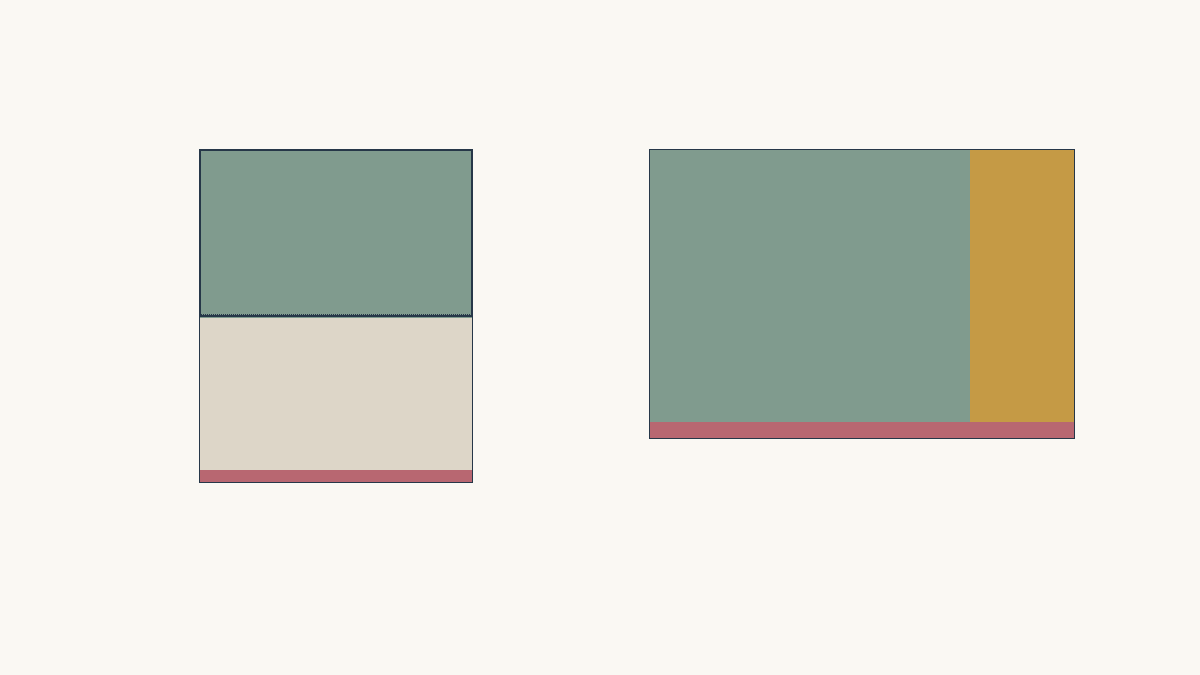
Compare wideback and standard-width backing by the pieces you can cut and the leftovers you can use, not by yardage alone. Two yards of wide fabric can contain more total area than four yards of standard fabric.
Start with the backing dimensions your quilter actually needs, then use the fabric's measured usable width. Wideback removes a main joining seam in a suitable layout; pieced backing can make better use of narrower fabric or pieces already on hand.
Fix one backing target
Our top is 60 by 72 inches. For this comparison only, assume the chosen service needs 4 inches beyond every edge. The target back is therefore 68 by 80 inches.
That allowance is a stated example, not a rule for every quilter. Confirm the actual service requirements before using the target. Our backing-yardage guide covers that first measurement step.
We will compare standard fabric with 42 usable inches and wideback with 106 usable inches. Both are hypothetical measured widths after the relevant selvages and preparation have been allowed for.
Robert Kaufman's Kona Wide listing gives 108 inches as its nominal width. That product specification does not establish 106 usable inches for a particular prepared piece; measure what you intend to cut.
Lay out the standard-width option
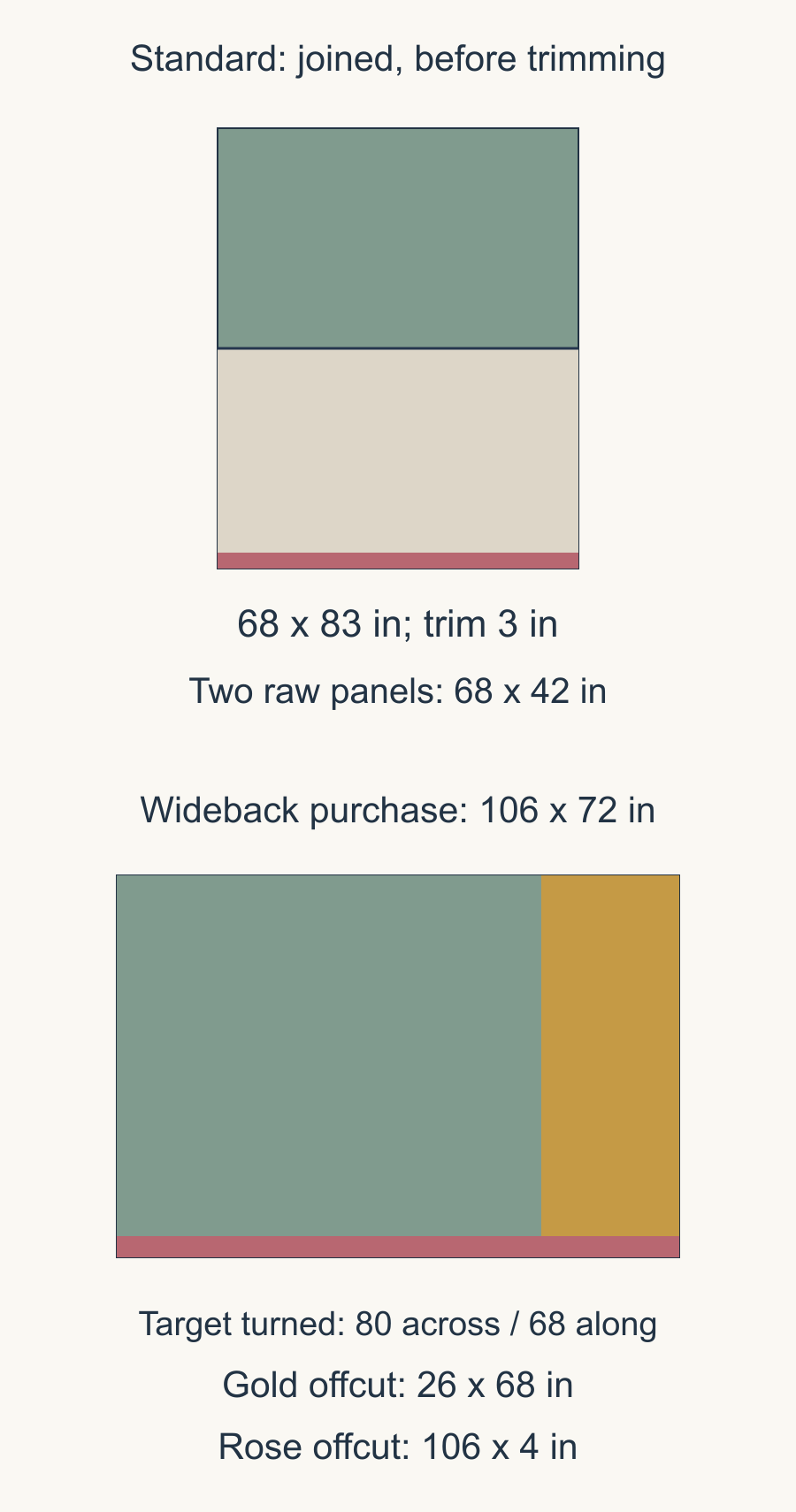
Cut two panels 68 inches long from the 42-inch-wide fabric. Join them along their 68-inch edges with a half-inch seam allowance on each panel.
Together they make 68 by 83 inches: 42 + 42 -1 = 83. Trim that length to the 80-inch target while keeping the 68-inch dimension intact.
Dawn Cavanaugh's APQS backing lesson recommends half-inch backing seams, removing internal selvages and pressing those seams open. Use the actual quilter's requirements and the intended fabric when preparing the join.
| Standard-width item | Calculation | Area |
|---|---|---|
| Two cut panels | 2 x 42 x 68 | 5,712 sq in |
| Needed back | 68 x 80 | 5,440 sq in |
| Main join take-up | 1 x 68 | 68 sq in |
| Trimming after join | 3 x 68 | 204 sq in |
The cut-panel area reconciles: 5,440 + 68 + 204 = 5,712 square inches. Accounting for the seam explains why subtracting only the final target area would overstate reusable leftovers.
Include the purchased length
The two 68-inch panels use 136 inches along the standard-width fabric, about 3.778 yards. Buying 4 yards supplies 144 inches before any additional preparation margin. You need at least 136 usable inches after preparation and straightening to get both panels.
Under our already-usable-width assumption, the 8-inch length cutoff contains 336 square inches. Add the 204 square inches trimmed after joining, and the reusable offcut area is 540 square inches. The 68 square inches taken into the join are seam take-up.
The full purchased usable area is 42 x 144 = 6,048 square inches. Its 608-square-inch difference from the target consists of 540 in offcuts and 68 in the seam.
Keep that distinction on the comparison sheet. A seam allowance is useful fabric in the backing, but it is not a spare piece you can put into another project.
Lay out the wideback option
From the assumed 106-inch usable width, cut a 68-inch length. Place the 80-inch target across the width, leaving a 26 by 68-inch side offcut.
Buying 2 yards supplies 72 inches along the fabric, so the unused 4-inch length produces another 4 by 106-inch offcut. If preparation or straightening reduces that usable length, the length offcut gets smaller; less than 68 inches would no longer fit this cut.
| Wideback item | Calculation | Area |
|---|---|---|
| Purchased usable fabric | 106 x 72 | 7,632 sq in |
| Needed back | 68 x 80 | 5,440 sq in |
| Side offcut | 26 x 68 | 1,768 sq in |
| Length offcut | 4 x 10⁶ | 424 sq in |
The two offcuts total 2,192 square inches. No main joining seam is required in this particular layout.
Compare the actual result
The wideback purchase uses half as many yards, yet contains 1,584 more square inches of usable fabric than the 4-yard standard purchase: 7,632 minus 6,048.
It also produces a much larger remaining piece. That 26 by 68-inch strip might be useful for another project, or it might be fabric you do not need. The value depends on what you will do with it.
The standard option contains a main seam and several smaller leftovers. If you already own suitable panels, the purchase calculation changes again. Enter the real pieces on your sheet rather than pretending the entire back must come from a new cut.
Jen Strauser's pieced-back discussion treats pieced backs as a design and use-up choice, while also noting front/back seam relationships. Her experience is context for that decision, not a test of our layouts.
Check orientation and preparation separately
The area calculation does not settle grain direction, directional print placement or seam placement relative to the quilting setup. Our backing seam-direction guide considers those questions with service requirements in view.
Check whether the actual wideback print can turn to fit the proposed target. A directional picture may make the convenient 68-by 80 placement unsuitable. Likewise, the standard panels need a deliberate join position and any matching allowance the chosen print requires.
Follow the fabric's preparation instructions and remeasure if preparation changes the usable dimensions. Add purchase margin deliberately instead of assuming every listed yard is already squared and ready for this exact diagram.
Choose with a complete comparison
Compare leftover shapes as well as their summed area. A long narrow strip and a broad rectangle can contain the same square inches but serve different next projects. Write one realistic use beside each substantial offcut, or record that you have no current use for it. That makes the larger wideback remainder a visible purchase choice instead of automatically calling all of it useful.
Record the target, actual usable widths, cut panels, seam allowance, purchased length and leftover shapes. Add real prices only when comparing the actual fabrics available to you. For these exact 4-yard and 2-yard purchases, the fabric costs are equal when wideback costs twice as much per yard as the standard fabric. Below that ratio the wideback costs less; above it the standard fabric costs less. Compare the final totals with any tax or shipping before choosing.
Choose wideback when the seam-free layout and remaining piece suit the project. Choose pieced backing when its materials, seam plan and smaller leftover inventory make more sense.
Your next step is to draw the target rectangle inside the real fabric dimensions. Count the seam take-up and name the leftover shapes before deciding which yardage number looks smaller.
Plan your next quilt
Lay out blocks and try colors in QuiltLab's grid editor before you cut.
Free forever, no card needed.
Get quilting tips by email
QuiltLab updates, tips and quilting inspiration. Unsubscribe anytime.
Related posts
Rounded Quilt Corners: Will Your Motif Survive?
Compare two corner radii against nearby motifs before trimming, then plan a consistent curve and suitable binding method.
Lightweight Quilt Batting: Check Care First
Write the coverlet’s care requirements, check the exact batting limits, and test the finished combination before calling it lightweight.
Quilting Negative Space: Extend, Fill or Echo
Compare three quilting approaches on one fixed quilt layout, then count the lines and check the open areas.