How Big Will Your EPP Hexagon Flower Be?
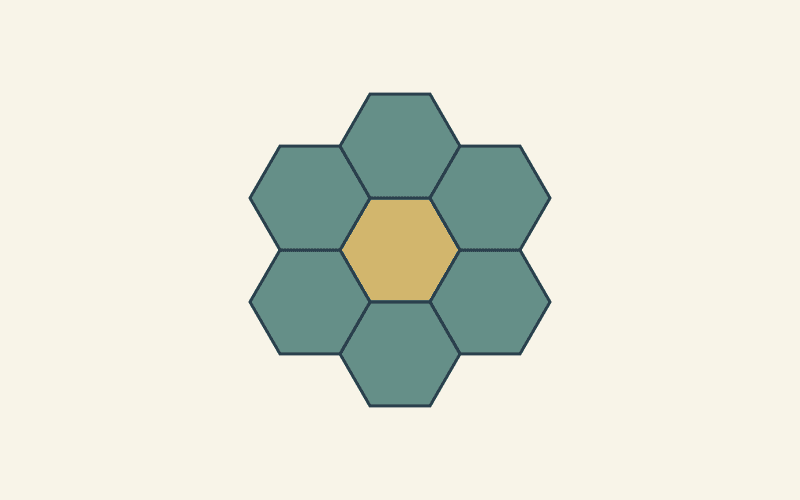
For a flower made from one center hexagon and six around it, one-inch EPP papers give a footprint about 5 by 5.20 inches in the orientation shown below. Measure one straight side of a paper when calculating your EPP hexagon flower size. Turn the whole flower 30 degrees and those width and height measurements swap.
Measure the papers first, then decide how the flower will face in your project. The outline is scalloped, so its bounding rectangle helps with placement but isn't the shape of a finished square block.
Know which “one inch” the package means
New Threads explains its hexagon sizes as the length of each of the six sides. A one-inch regular hexagon therefore has six one-inch edges. It does not measure one inch across the middle.
For one regular hexagon with side length s, the point-to-point distance is 2 * s. The flat-to-flat distance is sqrt(3) * s, or about 1.732 * s. Eric W. Weisstein's regular-hexagon reference at MathWorld gives the radius relationships behind those dimensions: the center-to-corner radius equals the side, and the center-to-flat radius is half the square root of three times the side.
For one-inch papers, that means two inches between opposite points and about 1.73 inches between opposite flat sides. Check which span your ruler is measuring. A paper turned slightly on the mat can make the distinction hard to see.
Keep the actual paper shape separate from the fabric cut around it. Paper Pieces' EPP introduction describes basting fabric around paper shapes before joining them. The paper controls the geometry used here; the fabric beyond it supplies the allowance required by your chosen method and template.
Measure the whole seven-hex flower
Our drawing places the center hexagon with a horizontal top and bottom edge, and points facing left and right. Its six neighbors touch the six sides. The complete flower measures:
- Width:
5 * s. - Height:
3 * sqrt(3) * s, about5.196 * s.
We derived those bounds from the seven regular hexagons' vertices. The diagrams are mathematical placement studies, not cut-size or print-ready templates.
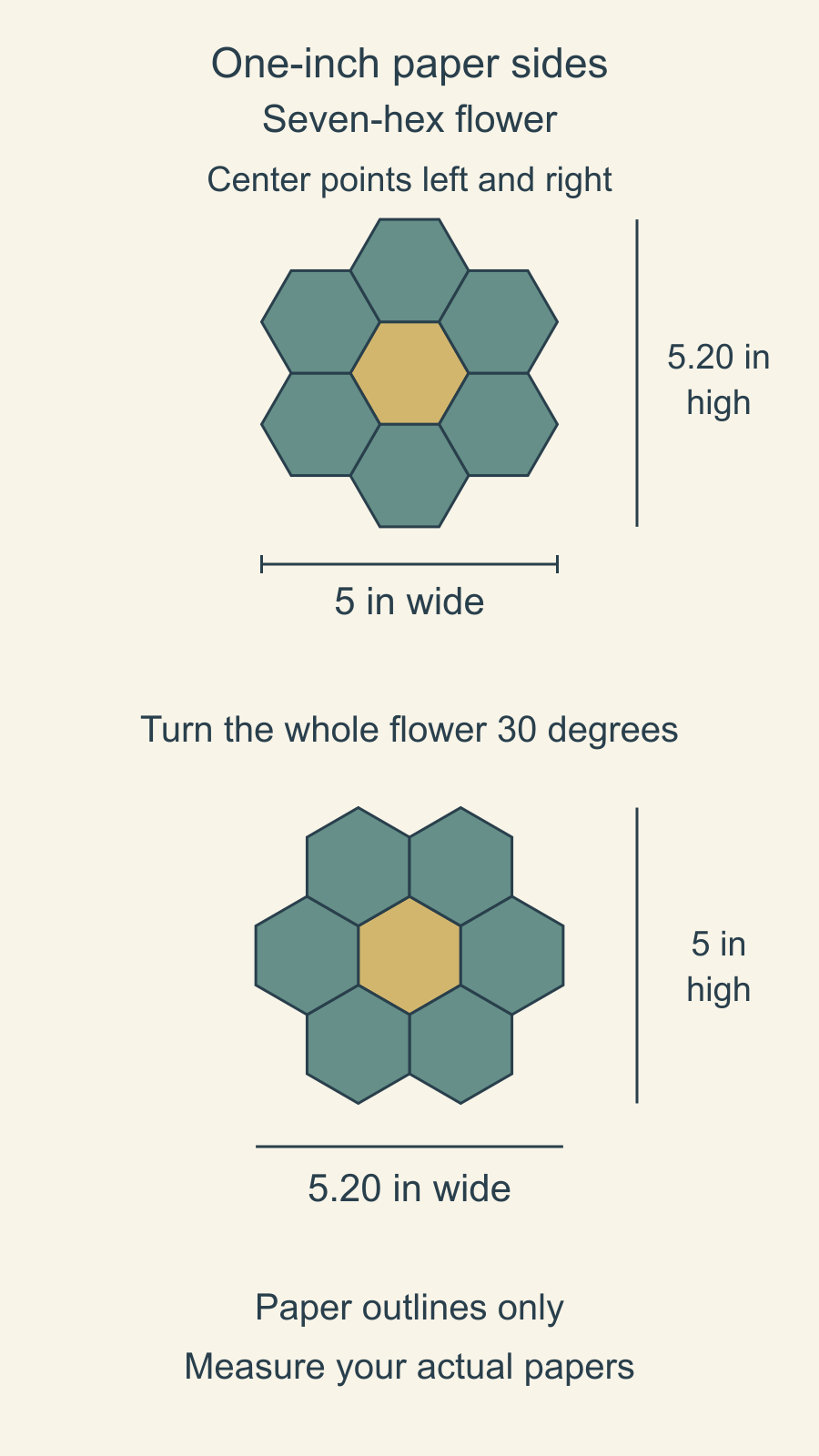
Why isn't the width six inches? Three hexagons across the flower don't sit as three separate two-inch rectangles. The pointed outlines interlock. The farthest right vertex lies 2.5 side lengths from the center, and the farthest left lies 2.5 side lengths in the other direction. That makes five side lengths overall.
The top and bottom extremes each lie about 2.598 side lengths from the center. Together they give approximately 5.196 side lengths. Treating the bounding boxes as separate blocks would leave space that the adjoining hexagons don't use.
Compare paper sizes before buying the set
The table keeps that same orientation throughout. Width and height describe the smallest upright rectangle enclosing the seven paper shapes. Decimal dimensions are rounded to two places.
| Paper side length | Flower width | Flower height |
|---|---|---|
| 1/2 in | 2.50 in | 2.60 in |
| 3/4 in | 3.75 in | 3.90 in |
| 1 in | 5.00 in | 5.20 in |
| 1 1/2 in | 7.50 in | 7.79 in |
| 2 in | 10.00 in | 10.39 in |
Doubling the paper side doubles both dimensions. It doesn't double the number of pieces: each flower still has one center and six outer hexagons. The individual pieces are simply larger.
Use both dimensions when checking a narrow background. A 1.5-inch-side flower measures 7.50 by about 7.79 inches. Centered in a hypothetical 8-by-8-inch finished square, it leaves a quarter-inch gap at the left and right, but only about 0.10 inch above and below. Those are bounding gaps, not a seam or applique allowance.
That example is tight enough to deserve a paper layout before committing fabric. A different finish, surrounding shapes or desired breathing room may need a larger field. State those choices separately instead of treating the bounding measurement as the final block size.
Keep the orientation with the numbers
Imagine turning the complete flower 30 degrees. The center hexagon now has a point facing up. The flower's former vertical extreme becomes its horizontal extreme, so the one-inch-side example is about 5.20 inches wide and 5 inches high.
Write a small orientation sketch beside any measurements you save. “Five-inch flower” leaves out both the second dimension and the paper size that produced it. A more useful note is “one-inch sides; left/right-pointing center; 5 by 5.196-inch outline.”
Don't generalize the simple swap to every angle. An arbitrary rotation can have different bounds. If you turn a paper layout to another angle, measure its actual enclosing span at that angle rather than selecting whichever table dimension looks convenient.
Keep motif repeats and cutting allowances separate
The flower always uses seven hexagons, but seven pieces don't necessarily require seven matching print repeats. A six-piece ring may repeat one motif while its center uses a contrasting fabric. Our fussy-cut hexagon guide deals with locating matching windows and counting usable repeats on cloth.
Its cutting template also needs room outside the finished paper shape. Adding a little to the flower's overall rectangle doesn't generate seven correct cutting outlines. Use the papers, template and allowance specified for your actual EPP project.
If you are deciding between English and foundation paper piecing, our comparison of the two methods explains their different jobs. These flower dimensions apply to regular hexagons arranged edge to edge, not to a foundation-paper pattern with unrelated printed seams.
Lay out seven actual papers in your chosen orientation and measure the longest horizontal and vertical spans. Record the side length, outline size and intended surrounding space together. That gives you a useful starting footprint before you plan the fabric cuts or join flowers into a larger arrangement.
Free patterns to try
Printable PDF patterns with cutting charts and diagrams, free to download.
Layer Cake Flower Pots
Quilt patternBeginner · 63 x 76 in throw
Layer Cake Big Buttons
Quilt patternBeginner · 63 x 63 in throw
Big Balloon
Quilt patternBeginner · 42 x 42 in baby quilt
Plan your next quilt
Lay out blocks and try colors in QuiltLab's grid editor before you cut.
Free forever, no card needed.
Get quilting tips by email
QuiltLab updates, tips and quilting inspiration. Unsubscribe anytime.
Related posts
When Is an Improv Quilt Finished?
Stop changing a composition when it answers your current design question. A before-and-after study helps separate necessary fixes from new ideas.
Build an Abstract Quilt Design from Three Shapes
Turn a sketch you own into a clear patchwork plan. Three colored rectangles show how to preserve a composition while extending a few straight seams.
Start a Damaged Quilt Assessment Before Repair
Record what you see, what you were told and what remains unknown before changing a damaged quilt. A simple condition map organizes the questions.