Round Robin Quilt Rules That Keep Rounds on Track
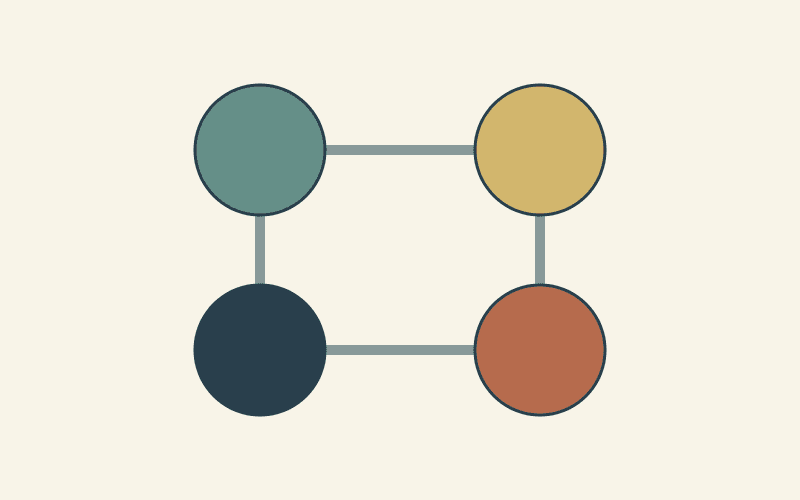
Agree on what travels between makers, what each round may add and how the work returns to its owner. Put the fabric, size, timing and permission decisions in writing before the first handoff. Clear round robin quilt rules give people room to design without making them guess what they may change.
Begin with the format. A group adding borders to individual centers needs different instructions from a group building rows. Decide whether everyone receives a completed top or the group is contributing to one shared quilt.
Choose the format before counting rounds
In AQS's 2018 round-robin article, Donna Stevens describes The Block Party. The AQS article also offers planning tips, including a meeting and material notes before the work circulates. It discusses both a shared-quilt approach and a quilt for each person.
A medallion center is one possible start. The Big Red Quilters' Guild's 2016-2017 round robin used rows or strips. Its past program is useful as a concrete example of a different structure, rather than a current invitation to join.
Write one sentence that names your group's format. For example: "Each person starts a top, three other makers add an agreed round, and the top returns to its owner." Then check that the handoff map actually delivers that result.
Separate starting work from contributed rounds
Consider four hypothetical makers: A, B, C and D. Each begins their own top. They pass work around the same cycle: A to B, B to C, C to D and D to A.
For A's top, the working stages are A's start, B's addition, C's addition and D's addition. The next pass returns the top to A. That return does not create a fourth outside contribution.
| Top owner | Starts with | Other makers add in this order | Returns to |
|---|---|---|---|
| A | A | B, C, D | A |
| B | B | C, D, A | B |
| C | C | D, A, B | C |
| D | D | A, B, C | D |
There are four tops and three outside contributions to each: 12 contributions. Including each owner's starting work gives 16 working stages across the group. Every maker works on each top once.
We drew this handoff exercise for planning; it does not describe an actual group or a sewn project.
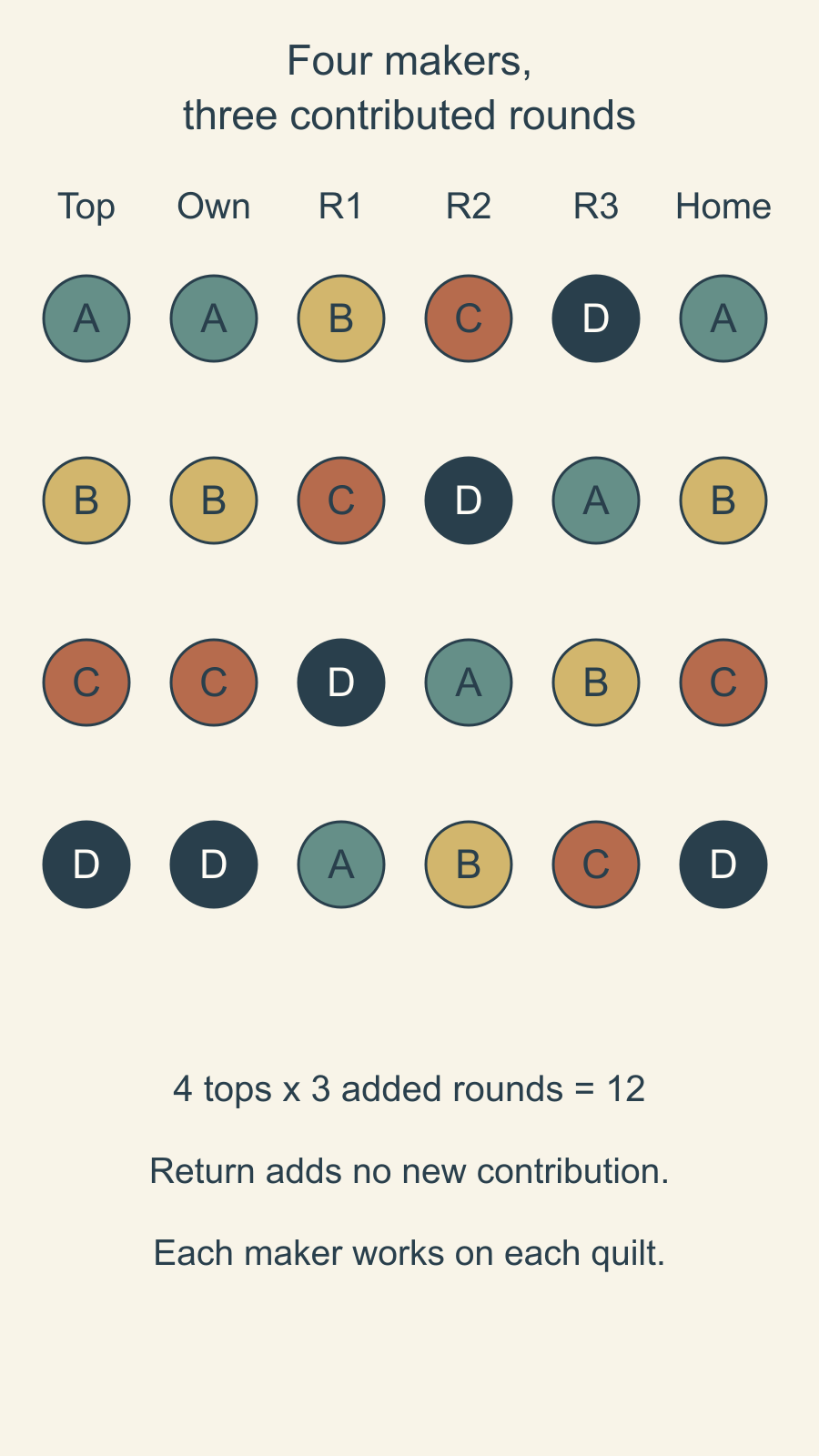
Use the same distinction in your schedule. "Four working stages" and "four added rounds" are different requests. Name the starting stage, each contributed round and the final return separately.
Write the boundaries that affect the next maker
Agree on the materials people may introduce. State any required fabric type, supplied fabrics, colors to use or avoid, and whether additional materials need the owner's approval.
Define the permitted changes too. May a maker trim the starter, alter its orientation, add applique or introduce an irregular edge? If the owner expects the starter to remain intact, say so before a design choice makes that difficult.
The St. Louis Modern Quilt Guild's published 2023 round-robin rules are useful for seeing those decisions gathered into one program. They also address the passing sequence, communication and absences. Their particular restrictions belong to that historical challenge; choose and document the requirements your own group has agreed to.
A brief can include these fields:
| Decision | Agreement to record |
|---|---|
| Format | Center, rows, borders or another named structure |
| Contribution | What one round is expected to add |
| Materials | Supplied fabrics and permitted additions |
| Size | Starting measurement and any growth limits |
| Changes | What needs the owner's approval |
| Timing | Handoff dates and the contact for delays |
| Sharing | Photo, identification and reveal preferences |
Keep unresolved decisions visible. "Ask before trimming" is clearer than assuming that every maker interprets a size limit the same way.
Measure what arrives and what leaves
Record the actual unfinished width and height before beginning a round. Check the orientation and any edge the next person needs to recognize. Repeat the measurements when the work leaves your hands.
For a border-based format, use the top in front of you when planning the next addition. Our guide to preventing wavy borders covers measuring and fitting the physical top. A preferred finished size in the group brief does not replace that measurement.
If a round changes the overall shape or creates an unexpected measurement, ask the designated contact how to proceed. A clear question at this stage is more useful than passing along an unexplained discrepancy.
The next maker should be able to identify the current dimensions, the intended top edge and any agreed exception without reconstructing the previous conversation.
Let a short journal travel with the work
Big Red's past row-based program asks participants to assemble a box or bag of fabric; instructions and a journal are optional. A traveling journal is a practical way to keep the handoff information attached to your group's project.
You can record the maker, date, starting size, work added, outgoing size and the next recipient. Add a photograph reference if the group has agreed to use photos. Keep the record focused on what the next maker needs.
For the fictional route above, a note can read: 'Top A; owner A; B completed outside round 1; next recipient C; then D; return to A after round 3.' This names the current stage and remaining route without counting the return as more work. Add the actual incoming and outgoing measurements at each handoff.
Write special instructions plainly. If supplied fabric must be saved for a later round, identify it. If a decision was approved after the work began, include the agreed outcome so another person does not accidentally undo it.
Choose who can see personal preferences or handling information, and what may appear in a public reveal. Agree on photo use rather than assuming that participation supplies every permission the group may want.
Plan for a missed handoff
Decide who receives a delay notice and who can approve a change to the route or contribution. Ask members to report problems early, while the group still has options.
Avoid solving a missing-maker problem by quietly sending someone else's top to a new participant. The route, materials and permissions may need another agreement first. Record the revised handoff if the group changes its plan.
Keep finishing responsibility clear as well. Receiving a completed top is different from receiving a quilted and bound quilt. State who handles those later stages and whether the original fabrics or journal return with the top.
Our group-quilt overview compares collaboration formats if the group is still choosing its structure. Once you have chosen a round robin, draw one complete route on paper, including the return. Use that map to finish the rules together before anyone starts adding a round.
Free patterns to try
Printable PDF patterns with cutting charts and diagrams, free to download.
Jelly Roll Railroad Tracks
Quilt patternBeginner · 72 x 78 in throw
Countdown Tree
Quilt patternBeginner · 30 x 40 in wall hanging
Red and White Christmas
Quilt patternBeginner · 45 x 55 in throw
Plan your next quilt
Lay out blocks and try colors in QuiltLab's grid editor before you cut.
Free forever, no card needed.
Get quilting tips by email
QuiltLab updates, tips and quilting inspiration. Unsubscribe anytime.
Related posts

When Is an Improv Quilt Finished?
Stop changing a composition when it answers your current design question. A before-and-after study helps separate necessary fixes from new ideas.
Build an Abstract Quilt Design from Three Shapes
Turn a sketch you own into a clear patchwork plan. Three colored rectangles show how to preserve a composition while extending a few straight seams.
Start a Damaged Quilt Assessment Before Repair
Record what you see, what you were told and what remains unknown before changing a damaged quilt. A simple condition map organizes the questions.