Sashiko Quilting for Beginners: Thread, Needle and First Stitches
Sashiko quilting means holding the layers of a quilt together with sashiko's even running stitch: thick, matte cotton sashiko thread on a long needle, pushed with a palm thimble. For a first try, use a thin cotton batting, mark a straight-line grid, and aim for stitches of about 4 to 5 mm on top. Madam Sew's sashiko guide puts traditional stitches between 2 mm (¹⁄₁₆″) and 7 mm (¼″), so that's the middle of the range.
The word means "little stabs." Sashiko began as mending and reinforcement, traditionally white thread on indigo-dyed cloth, and grew into a decorative art. On a quilt it reads as bold, visible stitching, close to what Western quilters call big-stitch quilting, with its own tools and pattern traditions.
What you need
Sashiko asks for only a few tools, but each one makes a real difference through three layers.
| Tool | What to choose | Why |
|---|---|---|
| Thread | Sashiko thread, or 12wt cotton | Thick, matte and strong; meant to be seen |
| Needle | A sashiko needle (long, large eye) | Holds several stitches at once |
| Thimble | A palm (coin) thimble | Lets you push the long needle with your palm |
| Batting | Thin, low-loft cotton or cotton blend | Loft makes the stitches uneven |
Thread. Sashiko thread is a twisted multi-ply cotton that you use whole, without separating the strands like embroidery floss. Olympus, a thread maker founded in Nagoya in 1908, has sold sashiko thread and kits since 1979, and it's the brand most quilt shops carry. If your shop doesn't have it, a 12wt cotton quilting thread is the closest stand-in: Aurifil lists sashiko among the uses for its 12wt cotton. Our quilting thread guide compares weights and what each is for. Madam Sew also suggests size 8 perle cotton.
Needle and thimble. Sashiko needles are longer than embroidery needles. Zen Stitching's Sashiko 101 notes that longer needles suit long straight lines and shorter ones suit curves. Their thimble sits on the palm side of your middle finger rather than the fingertip, so you push with your hand instead of your fingertip.
Batting. This is where sashiko on a quilt differs from sashiko on a single cloth. Stitcher Kimono Momo, who quilted a sampler with sashiko, puts it plainly in Quilting with Sashiko: "The loft from batting makes sashiko tricky." A thin cotton or 80/20 cotton-polyester batting gives you the flattest sandwich and the most even stitches. Our post on batting loft explains how loft changes the look of hand quilting.
Choose fabric that shows the stitch
Sashiko shows best on solids and quiet prints where the thread has room to read. The traditional pairing is white thread on indigo, so a navy, denim-blue or charcoal solid is a good first background.
Dark blues are also the fabrics most likely to bleed. Before you spend hours stitching white thread across one, test it for bleeding and decide whether to prewash it. A white grid that turns pale blue in the first wash is a hard lesson.
Mark the lines
Sashiko follows lines you mark on the quilt top. Use a chalk pencil or another temporary marker, with a ruler for straight lines. Water-soluble and heat-erasable pens both work; test either one on a scrap of your fabric first.
Start with a straight grid. A 1″ (2.5 cm) grid of squares, called koshi (checks), is the simplest pattern and teaches you to keep stitches even along a line. Madam Sew's guide suggests leaving a small space where the lines cross, so the stitches never meet in the middle of the intersection.
Once straight lines feel easy, try a curved pattern:
- Seigaiha (blue ocean waves): overlapping arcs, like fish scales.
- Asanoha (hemp leaf): six-pointed stars of straight lines, a traditional symbol of growth and strength.
- Kakinohana (persimmon flower) and jujizashi (crosses): grid-based patterns built from short stitches.
Baste, then stitch without a hoop
Baste the quilt sandwich well with pins or long thread-basting stitches. Kimono Momo advises against a hoop for sashiko: you want slack in the thread, not tension, and a hoop pulls the layers taut.
Then stitch:
- Thread the needle with a length of about 20 to 24″ (50 to 60 cm). We Like Quilting's beginner guide suggests that range; longer threads wear and tangle.
- Start inside the batting. As with any hand quilting, tie a small knot, come up through the top an inch from your line, and tug gently so the knot pops through the top layer and lodges in the batting.
- Load several stitches onto the long needle, rocking it up and down along the marked line, then pull the thread through.
- Smooth the fabric along the thread after each pull. Don't pull tight; the stitches should lie flat without puckering.
- Leave a little slack at every turn and between rows, as Madam Sew advises. A tight turn draws the quilt in.
- End the same way you started: a small knot close to the top, popped into the batting.
Expect your stitches to be longer through a quilt than on a single cloth. Kimono Momo found hers "further apart than those done on the single layer of the top." That's normal. What matters is that they're even with each other.
Make a coaster first
A small, thin sandwich teaches the rhythm without committing a whole quilt. Kimono Momo and Madam Sew both suggest practicing on a single layer or a small item before a full quilt.
Our free Square in a Square Coasters pattern makes four 5″ coasters, a good size for a first koshi grid. The Four-Patch Mug Rugs give you more room, at 11 by 8″, for a curved seigaiha border.
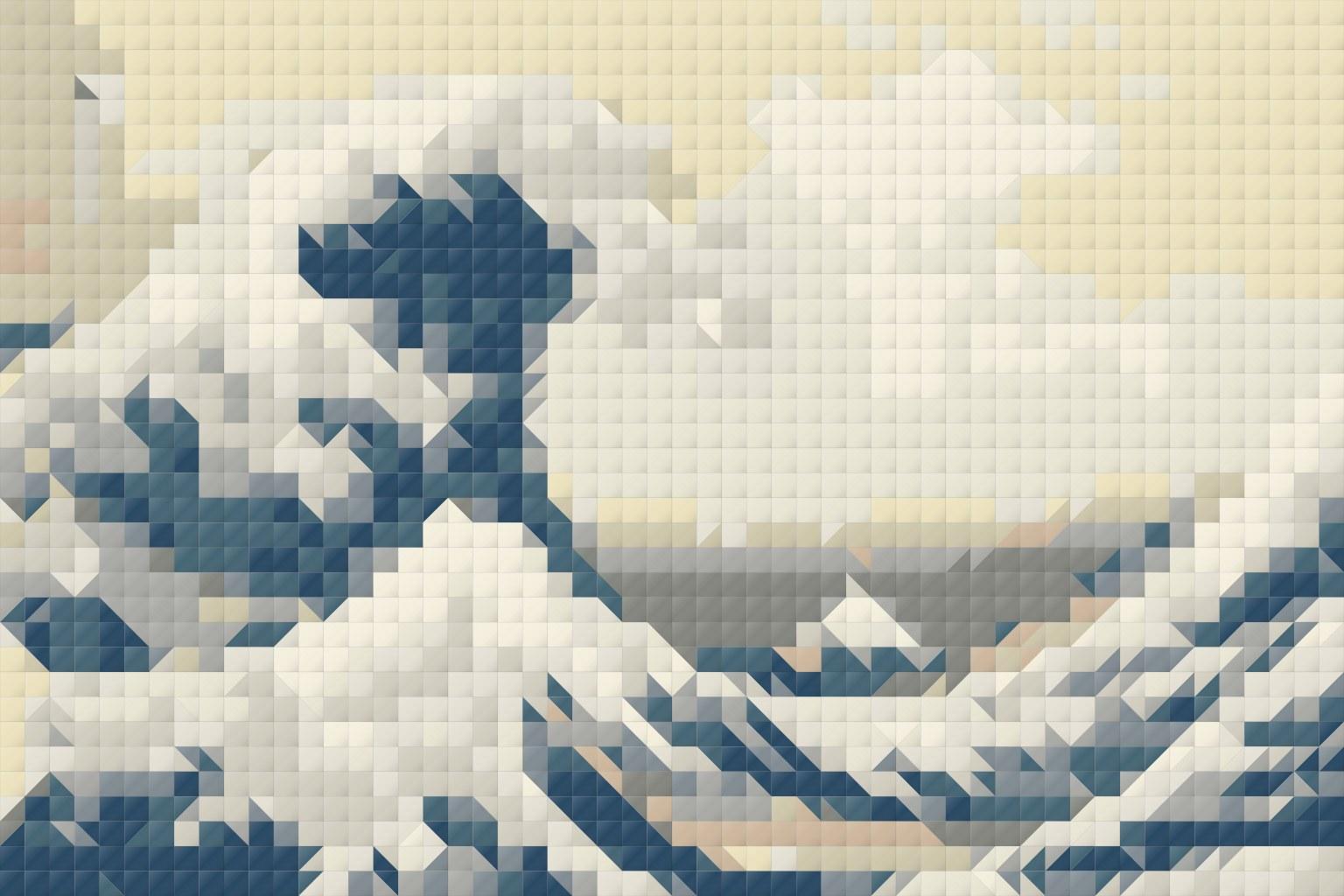
When you're ready for a bigger piece, choose a layout with large plain areas so the stitching has space. A wave-inspired quilt like our free Great Wave mosaic pairs naturally with seigaiha stitching in the sky.
Plan the quilt around the stitching
Sashiko changes how you design the top: busy piecing hides it, and open background shows it off. In QuiltLab you can try a layout with wider plain borders or alternate solid blocks in the Quilt Editor (how it works) before you cut, and compare how much open space each version leaves for stitching. You can start on the Free plan; see pricing for what each plan includes.
QuiltLab doesn't draw quilting stitches, so mark the sashiko pattern on the fabric itself.
Free patterns to try
Printable PDF patterns with cutting charts and diagrams, free to download.
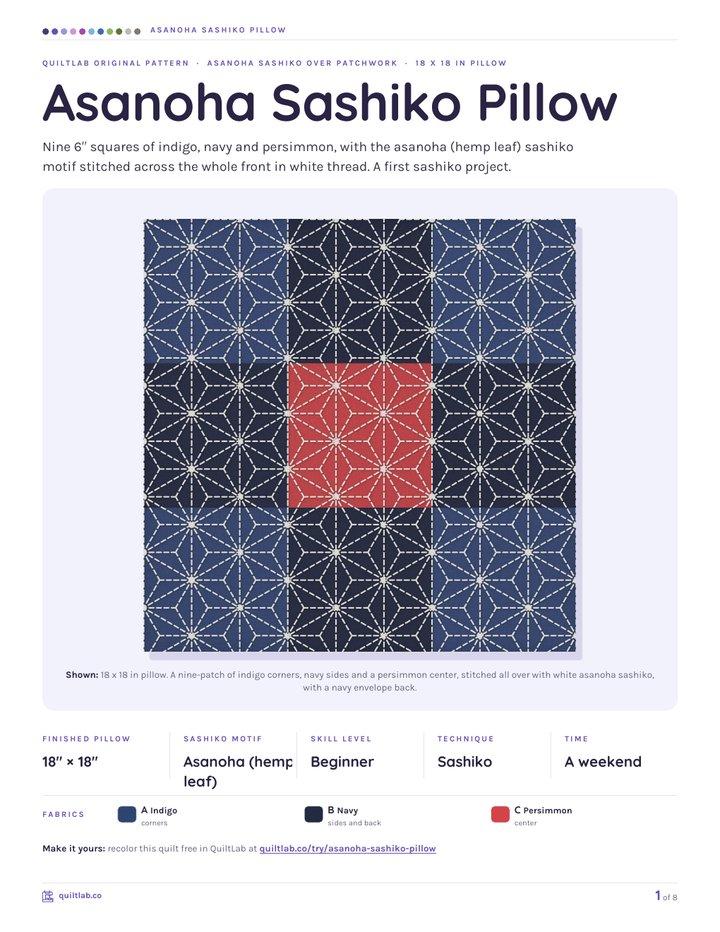
Asanoha Sashiko Pillow
Quilt patternBeginner · 18″ × 18″ pillow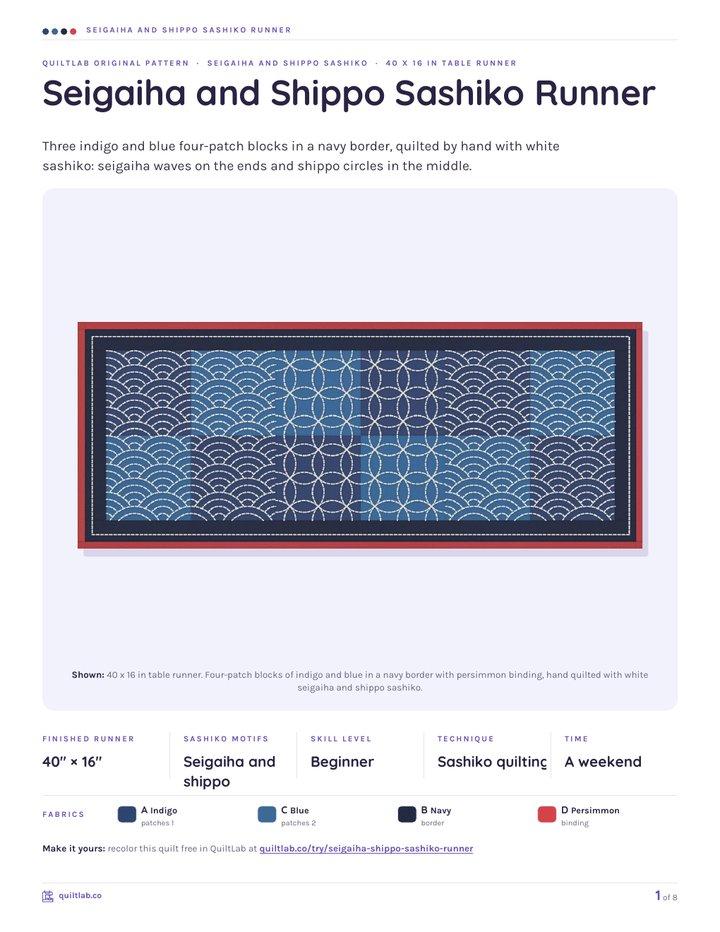
Seigaiha and Shippo Sashiko Runner
Quilt patternBeginner · 40″ × 16″ table runner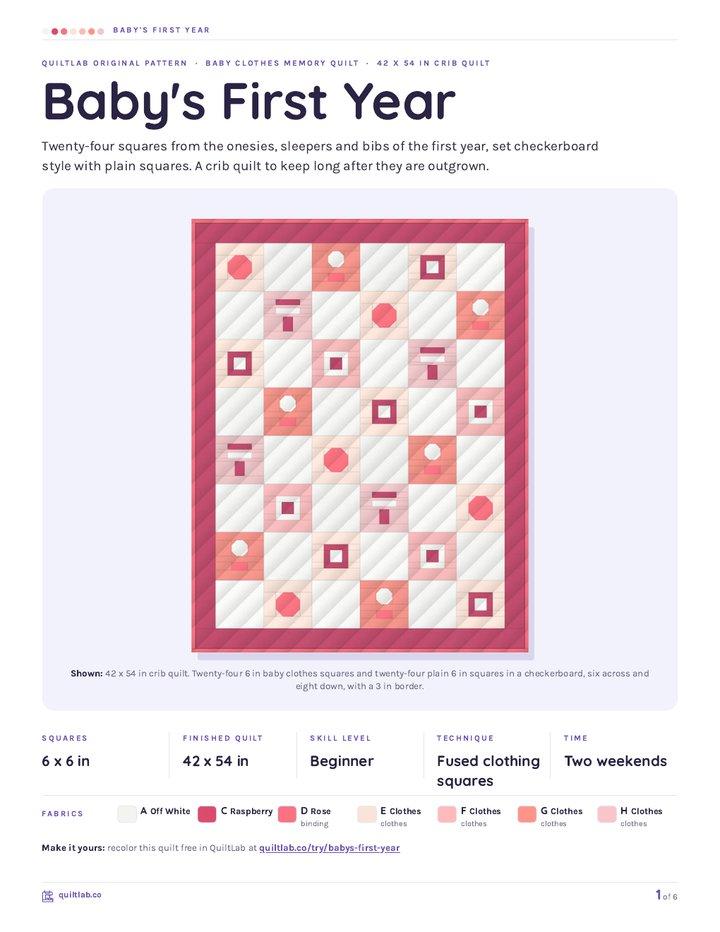
Baby's First Year
Quilt patternBeginner · 42″ × 54″ crib quilt
Plan your next quilt
Lay out blocks and try colors in QuiltLab's grid editor before you cut.
Free forever, no card needed.
Get quilting tips by email
QuiltLab updates, tips and quilting inspiration. Unsubscribe anytime.
Related posts
Curved Log Cabin Blocks with Straight Logs
Unequal straight logs make a curved-looking outline. Compare two ten-inch blocks, then turn four together without changing the finished size.
How to Design a Bargello Quilt: Plan the Wave on Paper
A bargello wave is a staircase of stepped columns. Number your strips, write one row per column, and see how column width turns a zigzag into a curve.
How to Design a Medallion Quilt So Every Border Fits
Plan a medallion ring by ring: check that each pieced border divides its side, add a plain spacer when it doesn't, and grow a 12 in star to a 48 in quilt.